


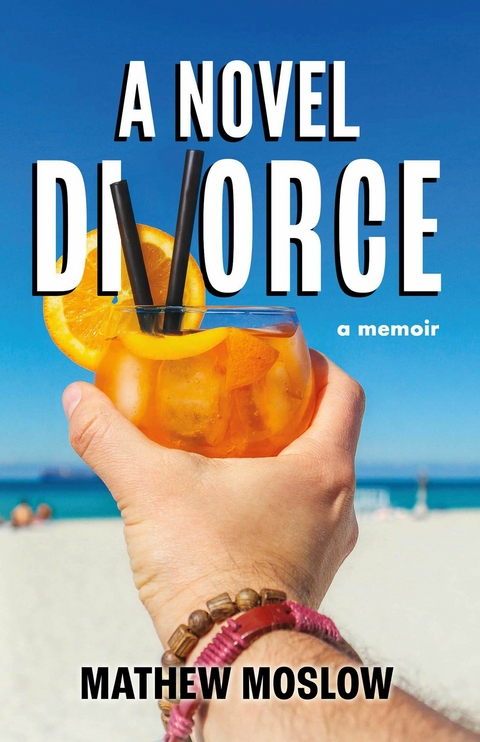
Novel Divorce (eBook)
316 Seiten
Bookbaby (Verlag)
979-8-3178-1203-4 (ISBN)
Mathew Moslow writes from the in-between: heartbreak and healing, masculinity and vulnerability, and tradition and undoing. He is the author of the memoir 'A Novel Divorce' and the forthcoming novel 'Beyond the Reach of Justice'-two works that chase emotional clarity through the careful, difficult practice of telling the truth. Born in Florida and raised in Jamaica, Mathew grew up between cultural codes, expectations, languages, and emotional registers. Today, he exists-literally and philosophically-in the heat of Florida, where he balances clinical nursing rotation with long-form writing, late-night self-excavation, and an insistent desire to understand what breaks us and what puts us back together. Officially, he is a student in a demanding pre-licensure nursing program. Unofficially, he redesigns how knowledge gets absorbed. He creates audio-responsive learning tools, tests information flows, and rewrites complex systems into human terms. For Mathew, research is not just about evidence-it's about connection. Everything-grief, medicine, love, burnout-is a puzzle worth mapping with care. When Mathew isn't writing or working in clinical settings, you'll find him reading 19 tabs at once, walking his dog with a podcast in one ear and a playlist in the other, or reorganizing a room not because it needs it-but because something internal shifted. He is a minimalist by design, a maximalist with playlists, and someone who finds clarity in frameworks like the Enneagram not as tools for branding ourselves, but as windows for compassion and change. He's drawn to the layered feel of things-books, people, spaces, feelings-and writes with that same attention. Writing, for him, has always been a map back to the self. His stories are invitations not just to witness what he's endured or confessed, but to explore what lives in the gaps between who we were and who we want to be next. His voice is spare and tender, literary but accessible, with an eye for the moment beneath the moment: the buried motive, the echo inside the apology, the joke stacked gently on top of the heartbreak. He doesn't aim for resolution so much as resonance, trusting that meaning forms when a reader can see their reflection in the wreckage, too.
What if the break wasn't the end-but the opening? When Mathew Moslow's long-term relationship fractures, it happens in a way that feels both inevitable and impossible. No explosive betrayal. No winners or villains. Just the long, slow disintegration of a life lovingly built-and no longer livable. What follows is not neat grief, not clean healing, but the weird, winding work of becoming someone new"e;A Novel Divorce"e; picks up where most breakup stories end: in the ruin, the reckoning, and eventually, the rebirth. With vivid prose, biting humor, and emotional clarity that never flatters easy redemption, Moslow chronicles a post-divorce landscape shaped by psychedelic preparation, queer connection, family dysfunction, sexual fluidity, spiritual disorientation, and the wild act of learning how to love again without defaulting to the old blueprints. Set in the lush backdrops of Costa Rica, Orlando, and Jamaica but told largely from the raw interior a journey unfolds. Through plant medicine, psilocybin therapy, Enneagram deep-dives, friendship, failure, and heartbreak layered on heartbreak, Moslow begins to reassemble his life using tools both ancient and painfully contemporary: ritual, rage, tenderness, playlists, texts unsent, memories unearthed, identities revisited, and the terrible/gorgeous realization that even clarity doesn't make pain disappear. This is a memoir about what love leaves behind and what a person must uncover when they stop performing the answers they once believed in. Moslow unpacks identity the way a person unpacks a box they forgot they sealed: slowly, confusedly, and with small bursts of recognition and horror. Bits of queerness held back too long. Desire misnamed. Generational harm inherited invisibly but lived out loud. And still, moment by moment, a deepening comes. A person forms. "e;A Novel Divorce"e; doesn't just document heartbreak. It frames it as a sacred turning point: not punitive, not performative, not fixed. Just seeded with possibility. In letting go of the traditional arc of romance, Moslow discovers a terrifying but redemptive form of connection one that doesn't hinge on permanence but on presence. He doesn't hide the mess. He writes it into ritual. What emerges is a deeply human story for people who've outgrown one version of themselves, or one story of love, and aren't sure what comes next. For those who've been broken open but not broken down. For anyone who's searched for the divine in a guidance counselor's chair, a steamy text thread, a rented jungle casita, or a grief group that turned into something like family. "e;A Novel Divorce"e; is not about perfection, nor recovery in its Instagrammed form. It is a blueprint for the honest, adult kind of becoming: layered, awkward, brave, and true. For the divorced, the disoriented, the healing, the haunted, and the hopeful this book is your mirror.
Pour Choices With My Soultwin
Andrea was unlike anyone I had ever encountered—a force of nature with an electricity that could illuminate the darkest room. Her presence was magnetic, drawing people in not through effort, but by the sheer gravity of her charisma. Her laughter was the kind you felt rather than heard, filling the air with an irrepressible vibrance.
Andrea was more than a friend; she was a soulmate, a connection so singular and profound that I doubt I will ever experience its equal. I have had close and meaningful relationships over the years, but my friendship with Andrea was different. She embodied something elusive, a quality none of my other friendships had offered—a subtle yet powerful presence that slipped effortlessly into my life, seamlessly.
Physically, Andrea carried herself with effortless elegance. Her bright eyes sparkled with a mischief that hinted at the tumult she was capable of conjuring, and her sharp wit made her conversations exhilarating—a verbal dance where you had to stay on your toes. Her energy seemed inexhaustible, and her style, while understated, hinted at a confidence that needed no embellishment. But everyone loves a little bauble and a bit of sparkle, and she was no different. In her presence, I always felt like I was part of something larger—a story, a spectacle, an adventure waiting to unfold.
Our lives, though measured so similarly, were utterly different, and perhaps that’s why we clicked so perfectly. We came to each other at a time when we were both seeking something real, something genuine. From the moment we collided at her birthday party—where I was, as ever, Justine’s eternal plus-one—our bond was instant. It wasn’t something we cultivated or built with time; it was a flash paper ignition, an instantaneous inferno that consumed everything around us.
As another friend remarked years later, while leafing through old photographs of our group, “You two were magnetic—you just pulled everything toward you.” And they weren’t wrong. Together, we became a kind of sideshow spectacle, leaning into the fascination and whispers that followed us. There were rumors and myths—some wildly exaggerated and others completely fabricated—about the nature of our relationship.
“Did you know they share a bed and sleep naked?” one rumor went. It was completely wrong, I slept naked; Andrea always slept in silky pajamas and we didn’t often sleep in the same bed.
“I heard Andrea is pregnant with his baby,” another offered conspiratorially. This one was true, we had several food babies over the years because we denied ourselves absolutely nothing.
There were even wild tales of orgies involving me, Andrea, and Andrea’s ex and the father to her two girls—complete with imagined “sounds of pleasure” drifting through the walls. Those sounds? No more than the unmistakable vocal stylings of Pussy O’Toole, Andrea’s karaoke alter ego, belting out power ballads. Those were absolutely unfounded, neither Andrea nor myself could begin to think of a worse hell than that.
For all the speculation, our relationship was never intimate in the way people assumed. We’d kissed for an audience’s amusement, danced inappropriately, and drunkenly flirted with the idea of more. But the thought of crossing that line felt catastrophic. Andrea and I together would have been a faux pas of Chernobyl-sized proportions.
Andrea wasn’t just part of my life—she was an entire era, a constellation of stories, a whirlwind of mischief, and an embodiment of everything that made those years unforgettable. To fold her into a chapter with everyone else would do her an injustice because Andrea deserves more than a paragraph or two. She deserves a stage. Our adventures together were so uniquely her that they could only be written in their own space—a chronicle of laughter, and a bond that defied convention.
If our friendship had a soundtrack, it was undeniably soca. The rhythms of our connection were solidified on the road, or deep in the heart of a fete where the music throbbed, and the crowd swayed as one. The queens of our soundtrack—Destra, Patrice Roberts, Alison Hinds—were regal figures in our world, commanding us with their anthems. We sang their songs with reckless abandon, every lyric a celebratory mantra that mirrored what we were together: fun, inclusive, and fiercely alive. Songs like “Bachanal” and “Colors Again” became hymns to our adventures, a collective joy that echoed the bond we shared.
It was in these moments, under the heat of the Caribbean sun or beneath the glow of fete lights, that our relationship truly came alive. Soca isn’t just music—it’s a feeling, an electricity that vibrates through your body and makes you feel invincible. And with Andrea, invincible was exactly what we were. Whether we were jamming in the middle of the road, flags waving high, or lost in the euphoria of a fete, these were the moments when everything else fell away. The world didn’t matter, expectations didn’t matter—all that mattered was the music, the movement, and each other.
The songs we loved captured the essence of life at its most alive. They didn’t demand anything from us except that we show up and be present—something Andrea and I did effortlessly together. We weren’t just dancing; we were living. Soca became the backdrop to our friendship, the rhythm that underscored every wild night and every meaningful conversation. It was joy distilled into sound, and Andrea and I reveled in it.
While we embraced the celebratory nature of these moments, I can’t help but wonder how Andrea and I would have been had we crossed into the world of “love drugs” like MDMA. Part of me is curious what layers of our friendship would have unfolded under those effects. We were already unfiltered with each other, raw in our honesty and affection. Would it have amplified that connection? Or blurred boundaries best left intact? Knowing Andrea, it’s not a question we’d linger on for long before laughing it off with a, “Let’s not find out.”
That boundary was part of what made our friendship so special. There was no need to push into those places because what we had was already electric, already euphoric in its own way. Andrea and I didn’t need enhancement—we were the enhancement to each other’s lives. I’ll never forget the times we shared, the music we sang at the top of our lungs, and the way it all felt like pure, unadulterated freedom. Together, we weren’t just friends—we were a celebration.
We bonded over a shared penchant for liberation. So many of our stories revolved around what we liked to think of as the liberating of items—others might call it pilfering—usually after a drink or two (or six). At a tourism convention, JAPEX, we made off one year with a literal treasure chest’s worth of fake doubloons and other trinkets. Another night saw us walking away triumphantly with an orange traffic cone. Then there was the camel—an oversized, ridiculous display prop—that remains the one heist we never managed to pull off.
We were always utterly plastered by the time we embarked on any of our so-called “brilliant” liberations, which made the entire thing feel like high-stakes comedy. The process was, in our minds, meticulously planned: We’d scope the scene, identify vulnerabilities, distract anyone watching, and execute the plan with the precision of an “Ocean’s 11” heist. Except, of course, we weren’t wielding gadgets or grappling hooks—we were armed with martini glasses and inflated confidence.
Our adventures often ended at Blue Beat, an upscale martini bar where we fancied ourselves local celebrities. Our friend, Steph, was the manager there so we did manage to get away with more bad behavior than most others. Steph, lovely in every sense, was instantly embraced into our group because she was wonderful, and we considered her one of us, a local, immediately. She spoke better patois than some other White girls I knew. Blue Beat was sacred ground, and its signature drinks—the Lychee Martini and the Godiva White Chocolate Martini—became staples of our nights out, either to start them or as nightcaps.
One night at Blue Beat cemented how far we were from true stealth. Andrea had set her sights on an oversized martini glass being used as a tip jar. It was supposed to be our pièce de résistance, whisked away under her skirt like a scene from some absurdly low-budget spy movie. The next morning, though, our James Bond delusions were shattered when Steph texted us security footage of the whole ordeal, catching Andrea and her “precious cargo.” Where we thought we had been sleek and covert, the security footage told a very different story. We looked exactly like our TV alter egos—Patsy and Eddy from Absolutely Fabulous—two winos after a big night out, fumbling for keys and trying not to wake Eddy’s judgmental daughter. “Ocean’s 11” we were not.
There were countless other moments like these: the time we took an eight-hour journey across the island in pursuit of a lobster patty only to find the shop had closed; or the night we fought off burglars in a house we were staying in, me stark naked. These stories form a kaleidoscope of mayhem and delight, a stream of memories that made up some of the best days of my life.
My relationship with Andrea was, without a doubt, the easiest one I’ve ever had. Why? Perhaps because it just was. There was no forcing, no trying—we didn’t need to define or examine it; we simply lived it.
I miss those days—not in a wistful, “good old times” way, but with the gut-punch realization that some moments can never be replicated. The freedom, the...
| Erscheint lt. Verlag | 14.11.2025 |
|---|---|
| Sprache | englisch |
| Themenwelt | Literatur ► Biografien / Erfahrungsberichte |
| ISBN-13 | 979-8-3178-1203-4 / 9798317812034 |
| Informationen gemäß Produktsicherheitsverordnung (GPSR) | |
| Haben Sie eine Frage zum Produkt? |
 EPUB (Ohne DRM)
Größe: 634 KB
Digital Rights Management: ohne DRM
Dieses eBook enthält kein DRM oder Kopierschutz. Eine Weitergabe an Dritte ist jedoch rechtlich nicht zulässig, weil Sie beim Kauf nur die Rechte an der persönlichen Nutzung erwerben.
Dateiformat: EPUB (Electronic Publication)
EPUB ist ein offener Standard für eBooks und eignet sich besonders zur Darstellung von Belletristik und Sachbüchern. Der Fließtext wird dynamisch an die Display- und Schriftgröße angepasst. Auch für mobile Lesegeräte ist EPUB daher gut geeignet.
Systemvoraussetzungen:
PC/Mac: Mit einem PC oder Mac können Sie dieses eBook lesen. Sie benötigen dafür die kostenlose Software Adobe Digital Editions.
eReader: Dieses eBook kann mit (fast) allen eBook-Readern gelesen werden. Mit dem amazon-Kindle ist es aber nicht kompatibel.
Smartphone/Tablet: Egal ob Apple oder Android, dieses eBook können Sie lesen. Sie benötigen dafür eine kostenlose App.
Geräteliste und zusätzliche Hinweise
Buying eBooks from abroad
For tax law reasons we can sell eBooks just within Germany and Switzerland. Regrettably we cannot fulfill eBook-orders from other countries.
aus dem Bereich


