
What You Find in the Woods (eBook)
184 Seiten
Modern History Press (Verlag)
979-8-89656-023-4 (ISBN)
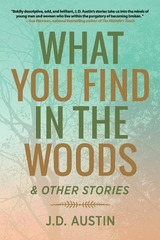
A young drunk and an old ex-drunk console each other on the city bus. An aging woman recounts the story of her sixty-year marriage as she goes to her deathbed. A distraught young man remembers his dead friends and calls on their spirits for the strength to go on living. Seasonal workers, washed-up athletes, lovers, brothers, friends, and enemies all fight for their identities and their sanity as the modern world seeks to tear them to pieces. In these ten stories, J. D. Austin explores the nuances, pitfalls, failures, and redemptions of men and their families in the Upper Midwest.
'J. D. Austin's book of short stories, What You Find in the Woods, stands as another proof of his amazing talent. His stories come to the reader as gritty and authentic as real life. Through his broken characters, he imparts age-old wisdom set within the homey and raw landscape of the northern Midwest. These stories take us into the minds of young men and women who live within the purgatory of becoming broken.'
-- Sue Harrison, international bestselling author of The Midwife's Touch
'These are stories Jack London might have written, if Jack London had been an opiate-addled ex-hockey player. What You Find in the Woods is about how we grieve, and how death surrounds us wherever we are. Throw in a car chase and a couple of beer jags and you have the literary equivalent of gelignite. Austin reminds us of the importance of homemade grilled cheese in nursing homes, of the dangers of the 'day-murdering nap, ' and the fact that nobody's free until the day after they die. These are powerful stories that Hemingway himself would have been proud to have written: they have the same coiled energy as 'The Killers' and 'A Clean, Well-Lighted Place.' What You Find in the Woods does for the Upper Peninsula what Knockemstiff did for Ohio: Jack Austin is a bright, scathing talent.'
-- Sebastian D. G. Knowles, Professor Emeritus of English, The Ohio State University
'Jack Austin's new short-story collection, What You Find in the Woods, offers a diverse set of tales, some short, some really novellas, that reflect the grittier side of life in Upper Michigan, especially for young millennial men seeking to survive while coping with issues like loneliness, heartbreak, and alcoholism. Austin creates realistic dialogue and even more realistic characters as he delves into the intricacies of the human experience, trying to make sense out of a world where sometimes we are our own worst enemies.'
-- Tyler R. Tichelaar, PhD, award-winning author of The Mysteries of Marquette
'...with his two opening stories plus the powerful titular story set midway-even though poor Jake was a goalie in hockey-Austin scores a 'hat trick' for the book. Well-made and exciting stories. And we will like his characters. He is a good weaver of fiction seasoned with just a touch of humor. I think J. D. Austin is grooming himself for some very fine writing. He is quickly becoming the Yooper's answer to Tom Wolfe. Read him.'
-- Donald M. Hassler, Professor Emeritus of English, Kent State University
'Although deep personal stresses and anxieties face the characters in these stories, there is an underlying sense of camaraderie and love that suggests hope. This a strong follow-up to the first novel of a promising young author.'
-- Jon C. Stott, author of Paul Bunyan in Michigan
The Bottom of the Cider Barrel
“What happened?” Roger asks, crouched over the hospital bed, wearing a control freak’s look of frustration.
“Well, I don’t know,” you say. “I was tired. My back hurt. I dropped my pill case behind the toilet and gassed myself trying to pick them all up, I guess.”
He rubs the baseball-sized tumor peeking out from under his shirt cuff. He starts to say something else but stops. It has all been said before. You’re both frustrated with saying the things there are to say. He reaches out his good arm and rests it on your hip brace. He has tears in his eyes.
“Ellie, my love, I think we have to move out.”
You nod. You reach out your good arm to rub his good arm. “Hey, hey. We made it. Honey. We’re here. You’re still here. Honey. What a life we’ve had! I remember it all! Don’t you? Don’t you remember?”
He smiles and coughs and wipes his nose. “Oh, I remember. But I don’t…it’s not—something spilled out along the way. You just aren’t the same in my head.” He starts to cry again. “It’s been seventy years, Ellie. I’m hooked. You got me. I don’t know what I’m going to do.”
“Oh, Roger,” you say, “We’re not going to die tomorrow. Or, well, you won’t.” And just like that, as the wrong words like slippery fish pass from your lips and land in his eyes, you know he must be the one to die first.
* * *
They take you home on a Sunday. The maple tree in the front yard is a blazing orange and yellow; leaves crunch underfoot on the sidewalk. The swing bench on the front porch creaks when the wind kicks up. You can hear it from the couch where Roger deposited you. He’s down in the basement, so out of sorts that he mercifully forgot to put on the Packer game.
On the way home from the hospital, you’d agreed to call your eldest daughter and give her launch authorization on the retirement facility in Marquette she’d been pushing for at least a year. Sons and in-laws would fill the place in a few days and empty it by the following weekend. And that would be that.
* * *
You met him in a rather unromantic way; you each were looking for a quick fix at the time. He made a joke about a doobie and you laughed, and that was pretty much it. When he brought in Tarot cards, he purportedly stole from the trinket shop on the corner, and asked you to read his palm, you nearly asked for his hand right then and there. Things were different back then; you were streaky and emotionally all over the place. For weeks you slept together and did a bad job acting too cool to really like each other. At the end of the summer, he was making pancakes when you had to run to the bathroom and weep. You told him you loved him. He said he loved you too, but not with the same gusto. It wouldn’t be until later that he was really sure.
* * *
He’d decided to love you by the time you finished school. He came to your graduation and suffered through car rides with your family and friends. You went up to his dad’s place on Keweenaw Bay for a weekend. The following week you left for a summer job in upstate New York. After a month, you were ready to quit. You called him in tears after getting screamed at in a meeting.
“My love, my love,” he said. “Hey, hey, hey. You’re so okay. Screw that guy, I mean, really, forget about him, but baby, baby, hear me on this one, I happen to know from experience. Getting yelled at is part of the job. I’m so sorry, baby.”
“I know, I know. Ughhh. I hate that it affects me so much.”
“Doesn’t make it okay, but I just want you to know that this guy probably thinks that that interaction was ordinary. You’re all good. All good, baby.”
Later during the phone call, a roommate came in who was at the meeting. Roger asked the kid why he hadn’t stuck up for you. The kid got righteous, at which point Roger got litigious, and after five minutes of going at it you were hysterical again, so the kid left. Roger realized he screwed up.
“Hey, baby, baby, I’m so sorry, I’m just trying to stick up for you! Hey, hey, it’s okay. Ellie, Ellie, breathe for me,” and so on and so forth for several hours. He was patient; he knew about your past, about what certain guys and family members had said and done.
You cried and cried. Not just that time—there were many instances, those days, of uncontrollable tears. Roger was solid as a rock through it all. Occasionally, he got frustrated, but most of the time, he was brilliant. “I’m like your sponge, baby. I’m here to soak up all the bad stuff. Let me soak it all up, baby. I’m here. I’m right here. I’m not going anywhere. I love you so much.” And he meant it.
* * *
He wakes you up in the late afternoon, gently. He didn’t actually wake you up; you heard him approach, hobbling up the basement steps and across the floorboards. You always let him wake you up, even if you’re already awake. You’re the snoozy one of the two of you. There has always been an element of flirtatious song and dance in his efforts to wake you from your naps. It was a sad day when, because of your busted hip, he could no longer wake you up by tickling you. And you had been sad about it, too! The devious gaslighting bastard. That’s what you tell him, and he grins his gap-toothed grin and gently pokes your ribs through the blanket.
“I made you a grilled cheese,” he says.
“Well, okay then,” you sigh, and then you both laugh, and begin the odyssey of rising and limping to the kitchen; you lean on him, he leans on the furniture whose layout he knows so well. It was a minutes-long journey, plenty long to look at pictures resting on side tables and hung in frames on the walls, at trinkets from here and there, the detritus of half a century and more.
You know you hope the move will kill him; you just can’t decide on whether or not you want to die too.
* * *
About fifteen years ago, you thought you had him beat. Unable to resist such offers, he took up a buddy on an invite to ride around the Great Lakes on the back of his massive Harley. It was early June. Roger wanted to camp, and you had to get a doctor to tell him, with you in the room as a witness, that he wasn’t allowed to sleep on the ground anymore. He had some rather poetic things to say about it afterward, but you could tell he was devastated. Sleeping rough in the woods was one of his all-time favorite things. You heard him and his buddy (whose control of their own volume was inversely related to how cranked up they were) talking about doing it anyway. Apparently, there was some new fancy-schmancy blow-up pad that was meant for people with problems.
On the way out the door, he gave you an extra-long kiss. Later, in the emergency room in Thunder Bay, you wondered whether he’d anticipated the crash. An arm was mangled, and they had to do a bunch of skin grafts. Wounds got infected. He forgot to take certain crucial meds at seemingly crucial junctures. You knew you weren’t ready then. And he pulled through, thank God.
* * *
On the flip side, you knew about his past, too. He was very open about it, and you loved him for that. About the hospitalizations, about the attempts, about the shrinks that drove him crazy with their patronization and their buttoned-up, sterile attempts to wade into his messy psyche. In the early days, he always said that you would get your turn. Part of his skill with hysteria came from his own father’s skill with him; he was always quick to credit his father when you thanked him for caring for you so well during your episodes. He was brilliant when his own life was moving forward. But in the winters, he shut down and was useless in a crisis. He was always good at telling you he loved you. But in the winter, that was all he could do, and that wasn’t enough, but it had to be.
* * *
“What did you put in this one?”
“Muenster, ched, red pepper flakes, minced garlic. The classic.”
“It’s incredible. I should eat up all the butter so you can’t.”
He smiled. “Perfect.” He tried not to watch you screw up your features in pain as you swallowed. He tried to watch the shaking leaves in the rattling branches out the window. The weight of the half-empty glass shook your hand, and you had to bring your head down close to the table to drink. His fist clenched over a red cloth napkin. “I’m glad you’re hungry today. I’ll leave the other half just in case.”
“You should eat it. Go ahead and eat it.”
“Are you sure? I had plenty of turkey and rice for lunch. I should really not.”
There was no reply.
“I’ll leave it just in case.”
“Thank you, darling.” You put your shaking hand on his.
It would be crass, you’ve decided, to take the Lord’s work into your hands and hasten his end. And you really should eat while you’ve got the appetite, painful though it is. You are only half-joking when you say you married him for his grilled cheeses.
* * *
The most romantic thing he ever said to you came in an insulting package. It was fifty years ago, your first or second winter, and you each were reading quite a bit. He was deep into a novel about a Confederate soldier hiking home across rural North Carolina. Some old man compliments a young man’s choice of wife by saying, “It makes as much sense to marry a girl for her looks as it does to hunt a bird because you like the way it sings.” Roger tried to dress it up by talking about your hourglass body, and he was right about that—still it stung, at the time. Now that your hip is broken along with your appetite,...
| Erscheint lt. Verlag | 1.3.2025 |
|---|---|
| Sprache | englisch |
| Themenwelt | Literatur ► Romane / Erzählungen |
| Schlagworte | Fiction • Literary • Novel • Rural • Short Stories • single author • Small Town |
| ISBN-13 | 979-8-89656-023-4 / 9798896560234 |
| Informationen gemäß Produktsicherheitsverordnung (GPSR) | |
| Haben Sie eine Frage zum Produkt? |
 EPUB (Ohne DRM)
Digital Rights Management: ohne DRM
Dieses eBook enthält kein DRM oder Kopierschutz. Eine Weitergabe an Dritte ist jedoch rechtlich nicht zulässig, weil Sie beim Kauf nur die Rechte an der persönlichen Nutzung erwerben.
Dateiformat: EPUB (Electronic Publication)
EPUB ist ein offener Standard für eBooks und eignet sich besonders zur Darstellung von Belletristik und Sachbüchern. Der Fließtext wird dynamisch an die Display- und Schriftgröße angepasst. Auch für mobile Lesegeräte ist EPUB daher gut geeignet.
Systemvoraussetzungen:
PC/Mac: Mit einem PC oder Mac können Sie dieses eBook lesen. Sie benötigen dafür die kostenlose Software Adobe Digital Editions.
eReader: Dieses eBook kann mit (fast) allen eBook-Readern gelesen werden. Mit dem amazon-Kindle ist es aber nicht kompatibel.
Smartphone/Tablet: Egal ob Apple oder Android, dieses eBook können Sie lesen. Sie benötigen dafür eine kostenlose App.
Geräteliste und zusätzliche Hinweise
Buying eBooks from abroad
For tax law reasons we can sell eBooks just within Germany and Switzerland. Regrettably we cannot fulfill eBook-orders from other countries.
aus dem Bereich