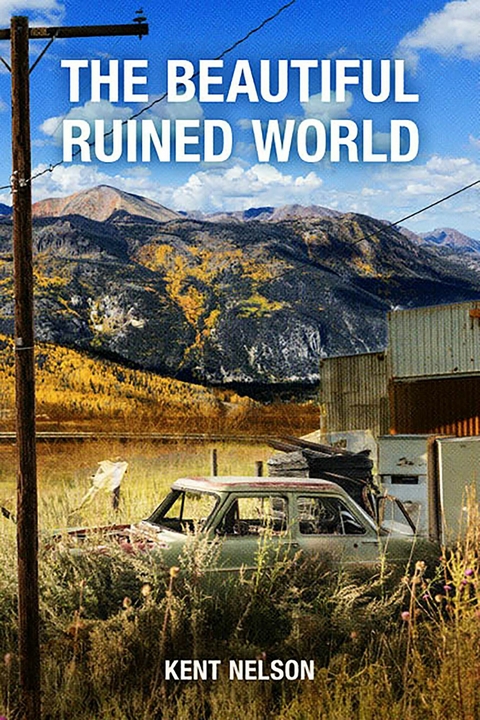
Beautiful Ruined World (eBook)
240 Seiten
Bookbaby (Verlag)
979-8-3178-1215-7 (ISBN)
Kent Nelson is the author of four novels and six short story collections. His fiction, often shaped by place and environmental and social themes, has appeared in The Best American Short Stories, Pushcart, and The O. Henry Awards, as well as in many other anthologies and magazines. Nelson's work has earned wide acclaim, including the Colorado Book Award, the Mountains and Plains Booksellers Award, the Edward Abbey Prize for Ecofiction, and the prestigious Drue Heinz Literature Prize. A Yale graduate and Harvard-trained environmental lawyer, Nelson has also worked as a doorman, dishwasher, tennis pro, innkeeper, city judge, ad salesman, and hired man on an alfalfa ranch-experiences that have informed his characters and landscapes. An avid traveler, he has journeyed all over North America, including Attu, the last Aleutian Island, in search of birds; his North American bird list is currently at 771 species. These adventures have contributed to his extensive knowledge of landscapes in which his novels take place. Nelson was ranked 6th in the U.S. in squash, captained the Yale tennis team, played varsity ice hockey, and competed in pro tennis player in Germany; he has run multiple marathons including L.A., Anchorage, Taos, and the Pikes Peak marathon.
Juliet Ruskin, married with a young child, finds herself troubled by the lies she's told her husband and the larger secret of her past. To cope, Juliet decides to write down her story, hoping to find forgiveness at the end. The story Juliet writes tells of the disintegration of a family who leave their seventeen-year-old daughter behind when they move across the country. Soon expelled from private school, the daughter has no place to go but to her parents' new house where the older couple have happily joined the local community. At a hearing of the county commissioners, the daughter's father hears of a proposed landfill near their home but finds his concerns rapidly silenced. Meanwhile, the daughter's mother who has recently accepted the starring role in a play begins behaving oddly and adapting behaviors of her volatile character. The only breath of fresh air the daughter has is Antoine, a Black exchange student from the Central African Republic. Finding his naivety charming, the daughter resumes hobbies she'd left behind and they quickly become friends. Unfortunately, Antoine finds himself a catalyst for trouble and racial hatred in the city while the daughter finds herself embroiled in things that will haunt her for years to come. When the story reaches its conclusion, and Juliet has written her sins, will she be able to find peace?
CHAPTER 3
The Ogden School was on the shoulder of a hill among eucalyptus and madrones, on property donated by Frederick Ogden in memory of his daughter killed in an equestrian accident. The ocean at Monterey was three miles distant. Classroom buildings were redwood, situated above the quadrangle and playing fields, with the dorms tucked back into the arroyos.
My banishment to Ogden—so I interpreted it—was the consequence of an evening in February, when I was fifteen, not long after I’d quit playing the piano. Hormones were a contributing factor, but not an excuse. It was mealtime, and Margaret was setting the table. My father wasn’t home yet from the lab. I was mashing potatoes. Chet walked in to the kitchen and said, “I got a valentine from Tracy.”
“What’s that mean,” I asked. “Are you engaged?”
“It means Tracy likes him,” Margaret said. “Yuk.”
“Do you get to touch her breasts?” I asked.
My mother smacked the counter with her hand. “Juliet!”
“Don’t ten-year-olds have breasts?” I asked.
“I said stop.”
“No, you said ‘Juliet.’”
My mother set the grilled chicken on the table. “We can’t wait for your father. Let’s eat.”
My mother tried the usual questions about school, who did what, and Chet and Margaret gave their nothing responses. I said, “I was supposed to take the drivers’ ed test today, but I refused.”
“Don’t you want to get your license?” Chet asked.
“All the accidents are caused by people with licenses,” I said. “I’m safer without one.”
“California requires you to have a license,” my mother said.
“The state is a bunch of bureaucrats, who require licenses for doctors, lawyers, and psychiatrists, but there’s no evidence a regular person can’t do as well as the few people who’ve passed a test.”
“If you want to drive one of our cars,” my mother said, “you have to have a license.”
“Is that a threat? You hear that, Chet and Margaret? We have to get permission to take a shit.”
My mother reached across the table and slapped me, and the next fall I was at Ogden.
Ogden had a good reputation, a soccer team, and no parents to criticize my every move. But I got a C in algebra. My father was livid. He made me a deal that if I got counseling once a week and raised my grade to a B, he would double my allowance. I might have been a smart-ass, but I wasn’t a fool.
My school counselor was Dr. Kaspar Renke, whom I called Rinky-Dink. He was short, had fuzzy blond hair, and wore checkered sports coats. He was also a sea-kayaker and runner of marathons. From the photos of his children, I guessed he was forty-something.
He had to be on my side, which I appreciated. We talked about my parents, sure, but he was also interested in the causes I cared about, like my work with homeless people and my questions about overpopulation of the planet. “With my doubled allowance,” I said, “I can do twice as much good, but it still isn’t close to enough.”
“You have the right spirit, Juliet,” Rinky-Dink said. “Do what you can.”
“My Dad’s a Republican. He’d freak out if he knew I was giving my money to homeless people. He wouldn’t understand about Kim Yu, either, so don’t you tell him anything. I don’t need his permission.”
“What about when he finds out?”
“I haven’t mentioned Drazan, either.”
“Who’s Drazan?”
“He’s a refugee from Novi Pazar. He’s lonely and calls me every night. His family paints boats and hauls trash.”
Rinky-Dink was quiet for a moment. “Is this politics?”
“What do you think about my name?” I asked. “Juliet was in Shakespeare, and Juliet Binoche starred in The English Patient . . .”
“You’re changing the subject.”
“Everything’s political. My parents are hosting a student from Africa, who has twenty-six brothers and sisters and lives in a village without electricity.” I picked up the picture of Rinky-Dink’s children posed in front of high, white mountains. “Where was this?”
“The Brooks Range, Alaska.”
“I’d like to go somewhere that far away, where no one knows who I am.”
Rinky-Dink looked at his watch. “You’ve avoided the hard questions,” he said, “but I’ll see you next week.”
“I don’t like lying,” I said. “It’s easier not to say anything.”
“Ah,” Rinky-Dink said, “but is that any different?”
That coming weekend I was seeing Kim Yu, but, because of Drazan, I was ambivalent. Kim had graduated from Ogden the year before and was now at Santa Cruz. We’d worked for a lot of the same causes—though Kim’s approach was different. Instead of activism, he advocated meditation. Only through the cultivation of one’s mental powers could such immense problems as reducing the world’s population be solved.
“Bullshit,” I said. “How can we solve a problem by doing nothing? How can sitting in a racquetball court make a difference? We have to consider food sources, demographics, global warming, overgrazing, deforestation. . .”
“Would you propose slaughtering a few million people?”
“We already have grassroots organizations for birth control, sterilization, and vasectomy.”
“Write letters to your Congressmen,” Kim said. “That’s what politicians want you to do, so you think you’ve acted. Try meditation with me.”
So I met him at the racquetball court once. We sat on the floor yoga-style facing the white front wall. Kim claimed he drew forth images of the world bereft of any green thing. I drew forth images of a white wall.
When we finished, I wasn’t convinced.
“Businesses want more people,” he said. “First, we must solve the problems of economics. Corporations rule the world.”
“Did you only now think of that?”
“I’ve had my vasectomy,” Kim said. “You can’t say I haven’t done my part.”
“You did what?”
“They don’t cut off your johnson,” Kim said. “If it’s a subject you’d like to pursue, I’ll be in my studio tonight.”
Kim was eighteen. I didn’t believe he’d had a vasectomy, so, walking back from the library, thirty minutes till curfew, I stopped at the art building. It was a chilly evening, and Kim’s studio windows were open to cut the paint fumes. He was working on an eight-by-twelve painting of an oil tanker run aground. Birds, fish, and mammals were fleeing in every direction. In the background a mushroom cloud lifted into bright sunshine.
“You’re not supposed to like it,” Kim said. “It’s a statement piece.”
“Okay, I hate it.”
He put down his brush and stepped closer. I smelled paint and sweat. His fingers snatched at the buttons of my jacket, and his cold hand went inside my shirt. He hadn’t even kissed me. His other cold hand slid between my legs.
I backed away.
“I told you I had a vasectomy,” he said.
“You think that’s the only question?”
“Why else are you here?” he asked.
After that, we had sex after his violin practice, twice on the floor of the racquetball court, and another time in the bicycle storage area in the basement of my dorm. It wasn’t particularly thrilling to have him spurt blank seed into a condom, but it was new to me. We were experimenting one night in Kim’s studio—I had his cock in my mouth—when his art teacher walked in. She had a different idea for the use of his studio, and Kim and I were sentenced to dorm arrest and to watching, separately, sex-ed videos. In such cases, school policy was not to inform the parents.
But then was then, now was now. My parents had moved to Colorado, and I was at Ogden. The summer before had been a bust. Kim had worked in Crescent City at his parents’ restaurant, and I languished in Berkeley. At the beginning of the school year, my roommate’s father took us to an ice cream shop in Monterey, where Drazan skated into my life on his roller blades. He was dark-haired, dark-eyed, and had a massive head. He noticed me because I had green hair. I liked his arms, which were like nautical ropes, so I gave him my cell number.
He called every night at eleven. He wanted a job at the aquarium. Could I help with the application? His family needed three hundred dollars to fix their car. Did I have money? His sister was still in Novi Pazar. Could I call the embassy? The more I did for Drazan, the murkier was my allegiance to Kim.
Seeing Kim that weekend was going to clarify my feelings. The problem was, I needed permission from my parents to go to Santa Cruz. My friend Rachel had a car, which the school knew about, and while her parents were in Brazil, she had to check on her grandmother in Seaside. I figured my parents might let me go to Rachel’s for the weekend—they didn’t need to know her parents weren’t there—and Rachel could instead drop me at the bus station.
The one hitch was my father wanted me to call home every evening from Rachel’s parents’ phone.
“What,” I said, “you don’t trust me?”
“A phone call is the least you can do.”
“All right,” I said. “I want to do the least.”
The other hitch was Kim. I said I’d be there Friday, and he said, “Friday? This Friday?”
“Four-thirty. Can you find the bus station?”
“I guess,...
| Erscheint lt. Verlag | 30.10.2025 |
|---|---|
| Sprache | englisch |
| Themenwelt | Literatur ► Romane / Erzählungen |
| ISBN-13 | 979-8-3178-1215-7 / 9798317812157 |
| Informationen gemäß Produktsicherheitsverordnung (GPSR) | |
| Haben Sie eine Frage zum Produkt? |
 EPUB (Ohne DRM)
Größe: 779 KB
Digital Rights Management: ohne DRM
Dieses eBook enthält kein DRM oder Kopierschutz. Eine Weitergabe an Dritte ist jedoch rechtlich nicht zulässig, weil Sie beim Kauf nur die Rechte an der persönlichen Nutzung erwerben.
Dateiformat: EPUB (Electronic Publication)
EPUB ist ein offener Standard für eBooks und eignet sich besonders zur Darstellung von Belletristik und Sachbüchern. Der Fließtext wird dynamisch an die Display- und Schriftgröße angepasst. Auch für mobile Lesegeräte ist EPUB daher gut geeignet.
Systemvoraussetzungen:
PC/Mac: Mit einem PC oder Mac können Sie dieses eBook lesen. Sie benötigen dafür die kostenlose Software Adobe Digital Editions.
eReader: Dieses eBook kann mit (fast) allen eBook-Readern gelesen werden. Mit dem amazon-Kindle ist es aber nicht kompatibel.
Smartphone/Tablet: Egal ob Apple oder Android, dieses eBook können Sie lesen. Sie benötigen dafür eine kostenlose App.
Geräteliste und zusätzliche Hinweise
Buying eBooks from abroad
For tax law reasons we can sell eBooks just within Germany and Switzerland. Regrettably we cannot fulfill eBook-orders from other countries.
aus dem Bereich