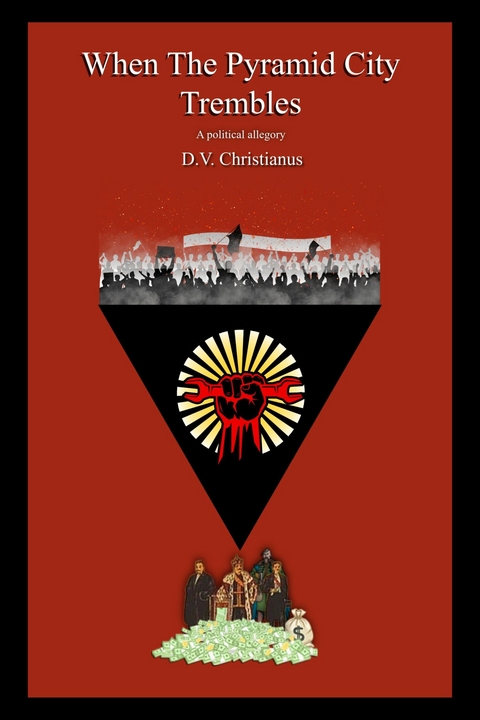
When The Pyramid City Trembles (eBook)
527 Seiten
Publishdrive (Verlag)
978-0-00-108018-8 (ISBN)
In a city shaped like a great pyramid where the elites rule from gilded towers and the workers toil beneath their feet, hunger and silence have long been the law. But when the cries of the oppressed reach the breaking point, the ground itself begins to tremble. When the Pyramid City Trembles is a sweeping political allegory about power, struggle, and the fire of revolution.
Through the eyes of workers, students, and intellectuals, the story unfolds as the masses rise against a corrupt order sustained by greed, bureaucracy, and deceit. From whispered dissent to the roar of a unified march, this novel captures the birth of a people's awakening and the inevitable collapse of tyranny.
Chapter I: The Predator’s Feast
The banquet hall blazed with gold, as if the walls themselves were dipped in sunlight and hardened into permanence. Above, chandeliers dangled like captured constellations, each crystal scattering light into shards that blinded more than they illuminated. The floor stretched wide, a mirror of marble polished so cruelly clean that it seemed nothing human had ever touched it. No dust, no footprints, no memory—only shine.
The tables curved in long rows, so heavy with meat, bread, wine, and fruit that the wood beneath groaned. A thousand animals slaughtered, their flesh glazed and arranged into decorative abundance. Grapes spilled in velvet heaps, bread steamed as if it had just emerged from the oven, and wine flowed so freely the air smelled fermented. It was not a meal. It was a display, a proclamation carved in excess: here is power, here is wealth, here is dominion.
The guests reclined in gilded chairs carved to resemble thrones. Each chair a crown, each goblet a weapon, each laugh a declaration that they, and only they, were meant to rule. Servants—thin, pale, unremarkable—stood in shadows, awaiting the smallest gesture. They were so silent that they seemed invisible, reduced to extensions of the furniture. Only their eyes betrayed life, darting from platter to platter, from hand to hand, watching what they could never touch.
At the head of the table sat the Magistrate. His robes bore the weight of law itself, heavy and ceremonial, woven with threads of silver and symbols of judgment. His posture was as precise as his smile: wide enough to soothe, sharp enough to warn. He raised his jeweled goblet slowly, and the murmurs around him died as though even breath had sworn loyalty to him.
“Look around you,” he began, his voice smooth, carrying the elegance of practiced speeches. “This feast is not indulgence. It is proof. Proof of order, proof of stability, proof that the sacred contract between ruler and ruled endures. They labor, and we protect. They obey, and we govern. This is not hunger, nor cruelty, but the balance of civilization.”
Some nodded, some smirked. The Oligarch, seated beside him, threw his jeweled head back and laughed with the ease of a man who never feared contradiction. His fingers, thick with rings, plunged into the roasted carcass of a bird, tearing it apart without pause for grace. Grease glazed his lips, dripping onto silken sleeves he did not care to preserve.
“Balance?” he spat, bones snapping in his fists. “No, Magistrate, call it what it is: necessity. They are filth, left to themselves. They drown in ignorance, they wallow in sloth. We feed them crumbs, and in return, they lift our towers, plow our fields, guard our gates. This pyramid you so love to sanctify stands because they are forced to kneel beneath it. Without their backs, without their sweat, without their hunger—” He wiped his greasy fingers on a napkin stitched with gold thread. “—we would not rise.”
The General shifted in his seat, armor clinking even in festivity, for he never removed it. His body was steel, his face carved into cold lines. When he spoke, his voice cut through the hall like a drawn blade.
“You mistake the reason they kneel, Oligarch. It is not because of crumbs. It is because of fear. Fear of punishment, fear of death. A square filled with corpses speaks louder than any law, any bread. Obedience is not bargained—it is forced. Should they rise, we cut them down. That is the contract. That is the balance.”
Murmurs of approval, scattered applause. Yet the Bureaucrat remained quiet. His thin fingers arranged food into squares on his plate, each bite precise, mechanical. He did not smile, nor sneer, nor indulge. He existed in lines, rules, and ink. When he finally spoke, his voice was low, almost bored, but it demanded attention nonetheless.
“You are both wrong,” he said flatly. “Fear fades. Hunger passes. Paper endures. A prison is not a prison until signed into being. A wage does not exist until documented. Even death is meaningless without record. You speak of swords and scraps, but both are illusions until I write them into permanence. You call me small, but without me, you are nothing but men at a table.”
The Oligarch’s face flushed, but the Magistrate smiled approvingly. The General scoffed, muttering that words had never killed a rebellion. Still, the Bureaucrat returned to his careful cutting, unmoved, as if the debate had already been decided by ink long before voices were raised.
From the servant’s line came a sudden sound—a stomach growl, loud enough to echo faintly against marble. Heads turned. One servant froze, his hands trembling as he clutched a silver pitcher. His face drained of blood as the General’s glare pierced him.
The hall held its breath, as though the air itself had become afraid. The servant’s hands quivered, the silver pitcher rattling faintly against the rim of a goblet. He dared not look up. The General’s jaw tightened, his gauntleted fist curling with a faint metallic groan. He had executed men for less—for silence mistaken as insolence, for a glance misread as defiance.
“Pathetic,” the General muttered, half to himself, half to the table. “Even their stomachs betray them. What discipline can exist among creatures who cannot command their own flesh?”
The servant’s knees bent instinctively, as though he might collapse and beg for punishment to pass him by. His lips trembled with the words he dared not speak.
But the Magistrate’s hand rose, calm and deliberate. “Enough,” he said, his voice soft but absolute. “The boy is not guilty of disobedience. He is guilty only of hunger. And hunger—” His eyes drifted across the table, lingering on the Oligarch’s greasy fingers, on the General’s armored bulk, on the Bureaucrat’s neat squares of meat. “—hunger is no crime. It is a condition. And conditions,” he added with a knowing smile, “are the law.”
The General’s fist unclenched reluctantly. He leaned back in his chair, though his eyes remained fixed on the servant with the promise of violence should weakness appear again.
The Oligarch snorted with laughter, raising his goblet high. “Ah, Magistrate, ever the poet! Hunger is no crime? Perhaps not. But it is the finest leash. They come crawling for scraps, licking at our boots for the smallest taste. It makes them predictable. Dependable. Even loyal.” He drank deep, red wine spilling down his chin like blood.
A ripple of amusement circled the table. Some nodded, some chuckled. Only the Bureaucrat remained unmoved, dabbing his mouth with linen as he murmured: “Loyalty is not measured in bread. It is measured in signatures. They are bound not by hunger, nor fear, but by documents they cannot read, laws they cannot question, decrees they cannot escape. I hold their obedience in ink.”
The Magistrate inclined his head toward him, pleased. “Indeed. Fear is temporary. Hunger recurs. But the written word—ah, that is eternal. Even their memories cannot stand against it.”
From the far side of the hall, music began. A trio of musicians struck strings and pipes, their eyes cast downward, their hands moving with nervous precision. Their melodies were bright, hollow, meant only to decorate the silence between the predators’ laughter. Dancers followed—women draped in cloth dyed the color of bruises, their movements graceful yet forced, like puppets whose strings were pulled too tight.
The Oligarch clapped in delight, tossing bones from his feast onto the marble where the dancers’ bare feet risked stepping. One girl nearly stumbled on a slick of fat, and though she caught herself, her face blanched in shame. The General smirked at her clumsiness, muttering something about weakness.
At the far end of the table, a figure cleared his throat. Thin, spectacled, his robes simpler than the others—an Intellectual, invited for novelty. He rose hesitantly, bowing before he spoke.
“My lords,” he began, voice shaking slightly, “this feast, this abundance, is a monument to your greatness. Yet let us not forget—” He paused, eyes flickering toward the servants. “—that the masses who labor for your glory must also feel the warmth of your benevolence. To govern is not merely to take, but to guide, to—”
The General slammed his goblet down, wine splashing across the table. “Spare us your sermons, scholar. Guidance? They are beasts, nothing more. The only guidance they require is the lash.”
The Oligarch sneered. “Let the fool speak. His kind are useful, after all. They weave words that turn our tyranny into justice, our greed into destiny. That is their purpose—to dress the whip in velvet.”
The Intellectual flushed, lowering his gaze. “As you say, my lord.”
The music quickened, drowning the awkwardness. Servants refilled goblets, replaced emptied platters, bowed and retreated again into invisibility. Yet the air had shifted. For beneath the laughter, beneath the music, beneath the endless chewing of meat, hunger still echoed. A sound too human to ignore, a reminder that beyond the hall’s golden walls stretched a city of empty bellies and broken backs.
Beyond the music, faint but present, there was another sound. It seeped through the thick curtains and the carved stone, so subtle at first it could have been mistaken for the wind. But the Magistrate’s ears twitched toward it, and for a moment he faltered in his measured smile.
It was not wind. It was a murmur—low, uneven, like the distant groaning of the sea. Yet when the breeze shifted, the murmur sharpened into words, carried faintly into...
| Erscheint lt. Verlag | 26.10.2025 |
|---|---|
| Sprache | englisch |
| Themenwelt | Literatur ► Krimi / Thriller / Horror |
| ISBN-10 | 0-00-108018-0 / 0001080180 |
| ISBN-13 | 978-0-00-108018-8 / 9780001080188 |
| Informationen gemäß Produktsicherheitsverordnung (GPSR) | |
| Haben Sie eine Frage zum Produkt? |
 EPUB (Adobe DRM)
Größe: 623 KB
Kopierschutz: Adobe-DRM
Adobe-DRM ist ein Kopierschutz, der das eBook vor Mißbrauch schützen soll. Dabei wird das eBook bereits beim Download auf Ihre persönliche Adobe-ID autorisiert. Lesen können Sie das eBook dann nur auf den Geräten, welche ebenfalls auf Ihre Adobe-ID registriert sind.
Details zum Adobe-DRM
Dateiformat: EPUB (Electronic Publication)
EPUB ist ein offener Standard für eBooks und eignet sich besonders zur Darstellung von Belletristik und Sachbüchern. Der Fließtext wird dynamisch an die Display- und Schriftgröße angepasst. Auch für mobile Lesegeräte ist EPUB daher gut geeignet.
Systemvoraussetzungen:
PC/Mac: Mit einem PC oder Mac können Sie dieses eBook lesen. Sie benötigen eine
eReader: Dieses eBook kann mit (fast) allen eBook-Readern gelesen werden. Mit dem amazon-Kindle ist es aber nicht kompatibel.
Smartphone/Tablet: Egal ob Apple oder Android, dieses eBook können Sie lesen. Sie benötigen eine
Geräteliste und zusätzliche Hinweise
Buying eBooks from abroad
For tax law reasons we can sell eBooks just within Germany and Switzerland. Regrettably we cannot fulfill eBook-orders from other countries.
aus dem Bereich