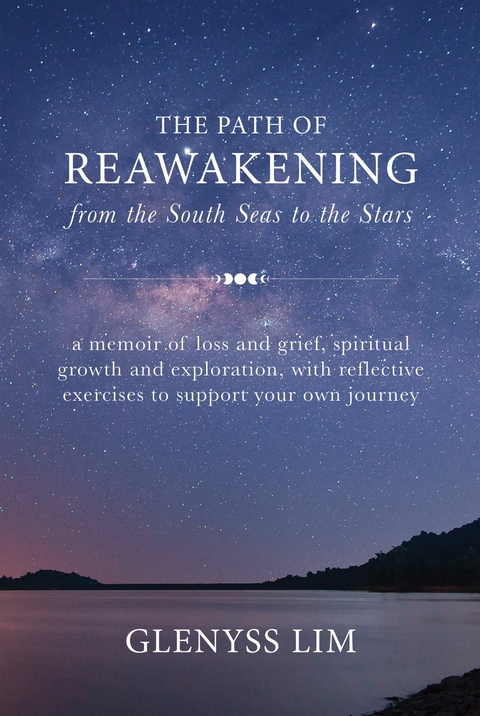
The Path of Reawakening from the South Seas to the Stars (eBook)
421 Seiten
Publishdrive (Verlag)
978-0-00-096992-7 (ISBN)
Through the lens of her personal stories, questions, and learning, Glenyss Lim empowers you to uncover your own wisdoms relating to loss and grief, healing, spirituality, the oneness in humanity's diversity, and taking responsibility for personal and collective evolution.
Her memoir invites you to ride along as she grows up on a New Zealand sheep farm, marries cross-culturally, pursues a healing lifestyle and career as a registered nurse, and relocates to the United States.
Accompany Glenyss on her spiritual journey as she connects with several renowned women who profoundly affect her life's work. She studies with medicine woman Lynn Andrews. She learns to heal the nervous system with sound healing trailblazed by Vickie Dodd and, later, with explorers of the trauma release process (TRE®). Most profoundly, Elisabeth Kübler-Ross, MD, the pioneering visionary and author of On Death and Dying, reached across the veil to share the story of her own dying, which Glenyss records here.
Engage with mutual curiosity as Glenyss volunteers in the third world, explores the psyche, pursues an understanding of the commonality of all people, and discovers healing and bridges between 'regular' life and the multidimensional spiritual world. Her experiences call to you to imagine the possible.
Gifts from My Ancestors
“On shoulders of ancestors—
wisdom, lessons, teachings, hard work—
also from things you know, you take the baton
and need to change and grow.”
—Dr. Tererai Trent
T
eddy’s ears sizzled and shriveled as the flames devoured his face, first slowly licking around the edges, then engulfing him in their unrepentant dance. I stood back from the winter night’s fire in our sitting room, posture tall and brave in my little girl’s nightie, as my beloved ragged Teddy went to his death.
Dad cajoled me to let Teddy go, as only his head remained, all tattered and torn. Big girls didn’t need to cling to a teddy bear, let alone one so bedraggled. I loved my mum and dad dearly, so I stood there doing what I knew they wanted, yet reluctant to let Teddy go. He’d brought me such comfort and companionship. I loved nothing more than licking his torn ear and rubbing its wet surface against my nostrils. While disgusting in the telling, the sensation and smell brought me such delight and solace.
I understood Dad’s logic, and I certainly wanted his approval and acknowledgment as a “big girl.” Ultimately, rational action claimed the day, yet my feelings of sadness, bewilderment, and a free-floating anxiety wafted about with nowhere to go. So there they sat in a subterranean cave.
My extended family and its history set the stage for practicality to rule over the luxury of emotion. It offered a strong sense of physical and social stability and the understanding of the necessity of hard work to survive.
I arrived into the world reluctantly on October 4th, 1952, the firstborn of Moira and Richard “Dick” Hoe. They married just a year before I came along. My arrival fulfilled the natural order of things for them and theirs—to marry and have children to continue the family line.
Much to my mother’s chagrin, I arrived two weeks late. She expected me to arrive “by the book” on my due date. When that day came, she waited and waited with great anticipation for “something to happen.” It didn’t. To rub salt in her wound, my cousin announced himself early, with his entrance that very day. Accordingly, he claimed the status of first local grandchild for Dad’s mother, something, decades later, my mother still considered herself gypped over. I’d failed to arrive on time. Not only that, I was a girl. It was my failure, my fault.
We lived in a small farming community: Puni, on the outskirts of Pukekohe township. The whole area burrowed into lush green rolling hills, barely thirty miles south of Auckland, New Zealand.
It comprised mostly dairy and a few sheep farming families, all White and generally of British ancestry. Besides this clan, the smaller groups of primarily Indian and Chinese families thrived with their market gardens, relying on the labor of the indigenous Maori people.
My childhood home nestled into the farm that Dad’s father, Joseph James Hoe, purchased after returning from WWI. The name of the road where we lived, Soldiers’ Settlement Road, reflected this war-era history. My grandmother, Vera Hoe, and Joseph Hoe developed the 139-acre farm first. At the time of their purchase, it comprised mostly native bush with one wire around the property’s perimeter. Ultimately, they developed it into more of an economic unit, though it still struggled. They raised seven children during the Depression, on that land of promise. One of those seven was my dad, the only boy and the third child. He worked long and hard on the farm. Others made big demands of him, not atypical of the times.
For someone of the following generation, I always enjoyed Hoe family gatherings, especially for the stories Dad and his sisters rekindled from childhood years. I learned of an era before the motor car, the kids riding to school on ponies and horses, and no electricity. I heard about their parents working until late at night milking cows or breaking in bushland, outings in a horse and cart to their grandmother Mum Wright’s where they enjoyed their ritual Sunday meal.
Other stories abounded. Dad wore trousers made from old calico flour bags and the girls donned hand-me-downs, in the era of want. The kids congregated together in the dark, the coal range the only light source as they made puppet shadows on the wall. This often occurred as they awaited their parents’ late return from the farm. They told another story of one sister who baked, I think Shirley. She messed up the recipe and furtively threw out the results, aware she wasted an egg, so precious in the Depression era.
Another anecdote, reflective of those times, stayed with me. It demonstrated the importance of compassion and helping others, even in times of your own great need. Many people lacked work during the Depression. Tramps, as they were called then, commonly wandered the roads with their swags. They used their own communication code and left a stone upon a letterbox to indicate this home proffered kindness and likely food. Apparently, tramps left a stone at the Hoe gate. No matter her own struggles, Gran always found a way to fill another mouth.
Their family stories intrigued me for what they revealed about a time gone by. Glimpses of pioneering life and the personalities of Dad and my aunts shone through. I sat there agog as they shared, laughed, and reminisced about a life I could not be a part of and could barely relate to. Yet, I took away a sense of family history and continuity, an innate belonging to something much bigger than myself, a community of extended family, with its different colors and hues of lifestyle, beliefs, and personalities.
I never knew my paternal grandfather, Joseph Hoe, as he experienced a sudden and untimely death at the age of fifty-one. My father, twenty-one years old at the time, inherited the responsibility of managing the family farm with his mother, and providing for the two younger of the seven children. He maintained a stiff upper lip, a big heart, and an attitude of, “That’s just how life is.”
Mum’s side of the family influenced my life growing up, too, just in different ways. Mum, unlike Dad, came from a small nuclear family. It included herself, her parents, Calvin and Muriel (nee Webb) Deed; and her only sibling/older brother, Mervyn.
Her father was a builder and wonderfully industrious with many hobbies. My grandmother maintained the home front and, as a music teacher accredited from Trinity College, London, taught private piano lessons from home.
These grandparents, Narnie and DaDa as we called them, were a major influence of love and stability to us children: me; my sister, Bronwyn, fifteen months younger; and brother, Richard, five years younger. We celebrated all our birthdays and Christmases, and shared with them our three-week annual beach holiday, as well as weekly and sometimes daily connections. Routine, rituals, predictability, and family social stability were the norm. Mum’s family brought many of the same core values as Dad’s.
Growing up in New Zealand on a sheep farm also shaped me enormously. I unconsciously developed a strong awareness of the sensory—sight, hearing, smell, touch and taste—along with the intuitive. Of course, I must add to that, the power of nature. My soul fed on living in nature buzzing with energy, vitality, and spirit. I recall my sense of buoyancy when out on the farm or in our large garden—the latter my mother’s pet project and place of creativity, peace, and escape. I hold memories of all the paddocks on the farm, excursions on the tractor with my dad and sister, and my younger brother, too. These involved feeding hay to the cattle; rounding up sheep to move to fresh pasture or for dipping, shearing, and docking; or ultimately driving them to the yards for their trip to the freezing works. We accompanied Dad to check on the animals, mend fences, or tend the myriad other jobs needed to develop and maintain a farm.
Special colorful times, extraordinary to the daily routine, marked the calendar: sheep shearing with its arrival of shearers onto the farm and the accompanying droving of the sheep, penning, fleecoing—the local vernacular for wool handling—wool bale pressing, and branding. Mum working endlessly to feed the men large cooked breakfasts, lunches, and homemade morning and afternoon teas. Then we experienced the docking of the lambs in spring, usually August; our end-of-term school holidays; and haymaking in the summer. Sometimes, a small plane appeared when topdressing was afforded, for flights over the farm to drop its load of promised new growth and life. I filled with excitement and a sense of adventure around these farming events and their flurry of activity. They all carried their own distinctive sights, sounds, smells, tactile experiences, and even tastes.
Throughout the incessant buzzing of farm life, underpinned memories remain of the sensory impact of being in nature and with the elements: the sun beating down, the wind blowing my face, the clouds wafting across the sky, the bouquet of the grass, a skylark flashing by as it took off from its nest in the tall spring grass. Not to mention the aroma of hay, the scent of sheep’s lanolin softening my fingers, the din of the sheep’s baaing, or the taste of dust whipped up by the dogs as they nipped at the sheep. The pukeko birds called and flashed their tails from down in the bulrushes. Panicked bleating lambs, separated from their anxious mothers, rent the air with their racket.
Dogs yapped...
| Erscheint lt. Verlag | 18.10.2025 |
|---|---|
| Sprache | englisch |
| Themenwelt | Literatur ► Lyrik / Dramatik ► Lyrik / Gedichte |
| ISBN-10 | 0-00-096992-3 / 0000969923 |
| ISBN-13 | 978-0-00-096992-7 / 9780000969927 |
| Informationen gemäß Produktsicherheitsverordnung (GPSR) | |
| Haben Sie eine Frage zum Produkt? |
 EPUB (Adobe DRM)
Größe: 24,6 MB
Kopierschutz: Adobe-DRM
Adobe-DRM ist ein Kopierschutz, der das eBook vor Mißbrauch schützen soll. Dabei wird das eBook bereits beim Download auf Ihre persönliche Adobe-ID autorisiert. Lesen können Sie das eBook dann nur auf den Geräten, welche ebenfalls auf Ihre Adobe-ID registriert sind.
Details zum Adobe-DRM
Dateiformat: EPUB (Electronic Publication)
EPUB ist ein offener Standard für eBooks und eignet sich besonders zur Darstellung von Belletristik und Sachbüchern. Der Fließtext wird dynamisch an die Display- und Schriftgröße angepasst. Auch für mobile Lesegeräte ist EPUB daher gut geeignet.
Systemvoraussetzungen:
PC/Mac: Mit einem PC oder Mac können Sie dieses eBook lesen. Sie benötigen eine
eReader: Dieses eBook kann mit (fast) allen eBook-Readern gelesen werden. Mit dem amazon-Kindle ist es aber nicht kompatibel.
Smartphone/Tablet: Egal ob Apple oder Android, dieses eBook können Sie lesen. Sie benötigen eine
Geräteliste und zusätzliche Hinweise
Buying eBooks from abroad
For tax law reasons we can sell eBooks just within Germany and Switzerland. Regrettably we cannot fulfill eBook-orders from other countries.
aus dem Bereich