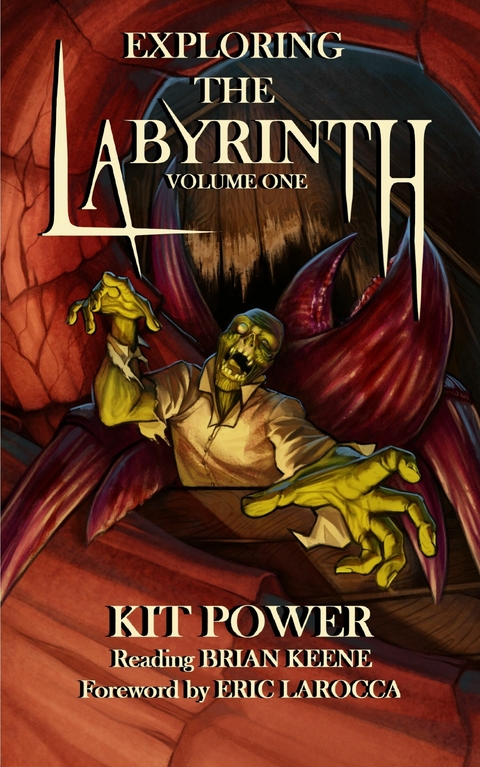
Exploring The Labyrinth (eBook)
418 Seiten
French Press (Verlag)
978-0-00-107739-3 (ISBN)
On the surface, Kit Power seems like a successful horror writer - three-time BFA finalist, two-time Splatterpunk winner, and author of the celebrated My Life in Horror essay series.
But that affable facade hides a terrible secret: he never read the works of Brian Keene on initial publication.
Podcaster. Philanthropist. Stoker winner. World Horror Grandmaster.
Brian. Fucking. Keene.
With this book, Power starts to un-fuck that. And he's taking you along for the ride.
With a foreword by splatter legend Eric LaRocca, what follows is a horror enthusiast's first-read peek at each of Keene's full-length fiction pieces from The Rising (2003) to Alone (2011), covering the Leisure Books years and much, much more.
But it's also Power's story: the firsthand account of a young writer finding his voice as he examines the work of one of the greats who went before.
And, finally, it's Keene and Power together. This volume concludes with an exclusive, heartbreakingly intimate interview you'll never find anywhere else.
So, keep a popcorn box full of eyes out for The Thirteen and join Power as he takes you...
Exploring The Labyrinth
It feels oddly appropriate that my first steps into the Labyrinth – Keene’s interconnected mythos of worlds, composed of varying, sometimes contradictory ‘Levels’ - would seem, on the surface, to be a wrong turn. Clickers was, after all, not written by Brian Keene, so starting a new discovery/career retrospective here, rather than with The Rising, could seem, at the very least, a little obtuse.
But it makes perfect sense. Honest.
Because while Keene may not have written any part of this novel, he did subsequently go on to write three Clickers titles with Gonzalez, including one that crossed over into the literary universe of The Rising. In that sense, then, Clickers is a hugely important strand in Keene’s career, so it makes sense to go back to ground zero, and see what came before. Not only will this help make sense of what follows, it should also tease out what influence Keene had on the Clickers series.[2]
[2] And, indeed what influence Gonzalez may have had on Keene, given how close the two were as friends and contemporaries.
I read the most recent Kindle edition of the book, which has an additional foreword written in 2010, over a decade after the initial publication date. I mention this because said foreword mentions this is the sixth edition of the book, and that one of the things this version does is fix some earlier editorial and formatting issues that had apparently plagued prior releases.
And I’m afraid that brings me to one more order of business before I get into the essay proper, and that’s the somewhat vexed subject of criticism.
Let’s start here: I am not a critic, and this is not a series of critical reviews. I am a writer, and I am a genre fan. I don’t dislike critics, or criticism – in point of fact, I actually think that criticism is an art form unto itself.[3] It’s just not what I do, as neither my enthusiasms nor my talents lie in that direction.
[3] And yes, there are ‘bad’ critics, just like there are ‘bad’ novelists or storytellers, and ‘bad’ can apply in the moral sense, or in the sense of ‘bad at their job’, or both - but still.
That’s not to say I don’t have critical faculties, or that I engage with creative work without any thought or attention to craft, or that I can’t see flaws even in work I admire, enjoy, or love. It’s more to say that, most times, I’m writing from a place of enthusiastic engagement, because that’s how I tend to feel about the work I enjoy, whether it’s music, movies, or books. There are plenty of folks out there who will try to sell you the snake oil of ‘dispassionate critical assessment’ (and some of them will be their own best customers, come to that) but I’m not one of them. Chances are, if I get to the end of a book (which is far from a foregone conclusion), I will have enjoyed the experience, and I’ll mainly want to talk about why.
Clickers is a fine example. I fucking loved it.
The intro talks a lot about the pulp 50’s B-movies and Guy N Smith/James Herbert influences, and they ain’t kidding. The structure is pure Rats-era Herbert, with chapters following the ‘lead’ characters interspersed with sections where you get to meet various interesting people and then watch them get hideously killed. I point out the formula merely to highlight, not to sneer. It’s a classic for a reason, and one I fully intend to emulate myself someday.
Both the characters and the deaths are vivid and well-drawn. The characters especially, actually. Rick Sychek appears to be a hilariously on-the-nose authorial insert, given his status as a midlist horror author on the way up, heading to a remote seaside town in Maine to get that difficult fourth novel put away. The guy absolutely crackles on the page – smart, charismatic, and just the right side of charmingly roguish. He’s a pleasure to hang out with.
In fact, there isn’t a character in this book that doesn’t feel fleshed out, alive, and with their own interiority, from the lead on down to the one-chapter victims. Gonzalez and Williams bring them all to life, from the small-town sheriff with a racist stick up his butt (and, it transpires, almost certainly a dose of PTSD from his service in ‘Nam), to his essentially decent but slightly hapless deputy, to the town doctor. It’s a huge strength of the book as a whole.
Similarly, Jack Ripley – Ripper to his fans, of course – is a delight. He’s a man with a cult underground comic career that he passed over to run a comic shop in a small town on the edge of the country (a role Keene himself has chosen to inhabit over the last couple of years, I realise, though this character predated his efforts on the Clickers series.) The lengthy scene where the two men meet and discover a mutual fandom really should be cheesy and overindulgent – and certainly the narrative slams to a halt for a dozen pages or more as they talk about their career paths and the then-current state of the creative industries. But honestly, it was one of the highlights of the book, for me.
There’s an incredible authenticity to the sequence and its dialogue. As a reader, I felt like I was getting to listen in on two working artists in a private conversation, and the passion and pragmatism really rang true. It’s not a million miles away from the experience of listening to Keene’s podcast, as I think of it – especially the interviews conducted at crowded conventions or noisy hotel rooms, where the audio challenges add to that atmospheric feeling of, in some sense, actually being there.
It’s one of the qualities I most look for and value in writing, I realise, that feeling of falling into the page, being swept along by events. And Clickers delivers that in spades.
It manages this in spite of some occasional rough edges in the prose. There’s a tendency towards word repetition in places, and the odd clumsily constructed sentence. The pacing is mostly superb, but there were also a couple of sequences (especially once the main event started and the Clickers were marching up Main Street, spitting acid and chowing down on half the town) that dragged a bit. Perhaps especially the moment of exposition, though I suppose that’s usually the least convincing moment of any B-movie, almost by definition.
Despite that, I found the book for the most part to be a lethally quick read, a gleeful headrush of horror set pieces populated by vividly drawn characters that feel in many ways like broad stroke stock characters, yet all of whom come to life on the page through a combination of deft personal flourishes and authentic dialogue.
And then, of course, there are the Clickers.
Somewhere between a crab, lobster, and scorpion, three feet long with foot-long claws whose snapping gives them their titular name. And, of course, they have stingers, which inject what appears to be fantastically corrosive acid into anyone unlucky enough to get into striking distance (spoiler: that turns out to be rather a lot of people.)
And, of course, there’s thousands of them, apparently driven from whatever hellish sea depths they usually inhabit by some freak 100-year storm. God, they’re fucking brilliant. Seriously. Classic creature feature monsters – basically recognisable, but outsized, twisted, more deadly. Add in speed, viciousness, and weight of numbers and they become exactly the kind of Implacable, unstoppable, unreasoning opponent you want for this kind of tale.
The venom is a particularly brilliant touch, both Upping the danger stakes and providing some superb gross-out splatter moments, as stomachs swell and explode, and the Clickers move in to eat the steaming, bubbling organs from the still-screaming victims.
Good times.
And there’s a lovely changeup shortly after the halfway point, when you discover the reason the Clickers have been driven to the shoreline.
Because the Dark Ones are coming.
So, I guess we also need to talk about Lovecraft.
I’ll be brief, as I’m both woefully underqualified and have not a single original thought on either the man or his work. I’ve got a complete works on my Kindle, and I’m currently at the 23% mark, having just finished ‘The Rats In The Walls,’ so I wasn’t kidding about being underqualified.
I have, however, read enough, and followed enough of recent debates about the man and his work to know that there will be a subset of Lovecraft fans that must feel personally insulted and aggrieved at the usage of the man’s iconography in such a brazenly pulp environment as this novel. I imagine it might feel sacrilegious, even.
I laughed like a goddamned drain.
It’s so delightfully, deliriously punk rock, that’s all. To take creatures from the cosmic horror milieu, who, in the source material, are disturbing primarily because of their indescribability, their unknown qualities, their barely-glimpsed-through-mist-monstrosity – and then fling them into a garish, technicolor splatterfest, and let the violent disemboweling and beheadings commence!
It’s gleeful, irreverent...–nd yet, there’s sincere love here, too, for both the source material and for the genre the Deep Ones Dark Ones stride into. The way that translates is that they are utterly...
| Erscheint lt. Verlag | 13.10.2025 |
|---|---|
| Sprache | englisch |
| Themenwelt | Literatur ► Romane / Erzählungen |
| ISBN-10 | 0-00-107739-2 / 0001077392 |
| ISBN-13 | 978-0-00-107739-3 / 9780001077393 |
| Informationen gemäß Produktsicherheitsverordnung (GPSR) | |
| Haben Sie eine Frage zum Produkt? |
 EPUB (Adobe DRM)
Größe: 675 KB
Kopierschutz: Adobe-DRM
Adobe-DRM ist ein Kopierschutz, der das eBook vor Mißbrauch schützen soll. Dabei wird das eBook bereits beim Download auf Ihre persönliche Adobe-ID autorisiert. Lesen können Sie das eBook dann nur auf den Geräten, welche ebenfalls auf Ihre Adobe-ID registriert sind.
Details zum Adobe-DRM
Dateiformat: EPUB (Electronic Publication)
EPUB ist ein offener Standard für eBooks und eignet sich besonders zur Darstellung von Belletristik und Sachbüchern. Der Fließtext wird dynamisch an die Display- und Schriftgröße angepasst. Auch für mobile Lesegeräte ist EPUB daher gut geeignet.
Systemvoraussetzungen:
PC/Mac: Mit einem PC oder Mac können Sie dieses eBook lesen. Sie benötigen eine
eReader: Dieses eBook kann mit (fast) allen eBook-Readern gelesen werden. Mit dem amazon-Kindle ist es aber nicht kompatibel.
Smartphone/Tablet: Egal ob Apple oder Android, dieses eBook können Sie lesen. Sie benötigen eine
Geräteliste und zusätzliche Hinweise
Buying eBooks from abroad
For tax law reasons we can sell eBooks just within Germany and Switzerland. Regrettably we cannot fulfill eBook-orders from other countries.
aus dem Bereich