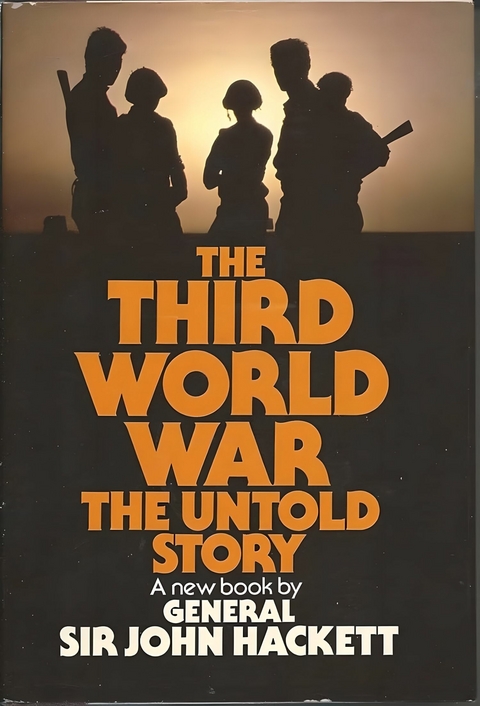
The Third World War (eBook)
394 Seiten
Publishdrive (Verlag)
978-0-00-107006-6 (ISBN)
Sir John Hackett re-examines his hypothetical scenario for World War III, incorporating the technological advances made in the four years since the publication of his book The Third World War: August 1985. The book also provides an inside look at the Soviet Politburo and the Red Army, due to input from a Soviet defector.
THE WORLD IN FLAMES - Chapter 1: Dies Irae
There could not have been many people in Western Europe or the United States who were greatly surprised when they learned from early TV and radio broadcasts on the morning of 4 August 1985 that the armed forces of the two great power blocs, the United States and her allies on the one hand and Soviet Russia and hers on the other, were at each other’s throats in full and violent conflict. Preparation for war, including the mobilization of national armed forces, had already been proceeding for some two weeks in the West (and for certainly twice as long in the countries of the Warsaw Pact) before the final outbreak. Yet the magnitude of the assault when it was first felt in its full flood and fury was none the less astounding, particularly to those in the Western world (and these were the majority) who had paid little attention in the past to portents for the future. Bombs were bringing death and devastation on the ground, aircraft exploding into fiery fragments in the sky. Ships were being sunk at sea and the men in them hammered into pulp, electrocuted, burned to death, or drowned. Other men, and many of them, were dying dreadfully in the flaming clamour and confusion of the land battle. Yet another world war had burst upon mankind. While the course of life in the short three weeks of the Third World War had no time to be as radically affected as in the five or six years of each of the first two, the consequences of this war were likely to be more far reaching than any before it.
World war had really been inevitable since the Soviet incursion into Yugoslavia on 27 July, the event which had brought about the first-ever direct clash between Soviet and United States troops on a battlefield. Moscow had long sought a favourable opportunity to reintegrate post-Tito Yugoslavia into the Warsaw Pact, in the confidence that the frailty of the union when its creator had gone would in good time furnish a suitable opening for intervention. As the cracks in Yugoslavia began to widen, particularly between Slovenia and the Federal Government in Belgrade, the Soviet sponsored so-called Committee for the Defence of Yugoslavia had most injudiciously staged an unsuccessful punitive raid into Slovenia. The Committee called for Soviet help and the opportunity was seen to be at hand. Within days Soviet units were in action against US forces from Italy. Fearful of the consequences if this crisis should get out of control, Washington had tried hard to cool it down and keep it quiet, but in vain, ENG (electronic newsgathering) film smuggled out by an enterprising Italian cameraman, showing US guided weapons destroying Soviet tanks in Slovenia, was flashed on TV screens across the world. Few viewers in the West even knew where Slovenia was. Fewer still doubted that the two superpowers were sliding with rising momentum towards world war.
There was no question where the focal point of any conflict between the armies of the two great power blocs would lie. It would be in the Federal Republic of Germany, where the Group of Soviet Forces in Germany (GSFG), largely stationed in what was known as the German Democratic Republic (GDR), faced the considerably weaker NATO forces of Allied Command Europe (ACE), in what NATO called its Central Region. It was in the GDR that the Warsaw Pact was even now staging manoeuvres of impressive size, so large as to arouse at first strong suspicion in the West, and then to confirm, that this was really mobilization in disguise. The manoeuvres had been notified to other powers, in accordance with the Final Act of the Helsinki Conference on Security and Co-operation in Europe. Some smaller though still considerable manoeuvres of the Southern Group of Soviet Forces in Hungary had not. It was from these that one airborne and two motor rifle divisions had moved into Yugoslavia.
The move into Yugoslavia was very nicely calculated by the Soviet Union. If the West did nothing to oppose it, a quick and easy gain would result, not of critical importance but useful, if only as a rough and timely warning to Warsaw Pact allies. If the West did oppose it with force, this would constitute an attack on a peace-loving socialist country that would justify the full-scale defensive action against NATO, as the aggressive instrument of Western imperialism, for which the Warsaw Pact was already in an advanced state of preparation. The fighting between Soviet and US forces in Yugoslavia could very easily be presented as evidence of imperialist aggression.
The war, which some believed had begun already in Polish shipyards, mines and factories the previous November,* was now a certainty and could not be long delayed. The NATO allies tried strenuously to complete their own mobilization, which had begun in the Federal Republic on 20 July, in the United States on 21 July, in Britain (where the co-operation of the trade unions - led by England’s leading Luddite-was not at first certain) on 23 July, with other allies following suit. In Britain in addition a strong and vigorous Territorial Army was constitutionally embodied and the lately formed but already highly effective volunteer Home Service Force, whose purpose was defence against both invasion by external forces and internal subversion, was activated.
*See General Sir John Hackett and others, op. cit., ‘Unrest in Poland’.
The agreement of governments to evacuate from Germany the dependants of American and British service personnel and other civilian nationals was given, with inevitable reluctance, on 23 July, and they began to move out on 25 July. Reinforcements for the United States Army in Europe (USAREUR) began arriving by air from the United States on the same day, together with the first reservists for the formations in I and II British Corps, the latter, formed in Britain in 1983, having most fortunately been deployed in good (though not full) strength for exercises in Germany at the beginning of the month.
On the morning of 4 August 1985, there were many in European cities who had heard (with quite a few old enough to remember) how it had been when people were told in September 1939 in much the same way, if without TV, that we had again a world war on our hands. People in the United Kingdom, for example, had then slung on their mandatory gas masks and taken up their tin hats, if their duties required it, in the full belief that the end was very near. In 1985 those with access to a fall-out shelter tended to make for it, or at least to see that it was in order and well stocked, while those without wondered rather glumly whether it had been wholly wise to disregard advice about survival under nuclear attack. In the cities of Europe in both wars the worst was expected at once. In neither did it happen - not immediately anyway.
Some of the towns and cities in Western Europe had not long to wait for the thunderous, irregular, ear-splitting crash of Soviet bombardment from the air, and the agonizing uncertainty over who was still alive at home, or even where home was in the street now turned to rubble. The places first attacked were those of importance in the movement of NATO troop reinforcements to the European mainland. Channel ports in Britain, and in Belgium and the Netherlands, though not yet in France, received early and violent attention on the very first day from long-range missiles launched from Soviet aircraft. Coastal airfields, especially those handling military transports, and the air traffic control centre at West Drayton near London were among early targets struck. The United Kingdom Air Defence (UKAD) Command, with its complex of warning systems, interceptor aircraft squadrons and gun and missile defences, was fully extended practically from the start. It was almost overwhelmed at first by the volume of attack upon defences that had never yet been brought to the test in this new type of war, in which computer response and missiles had replaced the searchlight and visually-aimed guns of earlier days.
Operations in the north, up as far as the Arctic Circle, opened at once on account of their relevance to trans-Atlantic reinforcement. Attacks on Atlantic ports soon followed, swift moments of appalling noise, leaving, in a silence broken only by the crackling sound of gathering fire, the twisted steel of harbour installations with little houses near the docks reduced to burning shells. As the Soviets gained airfields to the west, it was felt upon the French side too, with Brest and the Channel ports joining Glasgow, Bantry, Bristol and Cardiff on the list of towns hit.
It had taken the Soviets almost a full day to realize that, against their hopes and expectations, they had a belligerent opponent in the French Republic. Moscow had firmly believed that the French, pursuing as always the national self-interest with a single-mindedness unequalled anywhere, would find it more prudent to keep out. Yet for all the obstacles set in the way of Western defensive co-operation by de Gaulle’s withdrawal from NATO, and for all the reliance the Soviet Union had placed upon some years of left-wing government in France, the French Republic abided most faithfully by its obligations under the Atlantic Treaty.
In spite of assurances broadcast worldwide from Moscow that France would remain immune from attack if it remained neutral, and that the punitive and prophylactic operation undertaken by the USSR against NATO would in that event go no further than the Rhine, II French Corps in Germany had already been quietly placed by the French Government under the full command of the Supreme Allied Commander Europe (SACEUR) on the night of 3/4 August. Three further divisions and an army headquarters soon followed, with the French Tactical Air Force also placed under command for the support of French ground forces. French ports,...
| Erscheint lt. Verlag | 1.10.2025 |
|---|---|
| Sprache | englisch |
| Themenwelt | Literatur ► Romane / Erzählungen |
| ISBN-10 | 0-00-107006-1 / 0001070061 |
| ISBN-13 | 978-0-00-107006-6 / 9780001070066 |
| Informationen gemäß Produktsicherheitsverordnung (GPSR) | |
| Haben Sie eine Frage zum Produkt? |
 EPUB (Adobe DRM)
Größe: 4,2 MB
Kopierschutz: Adobe-DRM
Adobe-DRM ist ein Kopierschutz, der das eBook vor Mißbrauch schützen soll. Dabei wird das eBook bereits beim Download auf Ihre persönliche Adobe-ID autorisiert. Lesen können Sie das eBook dann nur auf den Geräten, welche ebenfalls auf Ihre Adobe-ID registriert sind.
Details zum Adobe-DRM
Dateiformat: EPUB (Electronic Publication)
EPUB ist ein offener Standard für eBooks und eignet sich besonders zur Darstellung von Belletristik und Sachbüchern. Der Fließtext wird dynamisch an die Display- und Schriftgröße angepasst. Auch für mobile Lesegeräte ist EPUB daher gut geeignet.
Systemvoraussetzungen:
PC/Mac: Mit einem PC oder Mac können Sie dieses eBook lesen. Sie benötigen eine
eReader: Dieses eBook kann mit (fast) allen eBook-Readern gelesen werden. Mit dem amazon-Kindle ist es aber nicht kompatibel.
Smartphone/Tablet: Egal ob Apple oder Android, dieses eBook können Sie lesen. Sie benötigen eine
Geräteliste und zusätzliche Hinweise
Buying eBooks from abroad
For tax law reasons we can sell eBooks just within Germany and Switzerland. Regrettably we cannot fulfill eBook-orders from other countries.
aus dem Bereich