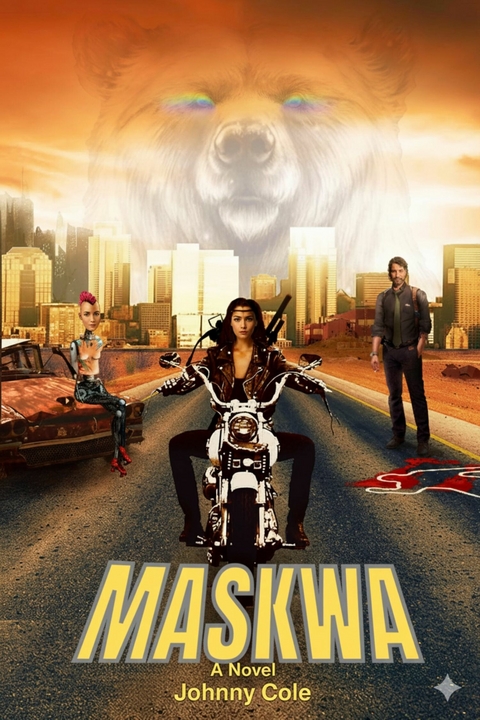
Maskwa (eBook)
335 Seiten
Publishdrive (Verlag)
978-0-00-106612-0 (ISBN)
In a near-future America where dust storms rage and water is scarce, Alaska Rainmaker rides the wasteland as a bounty hunter, tracking down criminals with her motorcycle and lasso. Part Cree, part Welsh, and wholly determined, she lives with seizures that bring visions of her ancestors - and the night her mother was murdered twenty years ago.
When bodies start appearing with crosses carved into their foreheads, Alaska reluctantly partners with her estranged father, Detective Jake Morse, to hunt the Copycat Killer. This serial murderer wears masks modeled after history's most notorious killers while targeting seemingly random victims. As the investigation deepens, Alaska and Jake work to uncover the connection between the murderer, the victims, and the mysterious death of her mother.
But the true horror runs deeper than human evil. Alaska must confront the Wetiko - an ancient Indigenous entity that possesses the spiritually wounded, transforming them into cannibalistic and narcissistic humans that feed on the innocent. Armed with her grandmother's teachings about bear medicine and guided by the spirits of Amazon river dolphins, Alaska transforms from a modern bounty hunter into a traditional medicine woman.
Meanwhile, her father's android partner, Ama, dreams of American citizenship and road trips. Climate activist Rachel Lamont broadcasts the truth through underground podcasts, and the mysterious Gemini Moon-a blue-skinned healer with six passports - works to heal trauma survivors, preventing further injury from Wetiko-possessed humans and society. Her motto is 'Grow through what you go through.'
'Maskwa' weaves together multiple genres - Indigenous spirituality meets cyberpunk technology, hard-boiled detective work collides with shamanic vision quests, and climate fiction merges with supernatural horror. The novel explores themes of generational trauma, the ongoing impacts of colonization, environmental collapse, and the power of Indigenous wisdom to heal both personal and planetary wounds.
Set against a backdrop of dust storms and digital surveillance, protest movements, and ancient prophecies, 'Maskwa' tells the story of a mixed-blood woman who must embrace her full heritage, including her lightning spirit and personal trauma that causes her seizures, as well as the bear medicine that makes her a healer. Her grandmother advises her that to defeat an evil that has been feeding on North America since the first colonizers arrived, you must face it 'from your scar, not your wound, and it can only destroy, if it can distract you.'
This is Indigenous futurism at its most visceral: a vision of what it means to be a rainbow warrior in the twilight of empire, where the old ways and new technologies merge in the fight for survival and justice.
The Cabin
Meanwhile, miles and eons away from the city's quick, chronic chaos, Alaska wove her motorcycle along a winding country road, flanked by hills draped in pine and vibrant, green grass. Wildflowers nodded in the breeze, and birds scattered as she rode past, cutting through the tranquility in a streak of leather, metal, and speakers rolling out Aguila y Condor by Arthur Mena – an ode to a Q'ero prophecy from the Peruvian Andes that she had heard about. It was a prophecy where the Indigenous peoples of the Americas would unite under the wings of the condor and the eagle, ushering in an era of peace and prosperity. Although that concept-vibe was currently beyond her personal grasp, she thought about that possibility as she turned down a familiar dirt road. At the end of the road, she entered an expansive meadow, alive with memories: hers, her ancestors, their ancestors, and the ancestors of Mother Earth.
The meadow opened up to a small lake that mirrored the sky so perfectly it felt like she was riding into an in-between world. It was a blend of spirit, earth, and imagination that enabled her to escape or dream whatever she wanted it to be.
At the water’s edge, a cabin stood like an old friend: rustic, weathered, and cozy. She pulled in close and parked, kicked the stand, unstrapped her helmet, and took a long, bone-deep breath. The kind of breath that drew from somewhere deep in her heart, drawn from the earth itself. She looked around, feeling and knowing she was home.
Alaska entered the cabin and pressed a small button near the door. With a click, the shuttered windows opened in unison, bathing the cabin in natural light. The space was simple: wooden beams, a small kitchen, a bathroom, and a bedroom. The living room featured a fireplace, a couch, a coffee table, a flat-screen TV, speakers, and shelves cluttered with gear and keepsakes. The cozy air caught the faint scent of cedar and sage, and the residue of burnt firewood lingered around the walls.
She dropped her saddlebag and slung her lasso onto a wall rack lined with other ropes, each intricately knotted and worn with use. Her jacket came off next, revealing a faded Buffalo Calf Road Woman T-shirt. The image beamed from her chest in printed defiance in honor of the Northern Cheyenne warrior woman, who, as legend has it, was the one who downed General Custer at his last stand during the Battle of the Little Bighorn. Alaska could relate to buffalos, calves, roads, women, and being someone else’s last stand.
Alaska looked around, then instructed, “Abacus, light the tree.” A beep answered. Abacus, her cabin’s computer system, surged to life and illuminated the Christmas tree in the corner; ornaments catching the light like trapped stars. Alaska then crossed the room with a stack of ‘Most Wanted’ posters she had removed from her bag and pinned them up on the wall, arranging them beside older bounty posters – her gaze already calculating the odds. Pinned next to the posters were crime-scene photos and clipped, yellowed newspaper headlines of a crime she generally preferred to ignore, but kept up nonetheless.
She stepped back, lit a bundle of sage, the flame crackling softly. The smoke curled through the air as she swept it over a small altar of family photographs. The picture at the center showed her mother, Taino Rainmaker, in her mid-thirties, with old-soul eyes and three tattooed lines extending from each corner – Cree markings of her lineage and her story.
The sage smoke drifted across the room and out the open window, where a child’s laughter, faint and distant, danced through the meadow. Alaska walked over to the window and squinted through the curtain at a dreamy flashback:
A little girl running barefoot through the tall grass, her yellow summer dress fluttering behind her. A long feather dangling from her left ear, the seven-year-old Alaska Rainmaker laughed and spun in circles, fingers trailing over wildflowers. Her joy flickered like an old reel from a home movie.
Then the flashback faded and dissolved.
Alaska’s hand trembled, and her attention was drawn immediately back inside the cabin. She reached into her jacket, pulled out the pill bottle, and shook it. It was empty, and a spike of dread pierced her chest. She ran to the bathroom and flung open the medicine cabinet. Nothing. Then to the kitchen, rifling through drawers, pushing aside jars and boxes. Nothing. Her vision blurred as her legs jellied out. She grabbed a wooden spoon from the counter and dropped hard to the floor, and her body twisted as she shoved the spoon between her teeth and bit down.
The seizure hit violently, her body arching as foamed saliva spilled from the corner of her mouth. Her eyes rolled back into darkness as her inner awareness drifted outside to observe the meadow buzzing with cricket songs in the tall grass, soft as feathers. She could perceive the bees dipping between the sweet nectar of wildflowers and the distant, dreamy blessing of the crystal clear creek beyond the trees. From above, she observed:
Her seven-year-old self was sitting hidden behind a low berry bush, bare feet stained red with fresh juice and fertile dirt. Her cheeks were smeared with the same deep crimson, like finger paint applied spontaneously or by accident. She licked her fingers slowly, savoring the last succulent burst of sweet-tart on her tongue. For a moment, there was only sun, sugar, and bliss.
Then a shadow eclipsed the sunlight, and young Alaska’s eyes blinked upward. Her mother, Taino, stood over her, still and quiet like a dawn about to break. She wore her hair in braids, and a hand-beaded pendant swung close to her heart. “Oh, there you are, Alaska,” she whispered in Cree, with amusement. Alaska jolted upright, her sticky fingers clutching the empty berry basket as she slid it behind her back. Her mouth twisted with guilt in opposition to her eyes, which feigned innocence. She quickly wiped at her face with the hem of her dress, but the red only smeared wider and clown-like.
Taino crouched down, eyeing her closely. “I see you’ve been collecting berries for us again.”
Alaska shook her head, too fast. “No, mama. I didn’t find any.”
Taino raised an eyebrow. “I can see that. They must be all gone.” Her voice dipped, gentle but heavy with knowing. “I wonder what’ll happen when there’s no more berries?”
Alaska squinted up at her. “Will the bears go hungry?”
“Yes. Our Maskwa Ancestors.” Taino tilted her head. “And?”
Alaska fidgeted. “And the foxes will have empty tummies. And the birds’ll stop singing, mama.” As if summoned, a pair of foxes stepped out from the grass. Cartoonish yet alive, with sleek fur and amber eyes. A bluebird swooped down and landed on a stalk nearby, and the meadow opened up like an animated storybook, colored in rich acrylic.
Taino nodded. “What’ll happen to us if we just take, take, take and give nothing back?”
Alaska bit her lip. “Will the Wetiko come?” The foxes nodded, and the bluebird tilted its head and stared at her.
“And what about Mother Earth?” asked Taino.
Alaska solemnly clarified, “She’ll get sick and sad.”
Taino smiled, hiding a more profound and older wisdom. “That’s right. That’s why we take care of each other and all our relations.”
Taino reached out, lifting Alaska and her empty basket, and they walked hand in hand through the waist-high grass. On Taino’s back, embroidered into her shirt, a bear danced among constellations. When Alaska glanced over, the bear winked at her. “Mama,” she asked nervously, “have you ever seen a real Wetiko?”
The sun dimmed, and clouds rolled in like wolves as Taino leaned in close, her voice low and mischievous. “Oh yes,” she said. “It has dead black eyes and pale, sickly skin, with claws sharp enough to skin and possess the spirit from your bones. It can barely breathe and continually gasps for air. Its chest is a hollow cage, because no matter how much it eats, it’s always hungry. So hungry it will even chew on its lip and eat itself, even after it eats you. She twisted her face, bared her teeth, and playfully lunged. “Rawrr!” Taino growled gleefully. Alaska squealed with delight, then bolted toward the cabin. Taino chased after her, growling like a cartoonish, possessed beast.
And the imagery slowly faded away.
Back on the cabin floor, Alaska jolted alert as her spirit crashed back into her adult body. Her hands shook as if the electricity hadn’t entirely left, and her chest rose sharply beneath her sweat-soaked shirt, as her breath tore back into her lungs like a whip crack. Her eyes flew open: wild, disoriented, and re-awakened. Her tongue felt like steel wool, and her brain became a storm of scrambled signals. The wooden spoon clattered from her mouth as she ripped it free and dropped it on the floor. Strings of saliva trailed from her cheek, which she wiped away with the back of her trembling hand. She looked around, and the cabin felt distant, as though it had pulled back to give her space to return from wherever she had gone.
Still breathing hard, she staggered over to the open cabin door, looked out, and surveyed the meandering meadow to see what, if anything, she could remember. Pulling off her boots and socks to reveal her blistered, bare feet, she instructed Abacus to play Save It For Later by Eddie Vedder through the cabin's outdoor speakers and stepped outside.
Her toes felt refreshed as she walked across the music–filled meadow, which she had done countless times since the day she lost her mother...
| Erscheint lt. Verlag | 28.9.2025 |
|---|---|
| Sprache | englisch |
| Themenwelt | Literatur ► Krimi / Thriller / Horror |
| ISBN-10 | 0-00-106612-9 / 0001066129 |
| ISBN-13 | 978-0-00-106612-0 / 9780001066120 |
| Informationen gemäß Produktsicherheitsverordnung (GPSR) | |
| Haben Sie eine Frage zum Produkt? |
 EPUB (Adobe DRM)
Größe: 3,3 MB
Kopierschutz: Adobe-DRM
Adobe-DRM ist ein Kopierschutz, der das eBook vor Mißbrauch schützen soll. Dabei wird das eBook bereits beim Download auf Ihre persönliche Adobe-ID autorisiert. Lesen können Sie das eBook dann nur auf den Geräten, welche ebenfalls auf Ihre Adobe-ID registriert sind.
Details zum Adobe-DRM
Dateiformat: EPUB (Electronic Publication)
EPUB ist ein offener Standard für eBooks und eignet sich besonders zur Darstellung von Belletristik und Sachbüchern. Der Fließtext wird dynamisch an die Display- und Schriftgröße angepasst. Auch für mobile Lesegeräte ist EPUB daher gut geeignet.
Systemvoraussetzungen:
PC/Mac: Mit einem PC oder Mac können Sie dieses eBook lesen. Sie benötigen eine
eReader: Dieses eBook kann mit (fast) allen eBook-Readern gelesen werden. Mit dem amazon-Kindle ist es aber nicht kompatibel.
Smartphone/Tablet: Egal ob Apple oder Android, dieses eBook können Sie lesen. Sie benötigen eine
Geräteliste und zusätzliche Hinweise
Buying eBooks from abroad
For tax law reasons we can sell eBooks just within Germany and Switzerland. Regrettably we cannot fulfill eBook-orders from other countries.
aus dem Bereich