


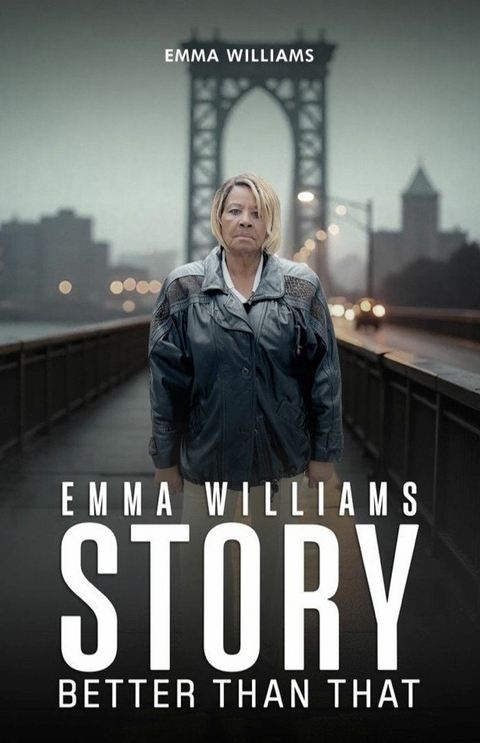
Emma Williams Story Better Than That (eBook)
144 Seiten
Bookbaby (Verlag)
979-8-3178-1932-3 (ISBN)
Emma Williams is an author from North Carolina. 'Better Than That' is her debut novel.
"e;Better Than That"e; is a powerful memoir of endurance, transformation, and the quiet strength that carries us through life's hardest moments. From her early years in Spring Hope, North Carolina, Emma Williams recounts a life shaped by generational hardships, personal loss, and resilience passed down through her family. Raised in poverty and burdened by emotional trauma, Emma's journey is not only filled with adversity-but persistence as well. She reflects on her complicated relationship with her mother, the pain of hidden abuse, and the struggles of a turbulent marriage that challenged her spirit. Searching for a fresh start, Emma moved to Newark, New Jersey, where she faced the realities of being a single mother, discovered the tough truths about love and trust, and relied on faith to keep moving forward. Her story is both personal and widely relatable, as if offers honest insights into survival, healing, and reclaiming self-worth. Told with clarity, humility, and heart, "e;Better Than That"e; is more than just a memoir it's a testament to rising above circumstance, confronting the past, and building a future ground in strength and self-belief.
Chapter 1
The Beginning
I suppose if I’m going to tell my story, I should start at the very beginning—with my parents, their histories, and the long line of people that came before them.
Spring Hope, North Carolina, has always been a small town with a population that has barely changed over the years. Even now, it sits at around 1,358 people as of 2024. The town is peaceful, quiet, and calm—like a place frozen in time. The people, too, have stayed much the same. Despite a few new businesses, most of the town remains unchanged. Even now, it still feels like something out of the 18th century. While some businesses have come and gone, the overall structure and atmosphere have stayed the same. One of the long-standing establishments in town is Williams Toney Funeral Home, which is owned by my mother’s family and which has been in business since the 18th century. It started with Jack Toney, and the business has remained in the family ever since.
My father, Sam Luther Drewery, was born on August 30, 1912, in Nash County, North Carolina to Edna Morgan and Dennis Drewery. He was about 5’10”. He had caramel brown skin and thick wooly hair. His relatives would joke around with him and call him “bear hair.” That’s how tight his coils were! My father was an easy going person. He would always joke and laugh, and he always had a story to tell. He was born the same year the British luxury ship, the Titanic, set off on its first and only voyage. On April 15th of that year, it struck an iceberg on its way to New York, a tragedy that became one of the most infamous maritime disasters in history. That same year, in Nash County, North Carolina, my father entered the world, his birth overshadowed by loss.
His mother, my paternal grandmother, Edna Morgan, passed away during childbirth, leaving him and his older brother, Luke Drewery, to be raised by their extended family. Their father, Dennis Drewery, my paternal grandfather, wasn’t the one to raise them. Instead, Luke and Sam were taken in by their mother’s brother (their uncle), Frank Morgan, and their maternal grandparents, Tom Morgan and Ann Vicks.
The Morgans had a history rooted deep in the land. My great-grandparents, Tom and Ann, were born into slavery under a landowner named Finch in Nash County. After emancipation, they stayed on the land, farming over 250 acres, clearing wasteland, and maintaining about 146 acres of meadow. The Morgan Farm was a place of hard work, survival, and perseverance, and it’s where my father spent his early years.
But at twelve years old, my father left his uncle Frank’s home and moved in with his paternal uncle, who was his father’s brother—Granville Drewery. Granville and Dennis’s father, George Drury, had come from a long line that stretched way back to England. In fact, the Drury name itself has a history dating as far back as the Battle of Hastings in 1066! It’s a name that carries weight in England, but for my father, it wasn’t the name that shaped him—it was the life he lived.
Although the name Drewery does have military historic roots in France among the black French people during 1700s and 1800s, the spelling of George’s last name was legally changed in the states from Drury to Drewery when he married a black woman by the name of Rixie Taybron. Dennis was one of the children they had together. When she died, he then married her sister Amandy Taybron, and Granville was one of the children they had together.
My belief is that the government changed the spelling of George’s last name for the Census, which was created in 1790. During that time, one of the main purposes of the Census was data collection and it collected information on six categories—free white males, free white females, free white males under 16, all other free persons, and slaves. George appeared to be a white man, but he was not fully white. And marrying a black woman means that he would one day have black children. I believe the government knew of the history of the Drewery blacks in France. But I do not know for certain.
John Drury, a white man, who was George Drury’s father, my great-great grandfather, married Hannah Carlton. She was a mulatto woman born in England. John and Hannah moved to Michigan at some point, where they began to start their own family and have children. George Drury was their youngest son and was born on December 24, 1846 in Michigan. At some point in his life, George moved to North Carolina, which is where he died.
John Drury came from a long line of people who had served in England’s military and royal service. The Drury name has an extensive history dating back to the Norman conquest. Tracing our lineage further, my ancestors were connected to England’s nobility and military service, particularly during the reigns of various English kings. However, the details of which king specifically granted titles or land to my family require more research. What is certain is that the Drury’s played a significant role in England’s history before eventually settling in America.
My mother, Lizzy Brinkley, came from a large family. She had three brothers: Willard, known as "Bro"; William, called "Wee Boy"; and Roosevelt, who was nicknamed "Bell." She also had six sisters: Sally, Sarah, Mattie also known as Aunt Kay, Louise, and Ida. The youngest was Willie Mae, named after my grandfather.
My mother was a force to be reckoned with. She had black, long wavy hair that fell about five or six inches past her shoulders, an oblong-shaped face, and a dark complexion. She was a beautiful woman. She was sturdy, weighing around 240 pounds, and had a serious, mysterious look about her. She could see right through a lie and wouldn’t tolerate nonsense. If she doubted your words, she’d say, "You better come better than that," and you knew you had to get your story straight.
At the same time, she was incredibly giving—she’d give the shirt off her back to help someone in need. But her kindness didn't mean weakness; she could shift her tone depending on the situation and everyone knew what time it was. My mother didn’t take any mess from anyone! That strength, I believe, is part of what kept me silent for so long. I didn’t want to hurt my mother—I loved her deeply. People often say, "I love Mama," and that was true in every sense for me.
My mother and her family lived near the Atlantic Coastline Railroad, the same tracks she would later run down when she was 19 to meet my father. Her sister, my Aunt Kay, had begged her not to go. My father’s reputation had already reached their town—rumors that he was married and had another family. My mother, however, was not one to be swayed by warnings. She had already given birth to her first son, Robert, in 1946, and the idea of staying home under her family's watchful eye did not sit well with her. Tradition dictated that the child of a young mother, especially one unmarried, should remain under their grandparent’s care for the sake of the child. My mother was determined to leave. She left, running down those tracks toward the man who would become her husband—despite all odds and against her family’s wishes.
When she arrived, she found my father living in what my Aunt Kay called a "chicken shack"—a tiny, barely-there house that seemed to confirm her worst fears. But my mother was a woman of pride and resilience. If she had doubts, she never let them stop her. She had a way of making something out of nothing and turning the most modest places into a home.
My mother had twelve children with my daddy. I was born in 1948, followed by my sister Mattie Lean in 1949. Then 1950 came around, and my mother didn't have a baby that year, likely because of the hard labor she endured. She worked like a man in the fields, doing the backbreaking work of farming. I remember watching her handle tobacco, a crop that demanded long, grueling hours. In those days, the harvested tobacco would be placed on a sled pulled by a mule or horse and then transported to the barns for curing. Workers would stand at a frame called a "tobacco horse," where they looped the leaves onto sticks for drying. My mother worked right alongside the men, never complaining, always pushing forward.
In 1951, my mother had my brother Willie Earl, followed by Dennis Ray in 1952, Mary Edna in 1953, my brother Sammy Lee in 1954, and there were no births in 1955. She had my sister Ann in 1956, followed by Mattie Bell in 1958. She had her next daughter Lizzie Mae in 1959, Connie in 1961, Diane in 1963, and Betty Jean in 1964. My mother did not birth any children in 1957, 1960 and 1962, although she did have miscarriages in those years.
My mother's father, Willie Brinkley, was born in July 1896 and passed away on February 13, 1982, in Nash County. He was a short, bow-legged man with a gentle spirit. I never once heard him say anything unkind. He didn't have much—he was a farmer, after all—but he carried himself with dignity. My brother once told me that he had a habit of collecting loose change he found on the ground. He would wrap the coins in a small cloth and tie it to his walking stick, carrying it with him everywhere.
My mother’s paternal grandfather (my great-grandfather), James Eugene Brinkley, was born in 1869 in Nash County and died on June 17, 1930, in Spring Hope, North Carolina. His wife, my great-grandmother, Ella Wright Brinkley, was born in 1872. Though I don’t know much about her, I do know that my great-grandfather passed before my great-grandmother. They were both born during the Civil War era, a time that shaped so much of our family's history.
My mother’s mother, Mattie Hendricks, was born in 1899 and passed away in 1957. I remember my...
| Erscheint lt. Verlag | 10.10.2025 |
|---|---|
| Sprache | englisch |
| Themenwelt | Literatur ► Biografien / Erfahrungsberichte |
| ISBN-13 | 979-8-3178-1932-3 / 9798317819323 |
| Informationen gemäß Produktsicherheitsverordnung (GPSR) | |
| Haben Sie eine Frage zum Produkt? |
 EPUB (Ohne DRM)
Größe: 505 KB
Digital Rights Management: ohne DRM
Dieses eBook enthält kein DRM oder Kopierschutz. Eine Weitergabe an Dritte ist jedoch rechtlich nicht zulässig, weil Sie beim Kauf nur die Rechte an der persönlichen Nutzung erwerben.
Dateiformat: EPUB (Electronic Publication)
EPUB ist ein offener Standard für eBooks und eignet sich besonders zur Darstellung von Belletristik und Sachbüchern. Der Fließtext wird dynamisch an die Display- und Schriftgröße angepasst. Auch für mobile Lesegeräte ist EPUB daher gut geeignet.
Systemvoraussetzungen:
PC/Mac: Mit einem PC oder Mac können Sie dieses eBook lesen. Sie benötigen dafür die kostenlose Software Adobe Digital Editions.
eReader: Dieses eBook kann mit (fast) allen eBook-Readern gelesen werden. Mit dem amazon-Kindle ist es aber nicht kompatibel.
Smartphone/Tablet: Egal ob Apple oder Android, dieses eBook können Sie lesen. Sie benötigen dafür eine kostenlose App.
Geräteliste und zusätzliche Hinweise
Buying eBooks from abroad
For tax law reasons we can sell eBooks just within Germany and Switzerland. Regrettably we cannot fulfill eBook-orders from other countries.
aus dem Bereich


