


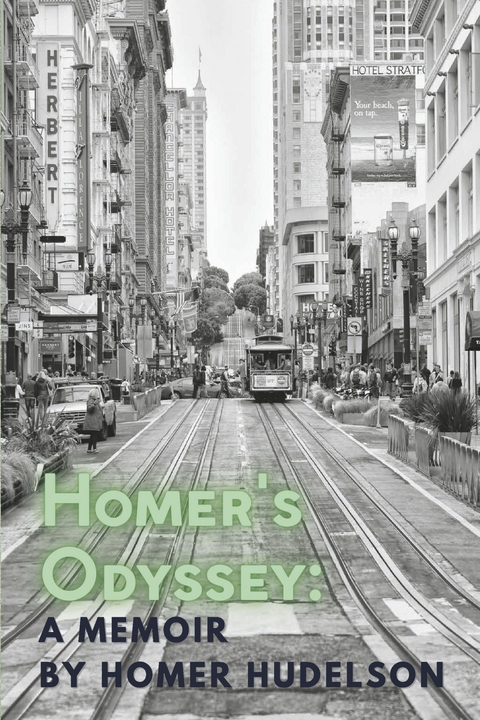
Homer's Odyssey: A Memoir (eBook)
156 Seiten
Bookbaby (Verlag)
979-8-3178-1759-6 (ISBN)
Homer Hudelson grew up in the Outer Sunset District of San Francisco, California in the 1930s, 40s, and 50s. His father died while he was a sophomore in high school. There were no pensions in those days, so with US Savings Bonds, money from his mother's babysitting work, and his newspaper route, Homer attended and was able to graduate from Sacred Heart High School in 1952. The next day, he was hired by the Southern Pacific Company. In 1958, he entered the San Francisco Police Department, and after thirty years of service, retired as a Lieutenant with an exemplary record. He also received three meritorious awards, one being the second highest award given by the SFPD. After retirement, Homer worked part-time with United Airlines and traveled the world. He is known by many for his volunteer role as a Eucharistic Minister at Seton Hospital, his love of golf and Bay Area sports, and his ability to tell one heck of a story.
Homer Hudelson spent 30 years in the San Francisco Police Department and experienced some extraordinary events firsthand, such as the Dan White Riots, the SF State Civil Rights Demonstrations, and the search for the Zodiac killer. In addition to his role as a police officer primarily on a motorcycle in the Traffic Division (and eventually a sergeant and lieutenant), Homer shares trials and tribulations from his childhood in the Outer Sunset of what locals affectionally call "e;The City."e; Homer's experiences range from a hilarious account of someone throwing their false teeth at him from a second-story window to poignant tales of the human condition. Any fan of true crime stories, or even just the history of San Francisco, will surely be entertained by this collection of tales.
Chapter 1
The Early Years
My sister Julia and I were born during The Great Depression in San Francisco California – she on June 22, 1932 and I on December 29, 1933.
My father, Homer C., divorced, married my mother, Adeline Victoria Keller. She had one child, Wendel Rudolph. She found it necessary to have her son raised by her sister, Hilda Bowen, because as a single parent and working as a telephone operator during that era, it became too difficult for her to raise her son. Later, my father indicated that he did not wish to raise him. My mother and father never told my sister nor I any reason for this.
Born in Rich Hill, Missouri, my father came to San Francisco during the Great Depression (1930s) for work and found it with the SF Chronicle Newspaper as a mailer—where the newspapers would come off the conveyor belt and be bundled for distribution.
My parents were simple people. My mother went only to the 8th grade and my father had two years of high school. They did not drink unless they were offered one socially. I never heard them use profanity and they never argued, never. My mother was an especially kind person. My father only used corporal punishment once because I teased my sister.
My mother and father both played the piano. My father would play the piano and my sister and I would sing songs such as “Embraceable You,” “Harbor Lights,” and “Always,” to name a few. My father built me a chin-up bar in the backyard of the house. He also built a punching bag stand in the garage where the punching bag could hang from the above stationary holder. My father could, in rhythmic style, punch the bag with his left shoulder, elbow, hand, and then repeat this same maneuver with his right hand.
Since we lived close to Ocean Beach on 48th Avenue, I would sometimes walk just a few blocks to the ocean to fish. Perch was the easy catch. On one occasion I did catch a striped bass.
Tod Powell, the SF Chronicle Sports Writer, agreed to write an article about a commercial fisherman and his boat harbored in Half Moon Bay. I was lucky enough to get a free trip on the excursion. We all caught black snapper and other fish. However, the highlight of the fishing trip for me was the 24-pound lingcod that I caught; it was almost as big as me! Mr. Powell wrote an article, with a picture of this fish and me. Not bad for an eleven-year-old.
My maternal grandfather, Ludwig Von Keller, became a barber after his arrival from Heidelberg, Germany in the 1930s. He had a barber shop on Haight Street about three houses east of Masonic Avenue on the south side of the street. I remember him cutting my hair with the older handheld type clippers. After cutting my hair, he gave me a round, yellow, hard candy the size of a quarter with a gold wrapper. Its flavor was butterscotch—sweet and tasty. He was able to purchase a home in the outer Sunset with his meager earnings. Haircuts were at that time 25 cents and a shave 15 cents.
Sometimes we would go to his house and listen to opera singers like Enrico Caruso on a Victrola Phonograph Player where we would wind up the phonograph handle before listening to the record.
Desserts and other pastries were served. My mother sang in the SF Choir and, being a Soprano, could sing a High C. My grandfather’s first wife, Louisa Castro, died before I was able to meet her. My mother told me that her grandfather, Castro, was one of the first Sheriffs of San Luis Obispo, a city in California’s Central Coast.
In April in 1850, Sheriff Henry J. Dalley was elected as the first Sheriff of San Luis Obispo County. Francisco Castro shortly thereafter became sheriff of San Luis Obispo.
In Fresno, California, after his arrival from Germany, my grandfather Ludwig, was trying to form a Barber’s Union there when he received the notorious “Black Hand” in the mail often associated with extortion or other intimidation. Later, in his seventies and with health issues, he moved to San Jose, California and purchased a home on North First Street. His daughter Hilda and her husband lived there with him. I remember staying there one summer when I was about 13 or 14 years old to pick apricots. Pay was 10 cents for a large bucket. Three immigrants, husband, wife, and a teenage daughter, worked and lived on the orchard where they built a shack out of wooden trays (used to dry apricots) as their lodgings.
I remember coming home on the bus at around 10 o’clock from an evening show in downtown San Jose — my Aunt Hilda told me that the front door to the house would be opened but the screen door locked; the back door would be open but the back screen door unlocked. After the bus left me off I walked about four blocks to the house. There were no concerns about safety. During the summer the weather was always hot.
Sometime later, my Grandfather Ludwig passed away. At the funeral, union representatives came and showed their appreciation and respect. I inherited his automobile, a brown four-door 1934 Dodge; it had bench-type seats that I believe were more comfortable than the bucket seats in today’s automobiles. It was somewhat damaged. The door handles to this vehicle were toward the front of the door, unlike the door handles of the cars of today.
I used this car to pick up two Catholic Sisters of Mercy—like the ones that taught us at Holy Name Grammar School—and drive them from their Motherhouse on Adeline Drive in Burlingame to St. Stephen’s Church, located on Eucalyptus Drive in San Francisco. A neighbor friend, James Seyler, went along with me. Before driving them to their destination they said prayers for a safe journey and for my safe driving We arrived safely at St. Stephen’s a short time later.
My other grandfather, William T. Hudelson, was from Kansas City Missouri, and was born in 1856. He was a medical doctor and would often take a horse and buggy to visit his patients. His obituary mentioned this and added that he often took the back roads for fear of hostile Native Americans. His wife, Mary Molly Cassidy, was from Meath, Ireland and they had seven children—six boys and one girl. I believe my grandfather had a drinking problem and they divorced. Mary died young from cancer and was forced to give up two of her children to a close friend before she passed away.
My grandfather eventually came to California and became a pharmacist. He lived with my father for a while before he died. My father and grandfather are buried side by side in Holy Cross Cemetery in Colma, California. It was said that before he died, my grandfather converted to Catholicism.
The Pacific Coast League Minor baseball games were played at Sixteenth and Bryant Street. The San Francisco Seals were the home team. I remember seeing one game when Dino Restelli, a home team player, hit a towering fly ball and when the infield gathered around the pitcher’s mound to catch the ball and record the out, no one called for the ball and it dropped near the pitcher’s mound with Mr. Restelli standing on third base with a triple. Hustle, O yeah.
When working odd jobs in my teenage years, I had an occasion to sweep and mop up a barbershop and next door there was a radio shop where I purchased a crystal radio with earphones. It was a simple radio receiver popular in the early days of radio that used only the power of the received radio signal to produce sound, needing no external power. I placed a copper wire antenna in the backyard and my dad and I would listen to the Seals’ baseball games.
Another job I had when I was about fourteen years of age (1947) was working at a meat market on Saturdays. This was from eight in the morning until six in the evening, with an hour off for lunch. I made fifty cents an hour. One Saturday it was busy so we didn’t finish work until six forty-five. I asked my boss for fifty cents for the overtime. He was visibly irritated, but gave me the fifty cents. He also told his brother, Paul Anderson, who was the chief engineer at the SF Ice Skating Rink about my request for the overtime money. Oh well!
My father, being a baseball fan, would take me to the Upper Great Highway, and in the center of the south and northbound lanes would hit fly balls to me, instructing me how to catch them.
I went to Francis Scott Key Grammar School on 43rd Avenue, and later in 1944 my sister, Julia, and I went to Holy Name Grammar School located on 40th Avenue. I entered the fourth grade and my sister the sixth grade The Catholic nuns, Sisters of Mercy, who dressed all in black, were my teachers. My father was Catholic but did not attend Mass — I believe because he was divorced. My mother was baptized a Catholic but followed the teachings of the Lutheran Church and she also did not attend church. In our first year at Holy Name we were baptized into the Catholic Faith; the tuition was $1.00 a month.
It is interesting to note that a classmate of mine at Holy Name School, Gordon Hendrickson, also became a police officer with the San Francisco Police Department. We also both became sergeants and lieutenants. We live close to each other and still see each other at the monthly Veterans’ Police Officers’ Association on Brotherhood Way in San Francisco.
I lived in the Outer Sunset District on 47th Avenue near Irving Street, only a few blocks from the ocean. Around and up the corner from our rented house was the Sunset Theater. My first recollection of admission to the theater in the 1930s was 5 cents. It would then increase to 7 cents, 10 cents, 12 cents, and then to 25 cents.
My parents did not own an automobile; instead, they traveled by streetcar, train, and the Greyhound Bus. In fact, I remember my cousin, Jackie, telling me that my...
| Erscheint lt. Verlag | 1.12.2025 |
|---|---|
| Sprache | englisch |
| Themenwelt | Literatur ► Biografien / Erfahrungsberichte |
| ISBN-13 | 979-8-3178-1759-6 / 9798317817596 |
| Informationen gemäß Produktsicherheitsverordnung (GPSR) | |
| Haben Sie eine Frage zum Produkt? |
 EPUB (Ohne DRM)
Größe: 1,7 MB
Digital Rights Management: ohne DRM
Dieses eBook enthält kein DRM oder Kopierschutz. Eine Weitergabe an Dritte ist jedoch rechtlich nicht zulässig, weil Sie beim Kauf nur die Rechte an der persönlichen Nutzung erwerben.
Dateiformat: EPUB (Electronic Publication)
EPUB ist ein offener Standard für eBooks und eignet sich besonders zur Darstellung von Belletristik und Sachbüchern. Der Fließtext wird dynamisch an die Display- und Schriftgröße angepasst. Auch für mobile Lesegeräte ist EPUB daher gut geeignet.
Systemvoraussetzungen:
PC/Mac: Mit einem PC oder Mac können Sie dieses eBook lesen. Sie benötigen dafür die kostenlose Software Adobe Digital Editions.
eReader: Dieses eBook kann mit (fast) allen eBook-Readern gelesen werden. Mit dem amazon-Kindle ist es aber nicht kompatibel.
Smartphone/Tablet: Egal ob Apple oder Android, dieses eBook können Sie lesen. Sie benötigen dafür eine kostenlose App.
Geräteliste und zusätzliche Hinweise
Buying eBooks from abroad
For tax law reasons we can sell eBooks just within Germany and Switzerland. Regrettably we cannot fulfill eBook-orders from other countries.
aus dem Bereich


