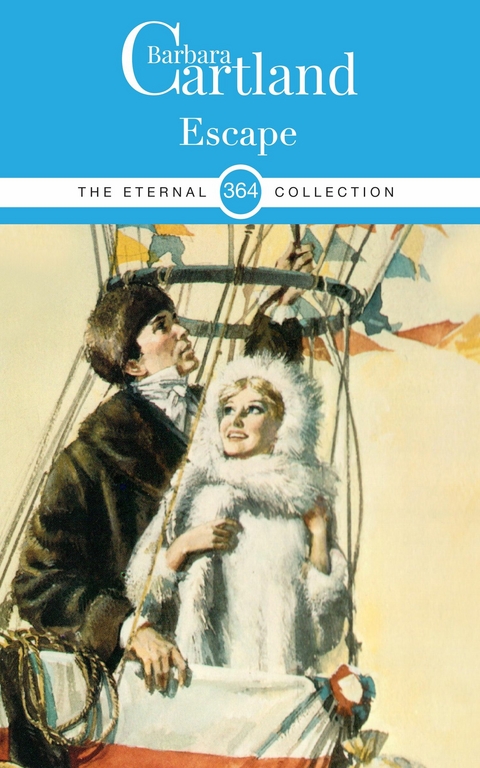
Escape (eBook)
354 Seiten
Barbara Cartland eBooks Ltd (Verlag)
978-1-78867-878-0 (ISBN)
Amidst the storm of the Franco-Prussian War, a desperate woman makes a perilous gamble. The enchanting Miranda Valmont, with her dying mother's fate hanging in the balance, approaches the enigmatic and impossibly wealthy Earl of Kyleston with a most unladylike proposal.
The Earl, weary of scheming London society and staying in Paris to escape the advances of Lady Irene, is intrigued by Miranda's audacity and decides to help her, but when her mother dies, the Earl insists that Miranda should return with him to England. Yet before they can leave, the Earl is injured in a riot outside the Opera House and while he lies unconscious, the Siege of Paris begins and their hoped-for escape seems destined to fail.
Trapped within the city's walls their only hope is a daring and audacious plan. But will their escape deliver them to freedom, or into the arms of something more perilous that the siege itself?
Amidst the storm of the Franco-Prussian War, a desperate woman makes a perilous gamble. The enchanting Miranda Valmont, with her dying mother's fate hanging in the balance, approaches the enigmatic and impossibly wealthy Earl of Kyleston with a most unladylike proposal.The Earl, weary of scheming London society and staying in Paris to escape the advances of Lady Irene, is intrigued by Miranda's audacity and decides to help her, but when her mother dies, the Earl insists that Miranda should return with him to England. Yet before they can leave, the Earl is injured in a riot outside the Opera House and while he lies unconscious, the Siege of Paris begins and their hoped-for escape seems destined to fail.Trapped within the city s walls their only hope is a daring and audacious plan. But will their escape deliver them to freedom, or into the arms of something more perilous that the siege itself?
Chapter One ~ 1870
The Earl of Kyleston walked through the impressive entrance to the finely built house in the Champs-Élysées and said to a servant as he did so,
“Has Monsieur le Vicomte returned?”
“Non, Monsieur.”
The Earl walked into a comfortable salon on the ground floor and almost immediately a footman appeared with champagne and a plate of pâté sandwiches. He looked at them somewhat indifferently, as if he were not hungry, and put them down on a small table beside his chair the glass of champagne without tasting it. Then as he sat back, he told himself he was bored – bored with the audience he had just had with the French Minister, bored with the luncheon at the British Embassy, which had seemed interminable, bored, although it seemed incredible, even with the alluring Horizontale with whom he had spent most of the night.
At thirty-three the Earl was considerably blasé and, as his relatives often said behind his back, spoilt. Everything had been too easy for him from the moment he was born, and the fact that when he was twenty-two he had inherited his father’s title, the huge estates, and the great wealth that went with it, had made life a bed of roses where he was concerned.
He was, in fact, a considerable personality in his own right and, being extremely athletic, excelled at every sport in which he was interested. Most of all, he was a magnificent rider, while his racehorses were first past the winning post in the classic races very much more often than those of his rival owners.
Although the Earl would give his whole mind, his time, and his attention to his horses and his other animals, and there was no detail on his estates or his houses that was too small to receive his consideration, he grew quickly impatient with people. Where women were concerned, his love-affairs never lasted very long. It was, in fact, the evaporation of a love-affair that brought him now from England to Paris.
He had pursued Lady Irene Curtis with an ardour that surprised even himself. She was certainly extremely beautiful and had glowed like a star in the social firmament when she arrived unexpectedly in the middle of the London Season.
Every man who saw her was immediately bowled over by her loveliness, but when the Earl had swept them all to one side, it was not surprising that Lady Irene had succumbed to his persuasions even more quickly than he had dared to anticipate.
Then when she was within his grasp, astonishingly and most unexpectedly he found that she no longer excited him. It was impossible to diagnose in what respect she failed him or why anyone as beautiful as Lady Irene should suddenly cease to attract him. But after a very short period of being her acknowledged lover, he knew he had to escape. Because they had been so talked about and the whole of the Social World was expecting them to announce their engagement, the Earl knew that it was going to be more difficult to extract himself from this particular situation, than it had been from similar entanglements in the past.
The difference was that Lady Irene was of great social consequence and she was determined, almost as fiercely as a tigress at bay, that the Earl should not escape.
The daughter of the Duke of Cumbria, she had been married when she was eighteen to a wealthy young Peer with whom she had little in common. His protestations of undying love were not substantiated by his actions, and being infatuated with the stage, he soon returned to the actresses whose bawdy exuberance was far more to his liking than the ladylike behaviour of his well-bred wife.
Lady Irene was not particularly distressed, as she had found after her marriage, even while living quietly in the country, there were a great number of men only too willing to pay her court.
It was, however, only after her husband’s sudden death in an accident and the subsequent year of mourning, that she had come to London and realised she was able to captivate the most sophisticated and critical society in the whole of Europe. After the strict propriety of the Prince Consort which had made the Court of Buckingham Palace extremely dull, London had begun to burst out into a new era of pleasure-seeking enjoyment.
The Prince of Wales quite openly disclosed that every pretty woman he saw attracted him, and his lead was gladly followed by the majority of the aristocracy. Lady Irene realised almost immediately that she had a wide choice and, having once set eyes on the Earl of Kyleston, she knew she need look no further. Never had she imagined a man could be so handsome, so raffish, and so exceedingly masculine.
She was mad about Thornton Kyleston, and it had seemed as if he felt the same way about her, until quite suddenly, almost as if he had fallen down to earth from one of the new-fangled and much-talked-about balloons, the Earl was bored.
‘I must get away,’ he told himself, but he knew it was going to be difficult.
The one thing he really disliked was recriminations, reproaches, and the unanswerable question, “Why do you not love me anymore?”
He was, however, extremely dexterous in getting himself out of a hole, and a visit to the Foreign Secretary provided him with exactly the excuse he needed to go to Paris.
“To tell you the truth, Kyleston,” Lord Granville had said, “I am finding it very difficult, from the conflicting reports I receive, to know exactly what is going on. You have helped the Foreign Office before, and I should be extremely grateful if you would help us again.”
“I will certainly do my best,” the Earl replied, “but I should have thought it was pretty obvious that the Germans intend business, while the French, as usual, are being frivolous about it.”
“You may be right,” Lord Granville agreed. “At the same time, knowing your shrewdness in matters like this, I shall wait eagerly to hear what you have to tell me.”
He paused before he added,
“Use the usual code and make sure that any messenger you send with your letters is not apprehended.”
“I will take every precaution,” the Earl promised, then added, “What is our Ambassador doing?”
“Shall I say, Lord Lyon is not as communicative as I would wish,” the Foreign Secretary replied with a smile.
“Then I will certainly try not to disappoint you.” The Earl laughed.
Lady Irene was shattered at the news of his departure for France.
“Darling Thornton, how can you contemplate for a moment deserting me when we are so happy and when there are so many marvellous balls to attend?”
The Earl, who disliked balls, managed to reply in what sounded quite a sincere tone,
“You can hardly imagine it is something I positively wish to do, but there are reasons that I cannot explain, but which concern our country, that make it imperative for me to visit Paris.”
Lady Irene’s eyes had widened with surprise.
“Are you telling me you are in the Secret Service, or something like that?” she asked.
“Certainly not!” the Earl said sharply, knowing what a chatterbox she was. “But I do happen to have many friends in ministerial posts in France and, as you know, the political situation there appears to be in somewhat of a mess.”
He knew as he spoke that Lady Irene had not the slightest idea of it, and, if she had, was not interested. But he realised with some relief that he had impressed her, and she therefore did not make as much fuss about his leaving as he had feared.
“Come back quickly, dearest!” she said. “I shall be desperately lonely without you and shall miss your kisses every hour and every minute of every day.”
The Earl thought cynically there was no likelihood of her being lonely. At the same time he realised that, if she had a heart, she was prepared to give it into his keeping, and although it was tiresome, he might have to stay in Paris for longer than he intended. He knew, however, that Paris was at the moment the most thrilling city in the world, and there would be a profusion of beautiful women only too willing to save him from feeling lonely, either by day or by night.
When he arrived in Paris, he went straight to stay with an old friend, the Vicomte de Soissons, who was always delighted to have him, and this at least rescued him from having to stay at the British Embassy, which he would have found intolerably boring. The Vicomte, who was a few years older than himself, managed with the dexterity of the French to have a charming wife whom he left in the country with his children.
He himself lived in Paris, where he was a leading light in the brilliant, witty, and wildly extravagant social set that circled round the Prince Napoleon. At the Prince’s parties the Earl knew he would find the most outrageous and expensive of the dazzling demi-mondaines, who were so experienced in entertaining a man that it was impossible for him to have even a moment’s boredom in their company.
The dinner party last night, the Earl thought, had certainly been amusing, and as there were several distinguished Ministers present, he had learnt quite a lot, which he intended to pass on to Lord Granville by secret code.
He found himself quite entranced by his partner at dinner, whose dark, flashing eyes and jet-black hair, and her skill in giving everything she said a double entendre, made her different in every way from Lady Irene.
Yet, strangely enough, when he left her house as dawn was breaking over the grey roofs of Paris, he found himself yawning, not because he was tired, but because he was thinking that the night had a certain lack of novelty about it. It was almost as if, he thought, he were reading a chapter of a book he had...
| Erscheint lt. Verlag | 1.10.2025 |
|---|---|
| Reihe/Serie | The Eternal Collection |
| Sprache | englisch |
| Themenwelt | Literatur ► Romane / Erzählungen |
| Schlagworte | wartime romance |
| ISBN-10 | 1-78867-878-8 / 1788678788 |
| ISBN-13 | 978-1-78867-878-0 / 9781788678780 |
| Informationen gemäß Produktsicherheitsverordnung (GPSR) | |
| Haben Sie eine Frage zum Produkt? |
 EPUB (Adobe DRM)
Größe: 1,1 MB
Kopierschutz: Adobe-DRM
Adobe-DRM ist ein Kopierschutz, der das eBook vor Mißbrauch schützen soll. Dabei wird das eBook bereits beim Download auf Ihre persönliche Adobe-ID autorisiert. Lesen können Sie das eBook dann nur auf den Geräten, welche ebenfalls auf Ihre Adobe-ID registriert sind.
Details zum Adobe-DRM
Dateiformat: EPUB (Electronic Publication)
EPUB ist ein offener Standard für eBooks und eignet sich besonders zur Darstellung von Belletristik und Sachbüchern. Der Fließtext wird dynamisch an die Display- und Schriftgröße angepasst. Auch für mobile Lesegeräte ist EPUB daher gut geeignet.
Systemvoraussetzungen:
PC/Mac: Mit einem PC oder Mac können Sie dieses eBook lesen. Sie benötigen eine
eReader: Dieses eBook kann mit (fast) allen eBook-Readern gelesen werden. Mit dem amazon-Kindle ist es aber nicht kompatibel.
Smartphone/Tablet: Egal ob Apple oder Android, dieses eBook können Sie lesen. Sie benötigen eine
Geräteliste und zusätzliche Hinweise
Buying eBooks from abroad
For tax law reasons we can sell eBooks just within Germany and Switzerland. Regrettably we cannot fulfill eBook-orders from other countries.
aus dem Bereich