


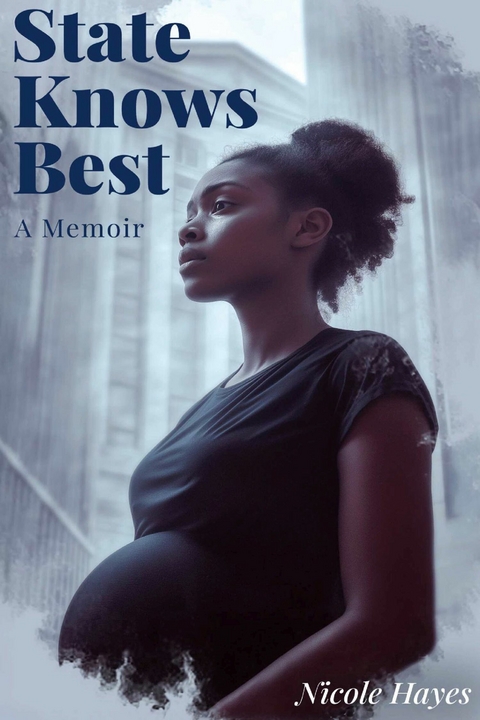
State Knows Best (eBook)
264 Seiten
Bookbaby (Verlag)
979-8-3178-1261-4 (ISBN)
Nicole Hayes is a memoirist and mother of six currently living in Phoenix, Arizona. A former ward of the state, she writes from lived experience with the foster care system, teen motherhood, and the lasting impact of adoption separation. Hayes holds a bachelor's degree in Communications and a master's degree in Elementary Education. Her work blends personal narrative with systemic critique, exposing the flaws of institutions that claim to protect while perpetuating harm. 'State Knows Best' is her debut memoir-written as both an act of healing and a form of protest. She also shares insights about adoption trauma, motherhood, and survival through her growing platform on TikTok under the handle @iwriteallot.
Experience a raw, unflinching memoir that dismantles the glorified narrative of adoption and exposes the deep failures of the child welfare system in America. Told through the eyes of a former foster youth turned teen mother, N. Hayes recounts how, at fifteen years old, the state pressured her to surrender her newborn son framing adoption as "e;selfless"e; while offering no real support, resources, or alternatives. Years later, Hayes learns that her son was never legally adopted. When her attempts to go through the court systems to reclaim her role as a mother end in yet another failure by the state, Hayes is forced to decide how far she's willing to go and what cost she's willing to pay. This memoir isn't about a happy reunion. It's about rage. It's about grief. It's about systems that fail mothers while rewarding strangers for stepping in as saviors. "e;State Knows Best"e; reveals how the state profits from crisis, punishes the poor, and masks exploitation in the language of love. For anyone who's ever been erased, silenced, or told they weren't enough this book speaks back. With fire. With truth. And with a refusal to be forgotten.
Back Story, Or Whatever
There are plenty of valid reasons for me to lie on my bed in my cramped room — the one assigned to me by my newest foster parent — staring at the ceiling, angrily wishing everything about my life were different. I’m fifteen, and my life is in shambles. I suppose it’s been that way since birth. The State took me away from my mother when I was still too young to remember her.
The State then placed me into scary foster homes with pervy dads and older brothers. Thankfully, I’ve gotten pretty good at blocking out a lot, but there’s one foster home I can still vaguely remember.
There was a boy there. As I think about it now and try to recall, I don’t think I ever knew his age. Maybe he was an adult — though to a young child, which I was at the time, any tall person is an adult. And to this day, I’m not 100% sure who he was, but I believe he was their older son. His name was Bobby, and all my mind will let me recall is that he would have me sit in his lap and turn on cartoons. Care Bears. Literally to this day, I don’t want to see a damn koala bear or even a stuffed bear. And I have a slight memory of him coming into the room me and my sister slept in at night. But like I said, I managed to block out a lot.
These were State-licensed and “approved” homes! Homes where me and my sister would sometimes stay together, but mostly, we were separated while we waited for our mother to clean herself up.
Spoiler alert: she never did. And well, now she’s dead. A lifetime of drug use eventually did her in. And in case you’re wondering, “Well, what about your father?” — he was 23 when she was just 15, and he also had a drug addiction and was in and out of prison. I never got to meet him, even though I actually attempted to — twice.
Why did I even want to meet him? I’m not sure I even know. But he died of a fentanyl overdose.
So of course, with these two for parents, the State got involved.
They didn’t get involved to help my mother, in my opinion. Which I think is what she actually needed — being just a child herself. Help. Support. Assistance. Maybe placed in a home herself, since clearly hers was not suitable.
But of course, that’s not what happened.
They snatched us away.
My sister Rebecca is older than me by all of 18 months. Me and her were bounced around for a bit, but eventually we got adopted.
I bet you’re wondering how I came to be lying in a foster home bed, then — if I had already been adopted. A new foster home. One without a dad, which I was thankful for.
Whelp.
Turns out adoptions can be undone.
The family that had adopted me — Elton and Patricia Hayes — were abusive, and that’s just putting it mildly. Me and my sister weren’t even in kindergarten when they adopted us, so we were young. Young with a lot of baggage. And our bags were full of trauma.
Instead of getting me and my sister therapy to help us work through the trauma we had experienced, they compounded it by “disciplining” us. When I wet the bed, I would be spanked and humiliated.
That’s right.
Instead of seeing that something was scaring me — preventing me from getting up and out of bed — I’d get whipped with a skinny belt. Most likely a purse strap.
It wasn’t like I wanted to pee the bed. And even with their rule of no milk or any sort of beverage after dinner, I’d still manage to wet my bed.
I would be made to strip my bedding and hang it outside, and before bed the next day, I’d have to retrieve it from around the side of the house.
I was terrified of the dark.
I’d try to do the task as quickly as possible, my young mind thinking if I was quick, no harm would come to me.
So I’d quickly exit the house through the kitchen back door, run across the patio — making sure not to get close to the pool and fall in — and go to the side of the yard, which had no lighting whatsoever.
These antics were all for nothing, though.
My adoptive brother Jason — my adoptive family’s biological son — would lay in wait for me outside in the bushes, just to scare me.
It worked every time. I was easy to scare.
Other times, when Jason was bored, he would body slam me to the floor.
Random, right?
Not so much.
See, Jason was into football, and he would simply be “playing” — even though I’d be somersaulted in the air, landing on the living room floor with the wind knocked out of me.
He yelled “tackle” first, so… duh, it was all in good fun.
The spankings weren’t the worst, though.
These Christian parents — the ones the State felt were fit to care for me and my sister — would force us into ice baths as punishment. And when Patrica didn’t feel like filling the tub with ice and cold water and holding mine or my sister’s head under, she’d make us kneel on hard tile floors for hours with a paper bag over our heads.
Ensuring we were in pain and disoriented.
Me and my sister would try to whisper to each other, keep each other’s minds off the pain — but if we were caught talking or peeking out from under the bag, we’d get more time.
Sometimes we spent the entire afternoon on our knees with bags over our heads.
I bet you’re wondering who saved us from this torturous treatment. A friendly neighbor? A teacher?
None of the above.
They just got tired of us.
Turns out the State’s return policy is open-ended.
So of course, my 15-year-old self was angry and confused.
I had been sexually abused by foster families I’d been placed in and mentally, emotionally, and physically abused by my adoptive family.
Families that the State certified and gave licenses to.
I was taken away from my mother because she had a drug problem — a victim of the ’80s crack epidemic — but waking up in this bed, pushed against the wall to make room for the bunk beds on the other side of the room and the dresser with drawers that wanted to fall off the hinges every time you pulled them out, with mismatched sheets, a scratchy comforter, and a thin pillow, was upsetting.
Nothing was fair.
Call me ungrateful if you want.
I would’ve rather the State had minded their damn business and left me in my actual mother’s care.
There was no way living with her, even on drugs, could have been any worse than any of the placements the State decided were in my best interest.
After the adoption was terminated, me and my sister were placed back into the system.
Wards of the State again.
Our first stop: a shelter.
Shelters didn’t always have room, so once again, me and my sister were separated. I went through three different temporary placements until my social worker was able to find a placement for both of us together.
Promise House. A Christian-based group home.
The last family I was placed with had been Christians — the father was a pastor even, of a small home-based church — so being Christian didn’t really hold the badge of high morality and integrity people thought it did. Anyone could be Christian.
Me and my sister got kicked out of this group home. My sister was the first to get the boot, though. I followed a few years later.
They said I had anger issues and needed a more therapeutic environment.
You see, in these types of settings — State-run homes or shelters — they didn’t want to deal with an angry child who couldn’t regulate their emotions.
I didn’t know how to regulate my emotions because, while living with my adoptive parents, I wasn’t allowed to have any.
Too hyper or wild? Spanked.
Made the wrong face while being spoken to? Spanked.
Didn’t respond fast enough, react quick enough? Punished.
I had become like one of those beaten and abused dogs you see in the commercials with the sad music in the background. Skittish and afraid. I remember ducking or walking past either of them quickly just to avoid getting hit upside the head.
Going to the shelter changed me.
In the shelter, I saw girls coming in and out of the house as they pleased. Cursing and getting into arguments with staff members — their elders. Authoritative figures.
They were doing things that would’ve gotten me beat and sent to kneel in the corner with a bag over my head for hours. Except… they weren’t getting beat.
As far as I could tell, they weren’t getting consequences at all. Not any real ones.
Deciding they didn’t want what was being offered for dinner wasn’t an issue. They were given the option to make a sandwich or eat a bowl of...
| Erscheint lt. Verlag | 11.9.2025 |
|---|---|
| Sprache | englisch |
| Themenwelt | Literatur ► Biografien / Erfahrungsberichte |
| ISBN-13 | 979-8-3178-1261-4 / 9798317812614 |
| Informationen gemäß Produktsicherheitsverordnung (GPSR) | |
| Haben Sie eine Frage zum Produkt? |
 EPUB (Ohne DRM)
Größe: 614 KB
Digital Rights Management: ohne DRM
Dieses eBook enthält kein DRM oder Kopierschutz. Eine Weitergabe an Dritte ist jedoch rechtlich nicht zulässig, weil Sie beim Kauf nur die Rechte an der persönlichen Nutzung erwerben.
Dateiformat: EPUB (Electronic Publication)
EPUB ist ein offener Standard für eBooks und eignet sich besonders zur Darstellung von Belletristik und Sachbüchern. Der Fließtext wird dynamisch an die Display- und Schriftgröße angepasst. Auch für mobile Lesegeräte ist EPUB daher gut geeignet.
Systemvoraussetzungen:
PC/Mac: Mit einem PC oder Mac können Sie dieses eBook lesen. Sie benötigen dafür die kostenlose Software Adobe Digital Editions.
eReader: Dieses eBook kann mit (fast) allen eBook-Readern gelesen werden. Mit dem amazon-Kindle ist es aber nicht kompatibel.
Smartphone/Tablet: Egal ob Apple oder Android, dieses eBook können Sie lesen. Sie benötigen dafür eine kostenlose App.
Geräteliste und zusätzliche Hinweise
Buying eBooks from abroad
For tax law reasons we can sell eBooks just within Germany and Switzerland. Regrettably we cannot fulfill eBook-orders from other countries.
aus dem Bereich


