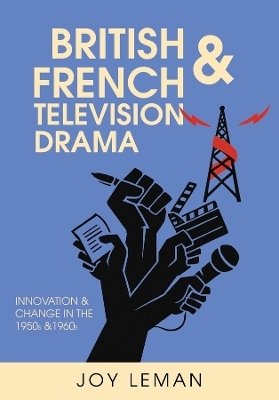
British and French Television Drama
Intellect Books (Verlag)
9781835952733 (ISBN)
- Titel nicht im Sortiment
- Artikel merken
A comparative study of the politics and production processes of television drama in France and in Britain during a formative historical moment for communication systems. This juxtaposition reveals surprising similarities in the intentions and achievements of practitioners in this expanding television field in Britain and France during the 1950s and 1960s.
The post WW2 era marked a substantial shift in socio-political structures and organisation in both countries within a context of change and possibilities for innovative approaches. This study reveals internal struggles within the French and British institutions controlling broadcasting as crucial determinants in the background decision making which constitutes the focus of the study. Analysis of those events indicates how creative initiatives with a social class perspective can penetrate the threads of communication control in a new system, prior to the consolidation of all the determinants of prevalent bureaucratic structures.
This book foregrounds how socially conscious communication practitioners deployed methods intended to retain control of style and meaning in productions in the face of management scepticism and, in some cases, direct interference. The text draws upon oral history contributions plus research documentation and archive material from within the Institutions. Case studies are presented across national and cultural boundaries. These are reinforced by authentic voices and testimonies from personal interviews which I carried out with directors and writers in both Britain and France.
The book provides a unique insight into active engagement, and socio/political judgements used by writers, editors, producers, and directors in reaching out to what was a rapidly expanding audience.
Dr Joy Leman is an independent media researcher working in Britain and France. She previously worked at the University of the Arts, London.
Acknowledgements
Preface
Chapter 1
Introduction
Historical Illusions: Different but the same
Cross-boundary comparison and drawing the lines: problems of method?
Historical Parameters and Public Service Frameworks
Drama as a television genre
Structure of feeling plus social imperative
Questioning the ‘golden age’
The Production Process, and Creative Practitioners
Chapter 2
Democratising culture
Peuple et culture, Télé-clubs and l’État d’Urgence
Cultural intervention, an affair of state: Manifeste des 121
Culture and Class in Britain
Cultural debates and definitions
Cultural activism – France and Britain
The BBC cultural mission
The culture of everyday life: authoritarian structures
The pre-Osborne drought
Angry writers: a catalyst for change?
Watching film in cinema …watching drama on television.
Chapter 3: INSTITUTIONS AND POLITICAL ECONOMY OF FRENCH TELEVISION.
Push pull factors of dramatic control
Comparison
Post-war priorities
Radio – a basic essential of everyday life
Television relaunched – officially.
Five-year plan and a promising future for television
Management structures: with commitment
RTF has landed – with govt control:1958/59
De Gaulle in the living room
De Gaulle, Peyrefitte and the voice of France
ORTF start up: liberalism and dramatic suppression.
Bureaucracy: les bouchons for programme makers
Co-production, the erosion of public service broadcasting- and advertising
May 68, censorship, no AI but transistors, and television drama directors
Return to normal life: sackings and reforms
Chapter Four: The Politics of British Television Drama: Class and Profitable Interventions
Introduction
Social and Historical context: post-war setting for television drama
Institutional priorities: BBC Management
Television has come to stay: a luxury service, or shoestring technology?
Television sets for the people - in Britain - and in France!
Public service, the BBC and centralized control
BBC management and the TV ugly duckling
Collins and McGivern: radio men converted to television
To expand or not to expand, a question of politics and television access
The Coronation, a Ten-Year Plan and competition for the BBC
Programmes for sale, but under strict control:the start of ITV
Regionality, ratings, drama and social class
BBC, competition, and the search for new ideas
Pilkington Report – Good marks generally...but for some, room for improvement
The Greene start-up: The New Young Gladiators of BBC2
BBC culture, industrialization, and the rise of professionalism
Television and Political Happenings
Conclusion
Chapter 5: THE POLITICS OF FRENCH TELEVISION DRAMA: The Liberation Generation
Introduction
Start Up: A Beautiful Future
Management and dramatic changes
Live output, technology, studios and dramatic results
Authenticity: politics and practicalities
Television director as auteur
Liberation Generation and the Institut des Hautes Cinématographiques (IDHEC)
The people’s teachers and public service
Live broadcasts: directors, auteurs, trade unionists, fingers on the buttons
Directors and politics part 1: ‘The strike would be hard and long…’
Continuity genre and codes of politics
Directors and politics part 2: the Lorenzi Affair and political victimisation
Censorship, Drama Directors, and control of production process
Drama Directors and control of the production process
Trade union membership and opposition to de-professionalisation
Television drama: quality and quantity post-1964
The drama of politics: May 68 and the television directors
Conclusions
Chapter 6: Writer, Director, Social Class: new voices in British television drama
Introduction
Writers, class, and the politics of culture: new writers, new drama
Television drama scripts as a try out for theatre and cinema
A sort of writers’ workshop
Crossing the boundaries to interpret reality: the tiny window of television.
Chayefsky and new insights
‘Television needs the writer even more than he needs television.’
The ‘eloquence of the vernacular’, and social class
Writers, politics, and teamwork
Reorganisation for writers
A ‘real organisation of writers’…and no golden age
Mediators and output: writers, producers, agents, gender, control
The writer/mediator conflict
“To get writers we have to woo them…good plays are in short supply.”
Chapter 7
Director, writer, change, and challenge in the drama of French Television
Comparison
The Director: the pivotal profession
The press TV critics and status of the director
The role of the writer
Director, producer: control?
Un des genres télévisuels par excellence: innovation and the politics of drama
Si c’Était Vous : the first Nouvelle Vague production
Les Cinq Dernières Minutes
Television Drama and Political Consciousness: La Camera Explore…
Écriture par l’Image -TV images and reality
Conclusion
Chapter 8
Comparisons
Television relaunch, reluctant government support
The People’s television sets
Political address and drama
Live transmission and recording potential: technology and aesthetics
Public service, literary adaptations and theatrical influences
Innovation, the author, and teamwork
Drama which connects from the left
Power in the studio
Creativity, management, innovative output
Bibliography
Specialist Libraries and Archives consulted
Libraries and archives
Manuscript and other Primary Sources
BBC Written Archives (Caversham)
British Film Institute Library Special Collections
Press Sources
Archive material
Personal Interviews
Index
| Erscheint lt. Verlag | 15.5.2026 |
|---|---|
| Sprache | englisch |
| Maße | 170 x 244 mm |
| Themenwelt | Literatur ► Lyrik / Dramatik ► Dramatik / Theater |
| Kunst / Musik / Theater ► Film / TV | |
| Kunst / Musik / Theater ► Theater / Ballett | |
| Sozialwissenschaften | |
| ISBN-13 | 9781835952733 / 9781835952733 |
| Zustand | Neuware |
| Informationen gemäß Produktsicherheitsverordnung (GPSR) | |
| Haben Sie eine Frage zum Produkt? |
aus dem Bereich