


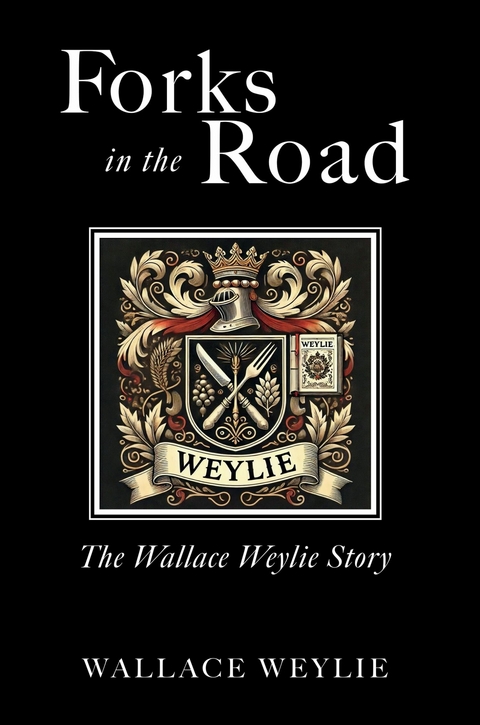
Forks in the Road (eBook)
196 Seiten
Bookbaby (Verlag)
979-8-3178-1448-9 (ISBN)
Wallace Weylie is a member of the Ontario Bar and the Florida Bar. He has two law degrees, from Osgoode Hall in Canada (LLB) and from the University of Detroit (JD) in the USA. He has been awarded the Queen's Diamond Jubilee medal for service to Canadians and served as General Counsel to the Canadian Snowbird Association Inc. since its inception, now over 35 years. He has his commission as an officer in the Royal Canadian Air Force, and is a member of the Phi Delta Phi, the largest legal fraternity in Canada and the USA. He served one term as an elected councilor on the town commission of Bridgeport, Ontario. He is a dual citizen of Canada and the USA. He was the founder of three law firms, in Kitchener and Kincardine, Ontario. As well as Indian Rocks Beach, Florida. He lectured on US Immigration Law in Korea, Jordan and China. He was a member of AILA, the American Immigration Lawyers Association.
This book is dedicated to the present and future WeyliesIn writing this book I am very conscious that everyone has a story whichis important to them, and everyone has had forks in the road. Decisions made at those stages of life determine thecourse of the future, and hopefully the best course is taken. My hope is that the readers will reflect on their lives and think of thoseforks in the road with which they were confronted and appreciate thedecisions they made that set the future for their lives. Wallace Weylie
. 1 .
The Weylies’ Origin
Even though this is the story of my life, I think this book ought to start not with my birth, but with those Weylies that came before me—for the place and situation in which I was born certainly shaped the way I grew up. And hence, the person I became as I grew. It shaped what I went through, who I am, and it might even shape the generations to come. For we are all Weylies, all descendants of those that were brave enough to leave their land and seek new horizons.
The Weylies came from Ireland and moved into Canada, becoming one of the pioneer families in Glanford Township, where they settled in 1864, more than seventy years before I was born. Originally, they came into Streetsville, Mississauga, which is near Toronto. One of the brothers from the original Weylies that migrated to Canada stayed there, making Streetsville his home, while the other moved further south, settling into Glanford Township, which is close to Hamilton, Ontario. This Weylie brother was my grandfather, who moved to Glanford with his family, which included four sons and two daughters. Once the family arrived though, they had to work hard to clear all the trees as the area wasn’t developed yet and it was mostly bush. Weylies were farmers, so this was a necessary step to get the land ready. Sadly, in the process, one of the sons (my uncle) died as a tree fell on him, a tragic accident that left five Weylie children, one of which was my father: Frank Weylie.
Still to this day, the Weylies live on this farmland in Glanford Township, a place I love visiting as it holds so many fond memories.
My father’s origin is important because, while living on the farm, he contracted what was called infantile paralysis back in the day. Today, we know this disease as Polio, which is a highly debilitating condition that can affect the spinal cord, creating different degrees of paralysis—in the worst cases, it’s even life-threatening. In my father’s case, the poliovirus left him crippled on his right side at the age of seventeen, making him unfit to become a farmer like the rest of the Weylies. Frank had a limp on the right side and his right arm also gave him grief, which meant he had to help himself with the other arm when using his right side. This made farm chores impossible for him, changing the course of his life drastically.
My father’s sickness set a bit of a pattern for my life: growing up, every one of my cousins were children of farmers, while I was not. My father had to find other ways to earn his money, his place; he had to find his own way.
At first, my father became what was called the cookie of the farm. His tasks included peeling the potatoes, the carrots, and getting the meals ready while my aunts and uncles did all the farming work. I think this made life very different for him, as while his siblings were out in the barn milking cows and doing farm chores, he was holed up in the house, doing mostly kitchen duties. I believe this influenced his life greatly and it was one of the main reasons why he didn’t marry until he was in his early forties.
My mother, Elizabeth Roberta Weylie, known by her loved ones as Bessie, was a schoolteacher before meeting my father. She taught out in the country where the Weylies’ farm was and lived in a local residence nearby. This residence was remarkably close to the Weylie farm, only next door or across the road, details I’m not sure about. It was due to this closeness that they met—and my mother always claimed she had saved Frank from being the cookie, as marrying was the reason my father got to leave that life behind. When they met and married, they were both in their forties, so I know my parents had a life before that, but unfortunately that is a life I know nothing about. The only thing I know about my mother’s life before meeting my father is that she moved to Ontario from Saskatchewan as I came across a letter written by someone there, recommending Elizabeth for a job as a schoolteacher. I never knew what pushed her to move, which in turn meant she met my father.
Now that I have lived a lot of my own life, I do wish I’d asked more questions, that I knew more about their life from before I was born. Maybe that’s part of the reason why I find myself writing this, too. My parents had over forty years of life before having me, years I know nothing about—years that have been lost and forgotten about.
What happened to my father in his early youth though was what led to me not growing up in a farming background, which would have been my life had my father not contracted polio as a teen. Most of my cousins lived that life, keeping in the Weylie tradition. I believe that was something that positively impacted my life, helping me get to where I am today and opening up possibilities so I could explore other horizons.
Before I came to be, my parents led a good life and they had a nice and big house in Mount Hope, Ontario. Back in the day, a woman was expected to leave her career when she married, which is why my mother didn’t marry until she was older: she wanted to teach, to have a career. I remember asking my aunt about it one day, and my aunt’s answer was: “Oh, yes, your mother had many beaus,” referring to the many men that were around in her life before meeting my father. But she didn’t marry until late, because that would’ve meant giving her career away. She did eventually quit teaching when she married my father and started helping him instead, living as a mother and wife.
While living in Mount Hope, my father was working as a salesman for Watkins Products, which is still in existence today. This company made everything from vitamin pills and linements, to vanilla and all kinds of natural products. My father traveled around the countryside, going door-to-door as a salesperson. But, as my father was crippled on one side, he couldn’t drive so my mother did all the driving instead. At the time, this was very unusual, as not many women knew how to drive back in the 1930s, but my mother was incredibly skilled like that.
Luckily for them and their finances, as my father was from one of the pioneer families in the area, he was very well known, which helped with the sales job. Everybody knew Frank Weylie, so everybody bought from Frank Weylie. He was known, he was trusted. When the war came about, he shifted to selling fertilizers and other products to the farmers, always finding a way to make ends meet. Despite his disability, he made his way. His own way.
Anyway, this is where I show up in the picture, as after my parents got married, they had me: Wallace Weylie. I was born on the 30th of November of 1936—the day of Winston Churchill’s birthday.
Even though they had this big and beautiful property in Mount Hope, my parents ended up moving down to Hamilton after I was born. I’m a little vague on some of those details, more things about those years that I wish I knew more about. What I do remember well is that they owned a place at 19 Gibson Street, in Hamilton, where I spent the first years of my life. I remember being four or five years old, living there, and being a little bugger. There are not many memories I keep from those first years, as I was too young to remember much, but I do recall how much trouble I caused them.
There’s one anecdote that never fails to make me laugh when I think of it: back then, there were streetcars to connect the suburbs and I used to go out and, mind me, I don’t know how, but I’d talk to the driver and they’d let me up. I was only five years old or so at the time, and I’d convince these adult men to let me up and I’d go downtown on my own, riding the streetcar and having the time of my life. My parents would have to find me afterwards and I’ve heard plenty of stories about it. “Where is Wally?” they’d say. “Where’s Wally?” I was such a handful; always was.
I was Frank and Elizabeth’s only child, and honestly, I think I was a miracle baby considering how old my mother was when she had me. Still, not having any Weylie siblings was never a problem, as life brought me amazing friends and some I even got to call brothers; but that’s a story for later.
Our home in Hamilton was a good place, but life would have it that I wasn’t going to be there for a long time. My mother had serious mental health issues; I don’t really know what her diagnosis was, as I was only a child, but I know it made her very combative at times. She’d not only fight with my father, but also with my aunts and uncles. I remember one particular occasion in which she was having a huge fight with my father, it was a battle. I don’t even know what they were fighting over, or if there was even a reason for it. There was always a bit of a division between my mother and my father’s family sides; my mother thought of the Weylies as hicks, as they were from the countryside. And the Weylies saw my mother as a stuck up, as she was an educated teacher from the city that came from a good family. Because of this, there was always a divide there, always a sore subject or a discomfort in the air.
I was in kindergarten when this incident took place, about five or six years old at most. We were downtown in Hamilton and my parents started having a verbal dispute, something I remember as an extremely dramatic time in my life. I never understood why, but my mother took me away and we went to the Hamilton police station, where she...
| Erscheint lt. Verlag | 30.9.2025 |
|---|---|
| Sprache | englisch |
| Themenwelt | Literatur ► Biografien / Erfahrungsberichte |
| ISBN-13 | 979-8-3178-1448-9 / 9798317814489 |
| Informationen gemäß Produktsicherheitsverordnung (GPSR) | |
| Haben Sie eine Frage zum Produkt? |
 EPUB (Ohne DRM)
Größe: 70,4 MB
Digital Rights Management: ohne DRM
Dieses eBook enthält kein DRM oder Kopierschutz. Eine Weitergabe an Dritte ist jedoch rechtlich nicht zulässig, weil Sie beim Kauf nur die Rechte an der persönlichen Nutzung erwerben.
Dateiformat: EPUB (Electronic Publication)
EPUB ist ein offener Standard für eBooks und eignet sich besonders zur Darstellung von Belletristik und Sachbüchern. Der Fließtext wird dynamisch an die Display- und Schriftgröße angepasst. Auch für mobile Lesegeräte ist EPUB daher gut geeignet.
Systemvoraussetzungen:
PC/Mac: Mit einem PC oder Mac können Sie dieses eBook lesen. Sie benötigen dafür die kostenlose Software Adobe Digital Editions.
eReader: Dieses eBook kann mit (fast) allen eBook-Readern gelesen werden. Mit dem amazon-Kindle ist es aber nicht kompatibel.
Smartphone/Tablet: Egal ob Apple oder Android, dieses eBook können Sie lesen. Sie benötigen dafür eine kostenlose App.
Geräteliste und zusätzliche Hinweise
Buying eBooks from abroad
For tax law reasons we can sell eBooks just within Germany and Switzerland. Regrettably we cannot fulfill eBook-orders from other countries.
aus dem Bereich


