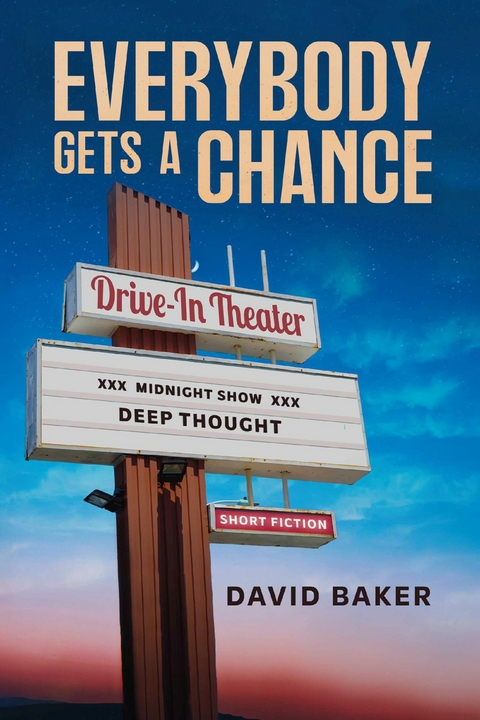
Everybody Gets A Chance (eBook)
400 Seiten
Bookbaby (Verlag)
979-8-3178-0331-5 (ISBN)
'Everybody Gets A Chance', a collection of short fiction and a novella, gives us: A swindled, hoodwinked young cabinet maker, choosing between his first serious relationship or a college education; An on-the-lam campus protester, forming her own band of half-baked, eco-terrorists; A burned-out lawyer, trying to save a community from an attach by a deranged anti-vaxxer. What these and the other characters in this book have in common is a conviction that all is not quite right with the World, and it's their job to put the planet back on its axis.... Told in ten short stories and a novella, we meet a cross section of the lost souls that have made America what it is today: A confusing, jumbled mass of people, looking for answers to the questions-How did this happen, and why me? Written by an author who's been described as 'Laugh-out-loud funny...' this collection will keep you amused while holding you to the edge of your seat, wondering what happens next. The author of the new novel. 'Patriot Acts', and the non-fiction guide book, 'Death Is No Excuse'-reviewed by readers as 'Can't put it down...' and 'The funniest book I've read,' promises to make this one of the most entertaining and moving collections of short fiction available today.
"e;Everybody Gets A Chance"e;, a collection of short fiction and a novella, gives us: A swindled, hoodwinked young cabinet maker, choosing between his first serious relationship or a college education; An on-the-lam campus protester, forming her own band of half-baked, eco-terrorists; A burned-out lawyer, trying to save a community from an attach by a deranged anti-vaxxer. What these and the other characters in this book have in common is a conviction that all is not quite right with the World, and it's their job to put the planet back on its axis.... Told in ten short stories and a novella, we meet a cross section of the lost souls that have made America what it is today: A confusing, jumbled mass of people, looking for answers to the questions How did this happen, and why me?Written by an author who's been described as "e;Laugh-out-loud funny "e; this collection will keep you amused while holding you to the edge of your seat, wondering what happens next. The author of the new novel. "e;Patriot Acts"e;, and the non-fiction guide book, "e;Death Is No Excuse"e; reviewed by readers as "e;Can't put it down "e; and "e;The funniest book I've read,"e; promises to make this one of the most entertaining and moving collections of short fiction available today.
1.
What Took You So Long?
My first serious, steady girlfriend moved thirty miles away, as soon as we started showing any genuine affection for each other. Most people would have taken the hint, but I was not one to let the Hand of God in your face, decide the course of human affairs, so, being too poor to drive, I bought a bicycle.
It wasn’t like I had a lot of money, even to spring for the bike. I was working a couple of odd jobs, fixing bicycles in a co-operative run by a bunch of bike-loving hippies, and making furniture in my spare time. I was on the way to getting a union card as an apprentice cabinet maker, a road I’d traveled down because my guardians were a couple of childless teachers, and the “Dad”, Darwin “Swede” Fredrickson, taught shop at Washburn Trade School. He had a fully equipped woodworking set-up in his basement, and from the time I was twelve, he’d been teaching me how to cut and plane unfinished hardwood, mostly black walnut, cherry and Honduras Mahogany. We’d go down there most nights and sand it, cut it, miter it, glue, clamp and screw it into place, and slowly build tables, cabinets, and, where the real money was, mantle and grandfather clocks.
Molly Fredrickson, my guardian “Mom”, was an English teacher at the local high school, where I was soon to graduate. I always thought the most interesting thing about her was that her parents, as Irish-Catholic immigrants moving into their mostly Protestant, suburban neighborhood, had crosses burned on their front lawn when they arrived in 1922.
Swede was an un-apologetic Commie. He wore his Socialist-Worker’s-Party, Vladimir Lenin, Workers-of-the-World-Unite cap all the time, as he chain smoked and rambled on about how the working man was getting screwed. Swede and Molly were both raging alcoholics, but they were the good kind, functional, non-violent and employed—they just got slowly schnockered every night when they came home, and so I had to keep Swede away from the power saws, miters and routers as the evenings wore on. We’d go down into the shop, he’d crack open a beer, and while I woodworked, he’d ramble on about all the injustices in the World.
“Tell me something,” I’d ask. “If Communism’s so great, then why are they building walls and barbed-wire fences just to keep people in, and folks are still getting shot, trying to get out?”
Swede would swish his beer can. “That’s beside the point—”
“Why is that ‘Beside the point’?” I’d ask, as I sanded away on a black-walnut grandfather clock. “When was the last time somebody got shot trying to ‘Escape’ over a wall from here, or from Canada? And while we’re at it, I got about two hundred bucks in materials and a couple hundred hours of labor in this clock. Why should the Government tell me how much I should charge when I sell it, or what I should do with the money—”
“Because you’ll charge whatever you can get for it, so you’re liable to price gouge some poor worker who really needs a grandfather clock—”
“Who needs a grandfather clock?” I’d ask, as we jabbered on and on into the night like this, Swede smoking and chugging beers, then moving on to whiskey on the rocks. He looked like Santa with a bad shave, a ten-dollar haircut, C.P.A.-style wire-rimmed glasses and really baggy pants. He was full of beans, but he meant well.
Sometimes I’d take a break and go upstairs, where Molly would be reading and getting plotched on her own, usually on hard stuff.
“Swede getting to you?” she’d ask. She looked like the almost-retired, white-haired, once-upon-a-time leprechaunish school teacher she was.
“He’s O.K.—he’s just trying again to talk me into devoting my life to working on a collective beet farm.”
“Can’t help it—his parents were labor organizers in the thirties, so it’s in his blood. That’s the problem with Socialists. If they were right, and they’re not, fixing things would take global reprogramming of human DNA. People strive, they want what’s theirs. And you can’t convince Socialists they’re wrong, because they’re too busy banging their shoe on the table, and they won’t shut up long enough to hear a complete opposing thought. Me, I just hate the smug, well-off folks that live around here.” She’d pause, turn the book in her hand to look at the cover. “You read any Robert Ardrey?” she’d ask, then go into a fifty-minute spiel about “The Territorial Imperative,” and how we were all just talking monkeys obsessed with sex and real estate, and how women only wanted to have sex with you if you had real estate, and so on…..
Since they were both teachers, I always thought they showed their affection by lecturing me on their obsessions—Socialist Workers’ Propaganda for Swede, and Armchair Anthropology for Molly, who felt compelled to drill me on how all human behavior was actually rooted in our simian ancestry. It got to me enough that I ended up writing my high-school, Junior Thesis, entitled, “The Weapon as the Backbone of Mans’ Society”. It was a chunky essay about how Humans developed our big brains by making nasty clubs, saws and daggers out of the bones of the critters we were eating, back when we were all tiny-brained, hairy little barely-upright goobers. My High-School Junior-Year English teacher, Peter Montgomery, called it “A mess”, but gave me an “A” for effort, because, he said, he was so sick of reading pious essays about valiant environmentalists cleaning oil slicks off trapped waterfowl.
I’d taken the job as a bike mechanic, mostly to get out of the house. Between Swede’s second-hand cigarette smoke and the sawdust, I figured my lungs would stack up poorly next to any sixty-year-old coal miner’s, and I was good with my hands and had a stocked tool box, so the hippies at Genoa Bike Co-Op hired me right away. I could handle both jobs because, as a senior in High School, I’d already mostly figured out classes, and I wasn’t planning on going on to College, so my grades didn’t matter. I figured I’d just join the Carpenter’s Union, become a cabinet maker, and eke out a living. The hippies at the Bike Co-Op were Commies too (there were a lot of those in the Sixties), so they gave me flexible hours and let me buy an ultra-light racing bike, at cost.
Once I’d bought the bike, I figured I could try out for Genoa Co-Op’s over-the–road racing team, which held thirty-and-sixty mile rides on weekends, out of the City By The Lake, into what were then cornfields, sandstone overpasses and country intersections, dotted with gas stations and diners. I made the team, and was regularly getting up at 3:00 A.M. on Saturdays and Sundays to hit the roads before the truckers started hogging them, practicing long rides with the team. I was the only member, male or female, without a ponytail, so we got hassled routinely by truckers, but those weekend races, out to river towns like Rockland and Emerson, were usually uneventful. There was a liberating feeling about being able to bike the kind of distance most people traveled in cars, and, as it turned out, that familiarity with the open road came in handy when Alison Warble nibbled me out of the isolation so many High School students occupy for their entire four years.
I was sleepwalking through American History class, like just about everybody else, when I first noticed Allie. We had this nearly-famous guy, Walter Miston, teaching from his own textbook. He was tiny, had crypto-fascist, slicked down white hair, and always wore a bow tie. He droned on and did a lot of, “If you turn to page so-and-so in my book” stuff, and it got so bad I started getting a bag of ice cubes from the cafeteria and putting them down my back to stay awake. Allie sat to my right, in assigned seats, the only class of Seniors in the building being treated like preschoolers. At some point, midway into first semester, she leaned over the isle, like she was picking something up, and whispered, “If I die of boredom here, I want you to have my bicycle, my collection of board games and all my sweat socks and sneakers.”
When she straightened back up, she looked over at me like she’d just been sent on one of those mercy missions to some earthquake region, to pull a couple of people out of the rubble. I felt like one of those rubble-rescued guys. I leaned over and gave her an ice cube, then pantomimed the collar drop so she could see the proper use of these amateur wake-up props.
People say there is such a thing as love at first sight, and while I’m not so sure, if I had to pinpoint when she first got under my skin, it was that exact moment when she dropped that ice cube down her back. As Miston drawled on in monotone, “……and people will argue that the American fossil fuel industry began with discoveries in Texas and Oklahoma, but it was actually Titusville Pennsylvania….” she suddenly sat straight up like she’d been electro shocked, looked at me and said, “Yeah, let’s dooo that agaaain.”
We met up in the hallway and went outside to the student mall to hang out between classes. We watched the greasers smoking and making fun of the squares, while the freaks all compared the Native American symbols on their embroidered belts, then re-threaded them, which was largely unnecessary, as their behinds were holding up their skin-tight, tattered jeans.
“Any chance I’ll see you Saturday night?”...
| Erscheint lt. Verlag | 25.10.2025 |
|---|---|
| Sprache | englisch |
| Themenwelt | Literatur ► Comic / Humor / Manga |
| ISBN-13 | 979-8-3178-0331-5 / 9798317803315 |
| Informationen gemäß Produktsicherheitsverordnung (GPSR) | |
| Haben Sie eine Frage zum Produkt? |
 EPUB (Ohne DRM)
Größe: 861 KB
Digital Rights Management: ohne DRM
Dieses eBook enthält kein DRM oder Kopierschutz. Eine Weitergabe an Dritte ist jedoch rechtlich nicht zulässig, weil Sie beim Kauf nur die Rechte an der persönlichen Nutzung erwerben.
Dateiformat: EPUB (Electronic Publication)
EPUB ist ein offener Standard für eBooks und eignet sich besonders zur Darstellung von Belletristik und Sachbüchern. Der Fließtext wird dynamisch an die Display- und Schriftgröße angepasst. Auch für mobile Lesegeräte ist EPUB daher gut geeignet.
Systemvoraussetzungen:
PC/Mac: Mit einem PC oder Mac können Sie dieses eBook lesen. Sie benötigen dafür die kostenlose Software Adobe Digital Editions.
eReader: Dieses eBook kann mit (fast) allen eBook-Readern gelesen werden. Mit dem amazon-Kindle ist es aber nicht kompatibel.
Smartphone/Tablet: Egal ob Apple oder Android, dieses eBook können Sie lesen. Sie benötigen dafür eine kostenlose App.
Geräteliste und zusätzliche Hinweise
Buying eBooks from abroad
For tax law reasons we can sell eBooks just within Germany and Switzerland. Regrettably we cannot fulfill eBook-orders from other countries.
aus dem Bereich