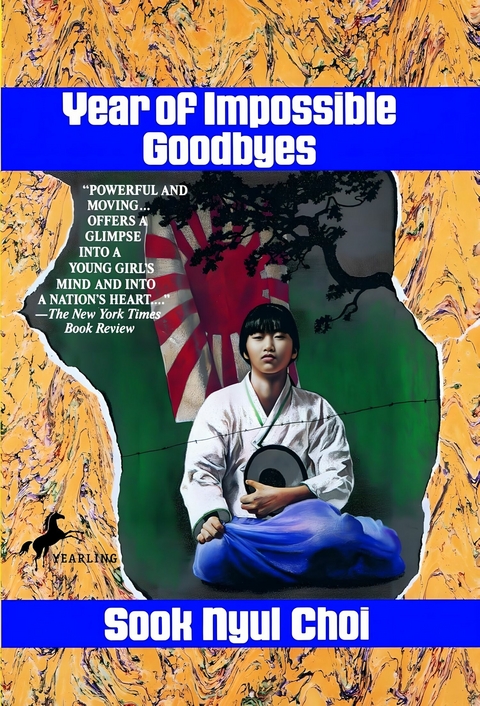
Year of Impossible Goodbyes (eBook)
100 Seiten
Publishdrive (Verlag)
978-0-00-102891-3 (ISBN)
It is 1945, and courageous ten-year-old Sookan and her family must endure the cruelties of the Japanese military occupying Korea. Police captain Narita does his best to destroy everything of value to the family, but he cannot break their spirit. Sookan's father is with the resistance movement in Manchuria and her older brothers have been sent away to labor camps. Her mother is forced to supervise a sock factory and Sookan herself must wear a uniform and attend a Japanese school.
Then the war ends. Out come the colorful Korean silks and bags of white rice. But Communist Russian troops have taken control of North Korea and once again the family is suppressed. Sookan and her family know their only hope for freedom lies in a dangerous escape to Americancontrolled South Korea.
Here is the incredible story of one family's love for each other and their determination to risk everything to find freedom.
Chapter One
Spring 1945
Small clusters of pale green needles emerged from the old weathered pine tree in our front yard. The high mounds of snow in the corner of our yard had begun to melt, the water flowing gently into the furrow of dark earth Grandfather had dug around the base of the tree like a moat. Grandfather’s tree stood alone in the far corner of the yard, its dark green-needled branches emanating harmoniously from the trunk, reaching out like a large umbrella. It was a magic tree, holding in the shade of its branches the peace and harmony Grandfather so often talked about.
Despite the warmth of the sun, the air in Kirimni, Pyongyang was dark and heavy, filled with the sound of gunfire and with the menacing glint of drawn swords. For the people in Kirimni, this day was no different from the bitter gray days of winter. The warmth of the spring sun and the thawing of the icy snow brought no respite from the oppressiveness that engulfed us.
Grandfather, hoping the Korean people might experience the exhilaration and beauty of spring again, had made sure my mother included the word chun, or spring, in the names of each of my brothers. My oldest brother’s name was Hanchun, meaning “Korean spring”; my second brother, Jaechun, was called “spring again”; my third brother, Hyunchun, the “wise spring”; and my youngest brother, Inchun, the “benevolent spring.” Inchun was now almost seven, and a benevolent spring still had not come to our village.
I saw Grandfather peer out at the yard from his room, and look at the delicate branches of the pine tree playing against the hazy, pale blue sky. He cleared his throat and called out to Mother. “Hyunsuk, today I will do my morning meditation under the tree.”
“But, Father, I’ve already prepared your place inside,” I heard my mother reply in a troubled voice. “Besides,” she added, “it isn’t warm enough for you yet. Why outside all of a sudden?”
“It is not all of a sudden. Not a single day has gone by that I haven’t thought of it. It has been thirty-six years since I have meditated in the warmth of a spring sun. Today, the Japanese soldiers will not keep me inside. I am too old and too tired to be afraid anymore.”
Although Mother let out a heavy sigh, she did not protest. Reluctantly, she brought out a clean straw mat and unrolled it beneath the pine tree, placing the thick cushion in the center of the shade. Grandfather emerged from his room and became part of the peaceful scene. The gentle rays of the April sun flitting through the pine branches played upon his face like dancing fairies.
Excited to see Grandfather meditate beneath his tree, I slid my rice-paper door open a crack and watched. I crossed my legs, resting my hands on my lap with the palms facing up, just as he did. Though his eyes were closed, I kept mine open to watch him. He sat tall and still, like a statue. He looked peaceful as he prayed, yet there was an intensity, an anticipation, in his expression, as though he were waiting for something special to happen. His wrinkles were deep, and I wished that I could run my fingers along the creases in his forehead as he sat motionless in prayer. I wondered what he had to tell the Buddha this morning.
He was still for so long. I began to worry that my Grandfather had been filled with the spirit of the Buddha and had been turned into a statue. I tiptoed outside, quietly crept up toward him, and put my finger under his nose. I felt his faint breath and he coughed gently to reassure me. I sat next to him and watched, happy to be near him. The smell of the pine permeated the atmosphere, and I breathed deeply.
The sun grew stronger as I watched Grandfather, whose shirt of worn gray cloth hung comfortably from his bony shoulders. His crossed legs looked like two bent chopsticks. His handsome face was sad, peaceful, intent, but always dignified.
The women in town called him “Patriot Grandfather” or “Scholar Grandfather.” Sometimes they brought special letters or poetry written in Chinese characters for Grandfather to translate into Korean script, Hangul. During my first lesson with Grandfather, he had shown me how to write his name. With his oxtail brush, he swiftly drew two large Chinese characters on a large piece of soft white rice paper. “Yong-Wun,” he explained, meant “Dragon Cloud.” With a few fluid strokes, his brush created an island of billowy clouds hovering over the mountains. When I looked at the picture more carefully, I saw there was a gentle dragon resting on a cloud, peering down upon the earth. Grandfather told me the dragon is a symbol of good fortune and dignity. Presiding over rain and water, the dragon works to save the crops during times of drought and bring abundance and prosperity to the people.
Grandfather opened his eyes and looked at me as if he knew I had been staring at him. I was disappointed to see him stir; time would no longer stand still. He looked deep into my eyes, and then smiled, happy that we had celebrated this spring day together in such a special way. We got up and hurried inside to start our morning lessons.
While I had my lesson, Mother and Inchun stayed in the yard to prepare for the girls who would be arriving to work at the sock factory. If the Japanese police came by, Mother or Inchun would rap on the door, signaling for us to put away our books. As a Korean child, I wasn’t supposed to be learning any of the Korean or Chinese that Grandfather was teaching me. I was almost ten and should have been in Japanese school. But as I was small for my age, Mother had been able to avoid registering me for the first grade when the police came by last spring. Mother kept hoping that the war would end, and that at least Inchun and I would be spared from attending Japanese school. All my older brothers and my sister had had to go.
I was glad to be home with Grandfather, reading and writing Korean and learning about the ancient Korean kingdoms. My favorite parts of the lesson were reading ancient Chinese poetry and practicing brush writing. But out forty-minute lesson went by too quickly. The police would soon be coming by to remind us to make our morning offerings at the Shinto temple. We were to pray for the good health of the Heavenly Emperor and for success in the war against the “White Devils.” This marked the beginning of each dreary day under the watchful eyes of the Imperial police.
Grandfather closed his thick, weathered Chinese text, and I went out to the yard to help Mother. I looked at our small house with its curved roof of gray clay tile and thought what a beautiful house it could be if we had the time to decorate it and plant a flower garden. Instead, a big, ugly wooden shack dominated the yard. It had been there for as long as I could remember. Built under the orders of the Japanese, it served as a factory to manufacture socks for the Japanese soldiers and merchants. My mother was in charge of the factory and supervised the young women who worked from early morning until late evening on the old knitting machines.
To shut out the sight of that ugly shack, I rested my eyes on the tree that stood in the far corner. A low stone wall ran behind the tree; the wooden gate stood slightly ajar. I wished that wall and gate could keep the Japanese police away from us. It was our gate and our house, yet the Japanese tromped in and out whenever they wanted to without so much as a knock.
Later that morning, Captain Narita came walking through the gate. He paced about the yard, his sword hanging from his small wiry frame. His thick gold-rimmed glasses magnified his cold probing glance. The sun reflected off the handle of his sword, the rims of his glasses, and his gold and red epaulets. A smile played upon his lips as he examined us with apparent disdain. Mother had always told me to go quietly inside whenever Captain Narita and his men came to the house, but this time I just stood and looked at him.
“You did not go to Shinto temple yet,” he said to Mother.
She looked him in the eye and responded in perfect Japanese. “We will go very soon. But for now we have to prepare tea and millet crackers for the girls so that they can make many socks for the Imperial soldiers. The girls come from far away, and on empty stomachs they will not be able to make so many socks.”
Captain Narita eyed Mother from head to toe. It was considered a serious offense even to look at the Imperial police; Koreans were expected to keep their heads bowed and obey orders unconditionally. The girls at the sock factory told me that Mother was probably the only person who could talk to Captain Narita and get away with it.
Stroking his mustache with one hand and his sword with the other, he said, “Then you make sure that all the girls make their offerings to our Heavenly Emperor and pray for the defeat of the White Devils.” Flanked by his two ever-present lieutenants, he strode toward the sock factory. Their swords and guns clanked against their belts in an all-too-familiar rhythm as they strutted past me. They inspected the inside of the factory and spoke briefly to my cousin Kisa, the mechanic, who arrived early each morning to grease the machines. They then walked straight through the yard and out the front gate, without inspecting the house.
We were all relieved to see them leave, and Mother set the table with a pot of cool barley tea and a tray of small millet cookies. “One day I would just love to surprise these poor hard-working girls with some delicious white rice cakes instead of coarse yellow millet cakes,” said Aunt Tiger, who lived with us.
Mother sighed. “Our farmers make enough rice to feed all of us, yet we must eat millet and barley. All...
| Erscheint lt. Verlag | 22.8.2025 |
|---|---|
| Sprache | englisch |
| Themenwelt | Literatur ► Romane / Erzählungen |
| ISBN-10 | 0-00-102891-X / 000102891X |
| ISBN-13 | 978-0-00-102891-3 / 9780001028913 |
| Informationen gemäß Produktsicherheitsverordnung (GPSR) | |
| Haben Sie eine Frage zum Produkt? |
 EPUB (Adobe DRM)
Größe: 1,3 MB
Kopierschutz: Adobe-DRM
Adobe-DRM ist ein Kopierschutz, der das eBook vor Mißbrauch schützen soll. Dabei wird das eBook bereits beim Download auf Ihre persönliche Adobe-ID autorisiert. Lesen können Sie das eBook dann nur auf den Geräten, welche ebenfalls auf Ihre Adobe-ID registriert sind.
Details zum Adobe-DRM
Dateiformat: EPUB (Electronic Publication)
EPUB ist ein offener Standard für eBooks und eignet sich besonders zur Darstellung von Belletristik und Sachbüchern. Der Fließtext wird dynamisch an die Display- und Schriftgröße angepasst. Auch für mobile Lesegeräte ist EPUB daher gut geeignet.
Systemvoraussetzungen:
PC/Mac: Mit einem PC oder Mac können Sie dieses eBook lesen. Sie benötigen eine
eReader: Dieses eBook kann mit (fast) allen eBook-Readern gelesen werden. Mit dem amazon-Kindle ist es aber nicht kompatibel.
Smartphone/Tablet: Egal ob Apple oder Android, dieses eBook können Sie lesen. Sie benötigen eine
Geräteliste und zusätzliche Hinweise
Buying eBooks from abroad
For tax law reasons we can sell eBooks just within Germany and Switzerland. Regrettably we cannot fulfill eBook-orders from other countries.
aus dem Bereich