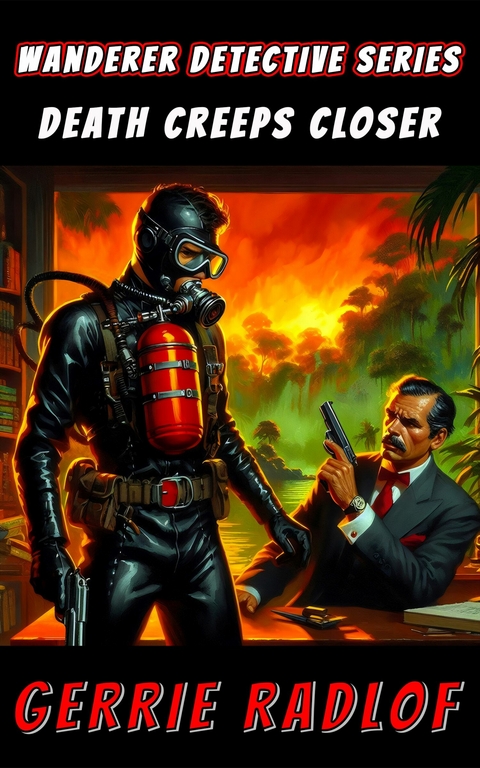
Death Creeps Closer (eBook)
126 Seiten
Pieter Haasbroek (Verlag)
978-0-00-102145-7 (ISBN)
A child vanishes without a trace.
Days later, his voice returns.
A ghostly whisper in the dead of night with a terrifying demand.
In the isolated basin of Wesselsdal, a community sealed off from the world, famed private investigator Obed de Swardt arrives to solve a chilling mystery. Children are disappearing, only to have their disembodied voices return with an ultimatum from the valley's long-dead founder. Evacuate Wesselsdal or never see your children again.
But this is no simple haunting. Obed is targeted by the same supernatural terror, a waking nightmare meant to break him. As the valley's plants begin to grow at an impossible rate, they unleash an invisible, creeping poison, turning the basin into a death trap. With the community in a panicked exodus and the exits sealed by a silent killer, Obed must unmask a ghost before he and the last survivors are suffocated by a curse born from mad science.
Perfect for fans of classic pulp adventures, riveting spy thrillers, and intricate mysteries where the stakes are life and death.
There's nowhere left to run. Fans of pulp, action, and mystery, prepare for the most intense manhunt of the series where the Wanderer is the prey. Death Creeps Closer is a ticking clock of a thriller that never lets up. The chase is on. Get your copy now!
8. DEATH CREEPS CLOSER
Chapter 1
A VOICE FROM THE “DEAD”
“If you do not eat your food, Jannie, the big man with the long beard will come and catch you, put you in the sack on his back, and carry you away.”
Little Jannie’s eyes widened. He looked at the old servant sitting next to him at the kitchen table, then he looked back at his food and the spoon held half-hesitantly, half-threateningly before his mouth.
“But where will he carry me to?” he finally asked, as if he first wanted to establish that before accepting the lesser evil of the food.
“Up there in the mountain is a deep cave where he locks up all the naughty little children.”
“Ai Griet,” Mrs. Botha’s voice came from the doorway. “It is not a good thing for you to frighten Jannie. You should not threaten the child to make him eat.”
Ai Griet, who had worked for the Bothas for years, who had raised Mrs. Botha and now her child, snorted indignantly. She looked around at her nonna.
“And why is Nonna healthy and plump and happy today?” she said haughtily. “Would Nonna have looked like this if I had not told Nonna the same stories when Nonna did not want to eat?”
Mrs. Botha smiled good-naturedly. Ai Griet was almost one of the family. Her children were grown and strong, and most of them worked in the town. Jannie was Mrs. Botha’s firstborn.
She walked back to the living room and then looked out the front door again. Her husband had not yet arrived.
She shivered suddenly. Sometimes it felt so desolate to her here. So far from everything.
Accidents never happened here. It was sometimes so quiet that the loneliness worked on her nerves. The only sign of life now was the lights in the street and a babble of voices from the hotel.
She looked in the other direction. In the evening twilight, she saw the crests of the mountains and hills that surrounded the valley. A strange feeling of foreboding descended upon her, but she did not see the dark, creeping figure here, close to the corner of her house among the few fruit trees.
Wesselsdal lay in a basin. Annually, numerous students from the universities, archaeologists, and other scientists came to study this peculiar quirk of creation. Some believed that a large inland lake had previously been here. Others attributed it to prehistoric volcanic activity.
Fortunately, the rainfall was but sparse, because nowhere was there an outlet in the mountains and hills that surrounded Wesselsdal, otherwise a tunnel or canal would have had to be dug years ago.
It was only from an aeroplane that one got the impression of a crater. Its shape was oval, and it stretched forty kilometres in length. The width was approximately twenty kilometres. Over the years, according to some of the archaeologists, the crater rim had weathered until it now looked like ordinary mountains and hills. The basin itself had the appearance of a green valley, with undulations and low hills, with ravines and dry watercourses, as if rivers had once flowed along them. Everything was covered with the most luxuriant and natural vegetation, because here in the valley, the town and the farms were sheltered from the worst winds and the most turbulent weather.
It was a peaceful community that lived in Wesselsdal. They were practically cut off from the outside world and, apart from the visits of the scientists, the students, and the occasional representatives from companies wanting to sell products to the twenty-odd farmers and the ten, twelve families in the town, visits from outside were of a personal nature.
The main road from Burgersfort, seventy kilometres away, wound from the south over the hills, into the basin, and ended in the town, because on the northern side, behind the low mountain range, flowed the Olifantsrivier.
Wesselsdal had its little post office, a blacksmith’s shop, a small motor garage, a school with one teacher, the single-storey hotel, a few shops, and the police station. A few retired farmers also lived in the town. Once every fortnight, a church service was held in the hall that served as school hall, town hall, and church hall. Wesselsdal’s existence was only thanks to the farming community in the vicinity which it served.
The pride of the town was the small power station that supplied them with electricity. They did have to be sparing with the power, but it created a feeling that, as a result, they were at least part of modern civilisation. Freddie Kleynhans, who was the owner, manager, and motor mechanic of the garage, was also the town’s electrician. Andries Gerike, the richest farmer in the basin, who had bought the ancestral farm of Jakob Wessels, after whom the valley was named, seven years ago, had specially persuaded Freddie to buy the garage when the power station was installed. The farmers had all contributed to bring about this improvement.
Mrs. Botha walked into the house. Her husband, Johan, was one of the shop owners and it was possible that he was working late. Or perhaps he could be at the hotel, because that was the gathering place of the small community when they chatted in the evenings or danced a little or played cards, or did something to shake off the boredom.
Ai Griet walked down the passage with a bundle of laundry. Mrs. Botha stopped her.
“Did Jannie eat his food after all?”
“He ate everything, Nonna,” the servant assured her.
“Where is he now?”
“He is around in the backyard. Perhaps he is on his way to Basie Verwey again. I do not have time to run around after him everywhere.”
“It will be dark soon, he cannot stay out too late,” said Mrs. Botha. “Mrs. Verwey might not like it if Jannie is still visiting there so late.”
It did not bother her much that Jannie was outside. Nothing happened in Wesselsdal. The few cars that occasionally drove through the main street just made dust, but posed no real danger to the children. They could not really get lost, because everyone knew everyone in Wesselsdal.
A quarter of an hour later, Johan showed up. He kissed his wife, Mavis, and then enquired about Jannie.
“I think he is across at the Verweys’,” she answered, slightly dissatisfied. “Were you lot all together again tonight?”
“Of course not,” he answered. “I just walked past there. Klaas and I chatted for a little while.”
“You and Klaas Jansen!”
He kissed her again. She smiled.
“In any case, I am quickly walking over to Nico. I will check if Jannie is not there.”
“Please do not chat for hours again, Johan, the food will dry out.”
The little town was situated on a rise, almost in the centre of the basin. The slope descended gradually on either side, but the total drop to the lowest point was no more than about six metres. Most of the houses and the few business buildings were situated on the main street, but behind it, on both sides, there was another street where a few of the houses stood. Around each house was a large garden and all that separated them were hedges or wire.
Johan Botha walked out the back door and across his yard between the fruit trees until he reached a hole in the fence of Nico Verwey, the teacher and Johan’s neighbour. Nico and his family were already eating and little Basie was with them.
“I thought Jannie was here with Basie,” Johan said after they had greeted.
“He is not, Omie,” answered Basie, and Nico confirmed that they had not seen Jannie there.
“That is strange,” Johan remarked. “I just wanted to come and chat about the surface of the tennis court. One of Andries Gerike’s men informed me this afternoon that there is a cluster of anthills nearby.”
“Then why can Andries not just have them broken up and carted away the next time one of his wagons or his truck comes to town for supplies?”
“Well, alright, why do you not call him? I first want to go and see where Jannie is.”
He walked out and across the backyard to the back street. Here it was dark, because there were only lights in the main street.
“Jannie!” he called loudly.
No one answered. He walked back in the direction of his own house, and a few times he called again.
Across the street, the elderly Klaas Jansen stuck his head out the door. Klaas was the postmaster, the station master, and master in various other fields in the town. The Railway truck only came to Wesselsdal once a week, and Klaas was not really a man who had to work too hard. His favourite seat was thus the hotel stoep, and for that reason most of the wives advised their husbands to be sparing in their conversation with Klaas. The men, of course, differed in opinion.
“Are you looking for Jannie, Johan?” he now enquired.
“Well, I do not know yet if I am looking, but he is not at home.”
Klaas joined him. They walked into Johan’s backyard and enquired if Jannie was there yet. Mavis shook her head and was immediately uneasy.
“Now where on earth can he be wandering around again? Look around quickly, Johan. I will search around here in front.”
Half an hour later, most of the residents of Wesselsdal were on Jannie Botha’s trail. They had already searched the entire town twice. Mavis Botha stood to one side at the corner of the hotel, which was in the middle of the town, and where a streetlamp burned in front of the stoep. In total there were but six lights in the street. A few of the other women tried to console her, but a feeling of foreboding had already overwhelmed her.
“We will have to use torches and lanterns then,” Frans Louw, the hotel owner, manager, and barman, advised the group of men. “Half of us...
| Erscheint lt. Verlag | 18.9.2025 |
|---|---|
| Übersetzer | Pieter Haasbroek, Ai |
| Sprache | englisch |
| Themenwelt | Literatur ► Krimi / Thriller / Horror |
| ISBN-10 | 0-00-102145-1 / 0001021451 |
| ISBN-13 | 978-0-00-102145-7 / 9780001021457 |
| Informationen gemäß Produktsicherheitsverordnung (GPSR) | |
| Haben Sie eine Frage zum Produkt? |
 EPUB (Adobe DRM)
Größe: 4,1 MB
Kopierschutz: Adobe-DRM
Adobe-DRM ist ein Kopierschutz, der das eBook vor Mißbrauch schützen soll. Dabei wird das eBook bereits beim Download auf Ihre persönliche Adobe-ID autorisiert. Lesen können Sie das eBook dann nur auf den Geräten, welche ebenfalls auf Ihre Adobe-ID registriert sind.
Details zum Adobe-DRM
Dateiformat: EPUB (Electronic Publication)
EPUB ist ein offener Standard für eBooks und eignet sich besonders zur Darstellung von Belletristik und Sachbüchern. Der Fließtext wird dynamisch an die Display- und Schriftgröße angepasst. Auch für mobile Lesegeräte ist EPUB daher gut geeignet.
Systemvoraussetzungen:
PC/Mac: Mit einem PC oder Mac können Sie dieses eBook lesen. Sie benötigen eine
eReader: Dieses eBook kann mit (fast) allen eBook-Readern gelesen werden. Mit dem amazon-Kindle ist es aber nicht kompatibel.
Smartphone/Tablet: Egal ob Apple oder Android, dieses eBook können Sie lesen. Sie benötigen eine
Geräteliste und zusätzliche Hinweise
Buying eBooks from abroad
For tax law reasons we can sell eBooks just within Germany and Switzerland. Regrettably we cannot fulfill eBook-orders from other countries.
aus dem Bereich