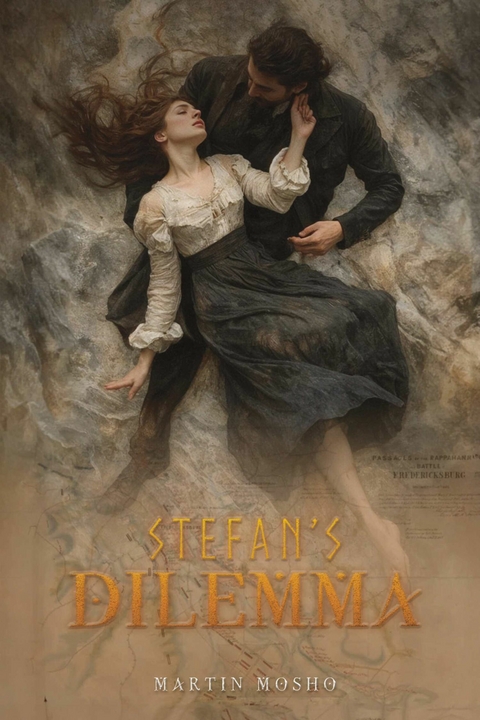
Stefan's Dilemma (eBook)
236 Seiten
Bookbaby (Verlag)
979-8-3178-0904-1 (ISBN)
Martin Mosho worked in advertising sales from 1960 thru 1997 -- including 15 years as a Manager with US News & World Report magazine. He went on to serve as instructor at Mercer County Community College. Upon retirement, he taught several programs on the American Civil War to historical societies, colleges, libraries, senior and adult education centers. Martin has written a number of books - and wanted to write a novel about an intense forbidden love story that lasted the characters entire lives. It took him 4 years to write it. Martin is married and has two children, Amy Beth and Greg, both of whom helped with the final editing of this book.
STEFAN'S DILEMMA is a historical novel that explores the depths of human emotion, forbidden love and the long shadows cast by past decisions over a lifetime romance. Taking place between 1862 and 1941, STEFAN'S DILEMMA, is a love story between Stefan and Henrietta, whose 3-month love affair in 1881, leads to a lifetime of love between them. This intricate tale spans decades, weaving together the lives of its characters with historical events and personal tribulations. This novel delves deeply into themes of love, regret, and the enduring impact of past decisions on the present.
Chapter Two
Philadelphia, Pennsylvania – 1881
The attraction between the young man and woman was mutual and immediate.
They first noticed each other when he boarded the West bound train in Philadelphia.
The young lady was sitting towards the back of the car with a mature woman, most likely her mother. They had probably gotten on at New York City. The young man found a seat and was quite pleased with himself. He had planned this venture for years and the moment had come. He was confident his plans for success would prove successful.
He noticed the young woman getting up and heading in his direction. She was beautifully dressed in the latest and most expensive fashion consisting of a hunter green dress and matching hat. She wore the short-brimmed hat at an angle, which accentuated her natural beauty and soft contours of her delicate face. She couldn’t have been more than 17 or 18. She had reddish, auburn hair and was about 5’ 4” tall.
She had an air of unmistakable aristocracy about her. She was fuller-figured and knew how to dress to create an alluring appearance. He was always more impressed by intelligence and personality than waistline size anyway.
He was overwhelmed by her.
As she walked by his seat, she glanced at him briefly, as modesty allowed, and continued to the vestibule.
He looked at her with great admiration, but fully aware that girls like her were not available to impoverished boys like him.
He was a handsome young man, but poorly dressed. With his limited funds, he had bought himself an inexpensive second-hand suit for three dollars, which included a plain cap.
As she passed him, she turned to look at him and caught his attention. Approaching him was, of course, inconceivable. Respectable women did no such thing in the 19th century, but some respectable women knew how to catch a man’s eye and send the proper signals.
She entered the vestibule between cars and looked out at the flat prairie rushing by. A few minutes later the door opened, and the young man walked in. She was not surprised.
She was impressed with his good looks, blue eyes, and light blond hair. He appeared to be about 5’ 10” tall and very slender. Perhaps too slender.
To her, this was nothing more than an opportunity for an interesting flirtation with a handsome young man on a boring train trip. Something for the moment with no lasting consequence.
He looked at her and said, “Good morning, Ma’am.”
“Good morning”, she replied, trying to look indifferent. She continued staring at the outside scenery.
Silence.
She removed her hat revealing her reddish hair that hung down in ringlets.
“That is a beautiful hat, ma’am. Where I come from, we don’t see young women as well dressed as you. My compliments.”
She knew instinctively he was in awe of her.
“Thank you. And where are you from?” she asked.
“Titusville, Pennsylvania. A mining town.”
“Are you a miner?”
“No, ma’am. I’m a machinist and I also repair firearms.”
“How far are you going?” she asked.
“Wichita. And you?”
“I am heading there as well. I live in Wichita. And what will you do in Wichita?”
“I am going there to find my future.”
“Are there no machinist jobs in Titusville?”
“It’s a small mining town, Ma’am. I want something more.”
“And you think the machinist jobs in Wichita are better than those in Titusville?”
“I expect they are the same, Ma’am, but the environment is different, if not better. Anything is better than Titusville. You can’t imagine the dreariness of it. My father was a miner. He only got to leave the mines when he enlisted.”
“Did he return to the mines?”
“No, Ma’am. He was killed in 1862 at Fredericksburg”.
“My sincerest regrets. And your mother?”
“Cholera took her many years ago. I was raised by her friend.”
“You never went into the mines?”
“No, Ma’am. That was my mother’s wish.”
“Your mother was wise.”
“My father hated the mines. He couldn’t handle the confinement. It was that and the constant danger that motivated him to enlist. She never forgot that.”
There was a moment of silence. She found him very soft-spoken and refined for a man born into a miner’s family. She admired these qualities. Men who were loud or abrasive were not for her.
“Are you finished with school, Ma’am?”, he asked.
“Yes. I just finished school. I am returning home. And please stop calling me ‘Ma’am’, I am not your schoolteacher. My name is Henrietta Colmes and you may address me as Miss Henrietta.”
“Stefan Petric.”
“That is Polish, isn’t it?”
“It’s Slavik, Miss Henrietta. Both my parents were born in Obrenovac, Serbia. I was born and raised in Pennsylvania.”
Henrietta was pleased that he referred to her as “Miss Henrietta”. It implied she was controlling the situation, and he was succumbing to her wishes. Or maybe he was just being condescending. She would find out soon enough. For a 17-year-old girl, she had become adept at determining a young man’s intentions.
“So, you are coming to Wichita to make your mark on the world. What makes you think you will succeed?”
“Hard work. I am good at what I do.”
“A lot of men work hard. What makes you stand out?”
“The need to go beyond being a machinist. And the West is the place to start.”
“There are opportunities everywhere for clever young men.”
“But Wichita is where I want to be. I do not see myself as being smarter than anyone else, just committed to being more than I am. I thought of going to Philadelphia or New York City, but the West seemed more attractive. I have been reading about it for years.”
“But why Wichita? It is just a cow town. There are bigger towns further West. Abilene, Dodge City, Dallas. Tombstone is also growing rapidly.”
Stefan laughed. “The truth, Miss Henrietta, is that Wichita is as far west as I could afford.”
“I respect your honesty, but I hope you were not influenced by those novels about the West. They are all based on silly lies. Contrary to what you may have read, there are no bloodthirsty Indians running around assaulting white women or taking scalps. The few who come into town to buy supplies are peaceful. The renegades stay elsewhere, out of sight. If anything, we whites are the predators. They are on the brink of being subdued to total obedience. On occasion there is trouble with the cowboys, but they are under control now. Our constables arrest them if they step out of line.”
“What happened to the Wild West?” he asked.
“No more. We have a conflict over water rights between ranchers but that should be resolved shortly. Most residents of Wichita are peaceful people who go about their business. The railroad is having a major impact on our economy. Eventually, all steers will be shipped that way, and the cowboys will fade away. Times are changing. If you are looking for the frontier of the dime novels, it does not exist.”
“I am aware of that. I am attracted to Wichita because it is growing rapidly with opportunities for young men. I’m looking for a new life, Miss Henrietta, not an adventure.”
“Was your old life that difficult?”
“If you saw the misery of my existence, Miss Henrietta, with little hope for the future or improvement, you would understand why I had to leave. Anything would be better than that. I don’t have a choice. I have to succeed. I may never be rich, and it is not my intention to be rich, but I have no intention of remaining poor.”
“How old are you?
“Nineteen.”
“You are very ambitious for someone so young.”
“That is because there is no one to give me anything. What else...
| Erscheint lt. Verlag | 1.8.2025 |
|---|---|
| Sprache | englisch |
| Themenwelt | Literatur ► Romane / Erzählungen |
| ISBN-13 | 979-8-3178-0904-1 / 9798317809041 |
| Informationen gemäß Produktsicherheitsverordnung (GPSR) | |
| Haben Sie eine Frage zum Produkt? |
 EPUB (Ohne DRM)
Größe: 570 KB
Digital Rights Management: ohne DRM
Dieses eBook enthält kein DRM oder Kopierschutz. Eine Weitergabe an Dritte ist jedoch rechtlich nicht zulässig, weil Sie beim Kauf nur die Rechte an der persönlichen Nutzung erwerben.
Dateiformat: EPUB (Electronic Publication)
EPUB ist ein offener Standard für eBooks und eignet sich besonders zur Darstellung von Belletristik und Sachbüchern. Der Fließtext wird dynamisch an die Display- und Schriftgröße angepasst. Auch für mobile Lesegeräte ist EPUB daher gut geeignet.
Systemvoraussetzungen:
PC/Mac: Mit einem PC oder Mac können Sie dieses eBook lesen. Sie benötigen dafür die kostenlose Software Adobe Digital Editions.
eReader: Dieses eBook kann mit (fast) allen eBook-Readern gelesen werden. Mit dem amazon-Kindle ist es aber nicht kompatibel.
Smartphone/Tablet: Egal ob Apple oder Android, dieses eBook können Sie lesen. Sie benötigen dafür eine kostenlose App.
Geräteliste und zusätzliche Hinweise
Buying eBooks from abroad
For tax law reasons we can sell eBooks just within Germany and Switzerland. Regrettably we cannot fulfill eBook-orders from other countries.
aus dem Bereich