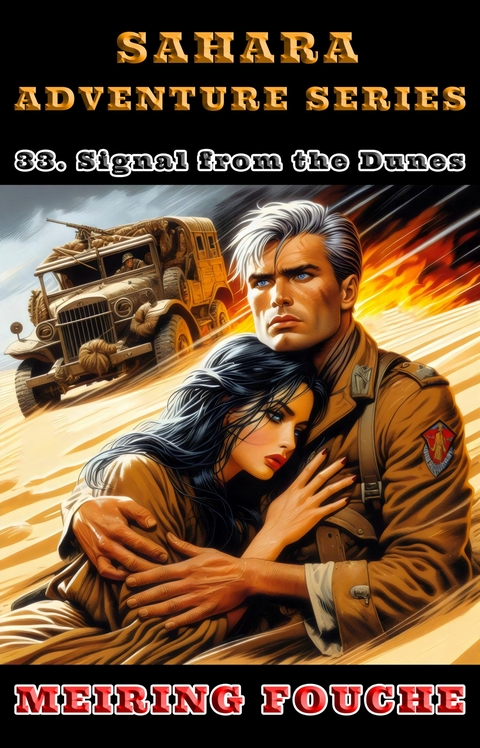
Signal from the Dunes (eBook)
88 Seiten
Pieter Haasbroek (Verlag)
978-0-00-077891-8 (ISBN)
A dying beggar's cryptic gift.
A WWII medal that should not exist.
And a name on the ribbon that will lead them into hell at Sidi Omar.
Sahara desert, 1940-1960. For Teuns Stegmann and his battle-hardened brothers of the French Foreign Legion, life is a grim routine of sand, sweat, and survival. But when a murdered messenger leaves them a mysterious British medal, they are thrust into a mission where the only map is a name pricked into its ribbon. They must find a cursed oasis that the desert itself has tried to forget.
Disguised as Arabs and joined by an enigmatic British woman and a fellow legionnaire with his own secrets, their journey becomes a brutal test of loyalty. Betrayed and left for dead under the scorching sun, Stegmann discovers the true stakes are far greater than a soldier's honor. A horrifying plague has already wiped one oasis from existence, and the secret of Sidi Omar is a scientific terror poised to threaten the world.
This novel is a relentless fusion of classic action-adventure and cold-war espionage thriller. Perfect for fans of Alistair MacLean's high-stakes suspense and the rugged heroes of Lee Child, it's a story where the heat of the desert is matched only by the chill of betrayal.
Step into this unforgettable thirty-third Sahara adventure now!
Chapter 2
THE MESSAGE
The interest of the few men there around the table is now so piqued that they curiously scan the café to see if they can spot any further sign of the Arab beggar. They scrutinize the place carefully, but there is no trace of the strange intruder.
Then they look at each other.
Something has awakened within each of them. The phenomenon is so strange that each man’s thoughts have run wild. Their interest is reflected by the fact that each, in turn, takes the medal in his hands and examines it attentively.
A military medal from the Second World War! A medal brought into an Arab café on a hot evening by an Arab beggar and then handed over, of all people, to men of the Foreign Legion!
These are elements in a drama they can sense but cannot interpret.
Eventually, the round, shiny object with its beautiful ribbon lands back in the hands of Teuns Stegmann.
This time, Teuns truly scrutinizes it. He examines it as if it were an insect he had placed under a magnifying glass. First, he regards one side of the medal. There is just the usual inscription on the back. It remains merely a military medal.
Finally, he contemplates the ribbon of the medal. Its colours are beautiful. There is blue, there is red, there is deep purple.
But it is not the beautiful colours of the medal ribbon that make Teuns Stegmann turn cold, that suddenly set his hands trembling. Perhaps it is because he has turned slightly pale, because sweat has broken out on his forehead, that the others lean forward and stare at him with glowing eyes.
“What... what is it that you actually see?” asks Petacci.
Teuns looks at each of his comrades in turn and then looks down at the medal again.
He spreads the ribbon open across his hand, holds it up to the light, and they see a muscle twitch on his jawbone.
“I thought there was something special about this medal,” he says finally.
“I knew it carried some kind of message...”
He hands it to Fritz Mundt.
“Look there on the ribbon,” says Teuns Stegmann, indicating with his long index finger.
The big German is a man of great strength, fearless courage, and endurance, but he is not blessed with a sharp intellect or particular powers of observation.
“What is it?” asks Fritz.
“Can’t you see, man?” asks Teuns impatiently.
“There on the ribbon, look at the ribbon.”
With a gesture of impatience, the alert, sharp-witted little Petacci plucks the medal from Fritz’s hand. He contemplates the ribbon, and when he looks up, there is a revelation in his eyes.
“What could it mean?” he asks Teuns.
Next, Jack Ritchie takes the medal, and he too now perceives the secret that Teuns and Petacci had noticed.
On the ribbon of the medal, a name has been applied, and in a peculiar manner.
Apparently, the letters of the two words written there have been pricked out through the ribbon with a thick needle. The letters consist of a series of small, scarcely perceptible holes through the ribbon.
And the name thus inscribed there is Sidi Omar.
“Sidi Omar,” says Jack Ritchie.
“Where in the wide world is that?”
Teuns Stegmann shakes his blond head.
“No,” he says, “I’ve never heard of him. Not of Sidi Omar. It must be somewhere in the Sahara, but the gods know where.”
Teuns’s face is deathly white.
This event has awakened sensations within him that have not awakened in any of the others. He rubs his hands together and then stands up quickly. He stands up while Podolski is also still examining the name on the ribbon.
“We must go to the fortress immediately,” he says.
“This is something that must be brought to the attention of Colonel Le Clerq. There’s more to this than meets the eye.”
“But what about our card game?” asks Fritz Mundt.
“To hell with the cards, man,” says Teuns.
“I think this is more important than a game of cards.”
He wipes the sweat from his forehead, picks up the few coins from the table, takes the medal, puts it in his pocket, and begins to push towards the door.
The others gather the cards and follow the tall South African.
They stop in front of the café door. It is almost pitch dark here, and the only light in the narrow, dirty Arab street is the light from the café.
It is a squalid environment, and when the men come to this café, they walk in the middle of the street.
Teuns turns around to see if they are all there, then steps out into the street and begins to stride in the direction of the Dini Salam fortress. The night is particularly dark, and even the faint glimmer of starlight seems insignificant tonight. There is a haste and urgency in Teuns’s stride.
He leads them quickly up the street, and in the pocket of his uniform trousers, he clutches the medal tightly.
Teuns walks so lost in thought, so absorbed, that he almost falls flat on his face when he stumbles over something further up the street.
And only as he lifts his tall body does he hear the groan. Realizes that he has just stumbled over someone.
The others also halt, for they too have heard the groan.
Fritz Mundt hastily strikes a match, and there in the dirty street of the Arab quarter of Dini Salam, they see the rather tall man lying stretched out in the dust.
He lies on his back with his hands thrown wide, his head turned slightly askew, and his chest is covered in blood. It is not this that fills them with revulsion and disgust, for many times they have come across an Arab in these dark streets who has met the blade. It is the person lying there that fills them with dread and suspicion.
Because the man lying on the ground with his bloody chest is the Arab beggar who, a short while ago, came and handed them a medal from the Second World War.
In the light of the matches they strike, they see his throat move convulsively, how his lips stir, and how blood pushes out from the corners of his mouth each time he takes a shallow breath.
Teuns immediately crouches beside the stricken beggar.
He speaks lowly near the man’s face.
“Who are you and where do you come from? And why did you come to us tonight? What lies behind the thing you brought us?”
For a moment, it seems as if light enters the man’s eyes. He rattles again.
His larynx moves once more, and then the words come very softly over his bloodied lips.
“Go to Sidi Omar,” he says in Arabic. “Go to Sidi Omar,” he repeats again. And then he says for the third time. “Go to... Sidi... Omar.”
“Sidi Omar?” says Teuns.
“Why must we go to Sidi Omar, and where is it?”
The man raises his right hand as if wanting to indicate something, as if wanting to emphasize something, but then it falls limply back onto the sand.
Blood comes rattling over his lips. His head falls sideways, and in the light of the match that Podolski holds there, they see how his eyes break, how his mouth falls open, how he dies.
Through the faint light of the match, Teuns looks up at the others. Then he looks down at the Arab again.
“He’s no more a beggar than I am,” says Teuns.
The man’s face is narrow, well-formed, almost noble.
His body is slender but sturdy and well-built. His beard is well-groomed, his hands are well-kept. He is not filthy and dirty like the usual Arab beggar.
What can you do with a man who has died in the middle of an Arab street?
You can do nothing with him. You leave him lying where he lies, especially when it is a man like this who has apparently brought a message to the French Foreign Legion.
When Teuns straightens up, he knows that there are eyes in the darkness watching them, observing their actions, drawing conclusions.
Therefore, he just says quickly and whisperingly.
“Just leave him here, let him lie!”
The match goes out, and the men begin to stride down the street. A little further on, they turn left, walk away from the Arab quarter across the open patch of sand that separates the fortress of Dini Salam from the town of Dini Salam.
They walk quickly through the gate, into the courtyard, and Teuns breaks into a jog towards the living quarters of Colonel Le Clerq, commander of the garrison in the Dini Salam fortress.
For Colonel Le Clerq too, this is an ordinary evening.
Therefore, he had turned in early with his bottle of cognac beside his bed. It takes a while before the orderly manages to get the colonel to sit behind his desk.
He looks up irritably as Teuns and Petacci enter.
“What is this business?” asks Le Clerq impatiently.
“Is it necessary for you to disturb me at this time of night? If you had something to say, couldn’t you have reported it to Capitaine D’Arlan?”
“Forgive us, mon Colonel,” says Teuns Stegmann.
“Something has happened which, in our opinion, must be brought to your personal attention.”
Le Clerq glances sideways up at Teuns.
“Has the garrison deserted, or is a great host of Arabs on our doorstep that you come to bother me at this time of night, Legionnaire?” asks the colonel gruffly.
Teuns pulls the medal from his pocket and lays it before the colonel on the table.
Le Clerq glares at it. Then he slowly reaches out his hand as if afraid it is a sand viper that might bite him.
“And this?” he asks.
“Mon Colonel,” says Teuns, “it is a medal that an Arab beggar came and handed to us in a café.”
Le Clerq looks up quickly.
“An...
| Erscheint lt. Verlag | 25.8.2025 |
|---|---|
| Übersetzer | Pieter Haasbroek, Ai |
| Sprache | englisch |
| Themenwelt | Literatur ► Romane / Erzählungen |
| ISBN-10 | 0-00-077891-5 / 0000778915 |
| ISBN-13 | 978-0-00-077891-8 / 9780000778918 |
| Informationen gemäß Produktsicherheitsverordnung (GPSR) | |
| Haben Sie eine Frage zum Produkt? |
 EPUB (Adobe DRM)
Größe: 5,8 MB
Kopierschutz: Adobe-DRM
Adobe-DRM ist ein Kopierschutz, der das eBook vor Mißbrauch schützen soll. Dabei wird das eBook bereits beim Download auf Ihre persönliche Adobe-ID autorisiert. Lesen können Sie das eBook dann nur auf den Geräten, welche ebenfalls auf Ihre Adobe-ID registriert sind.
Details zum Adobe-DRM
Dateiformat: EPUB (Electronic Publication)
EPUB ist ein offener Standard für eBooks und eignet sich besonders zur Darstellung von Belletristik und Sachbüchern. Der Fließtext wird dynamisch an die Display- und Schriftgröße angepasst. Auch für mobile Lesegeräte ist EPUB daher gut geeignet.
Systemvoraussetzungen:
PC/Mac: Mit einem PC oder Mac können Sie dieses eBook lesen. Sie benötigen eine
eReader: Dieses eBook kann mit (fast) allen eBook-Readern gelesen werden. Mit dem amazon-Kindle ist es aber nicht kompatibel.
Smartphone/Tablet: Egal ob Apple oder Android, dieses eBook können Sie lesen. Sie benötigen eine
Geräteliste und zusätzliche Hinweise
Buying eBooks from abroad
For tax law reasons we can sell eBooks just within Germany and Switzerland. Regrettably we cannot fulfill eBook-orders from other countries.
aus dem Bereich