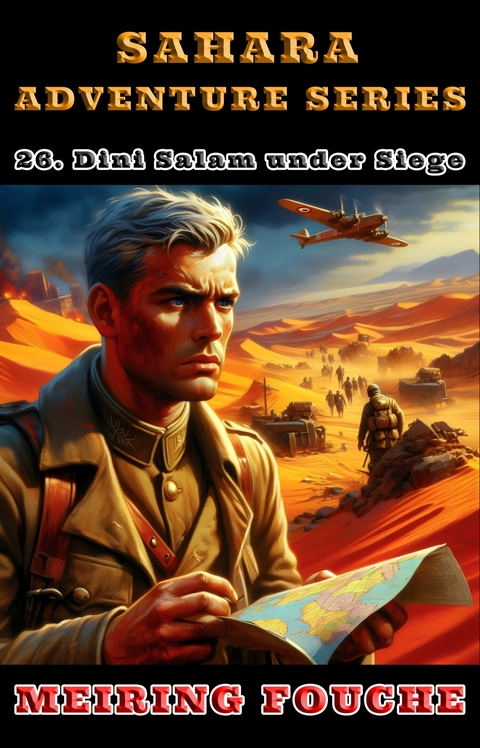
Dini Salam under Siege (eBook)
97 Seiten
Pieter Haasbroek (Verlag)
978-0-00-077872-7 (ISBN)
Thirty thousand warriors scream for blood.
One fortress stands against the storm.
For the French Foreign Legion, survival is measured in seconds.
Sahara desert, 1940-1960. In the blistering heart of the Sahara, Legionnaire Teuns Stegmann stands on the ramparts of Dini Salam, a lone bastion against a furious tide of desert tribes. When a foolish command orders the execution of a captured holy man, it becomes a death sentence for the entire garrison. Only the cunning Captain D'Arlan sees the trap, but defying orders is an act of treason.
But when the prisoner is assassinated by mysterious phantoms of the desert, the Legion is blamed. Framed for a murder that ignites the Sahara into a storm of vengeance, Teuns is captured and faces a gruesome fate at the hands of a beautiful and ruthless desert queen. With the fortress gate shattered and his brothers-in-arms facing annihilation, survival is no longer enough.
This gripping, action-packed historical adventure is a relentless military thriller filled with twists you won't see coming. If you love stories of desperate last stands, battlefield intrigue, and heroes who refuse to die, you won't be able to put this down. Perfect for fans of Alistair MacLean and Wilbur Smith.
Step into this unforgettable twenty-sixth Sahara adventure now!
26. DINI SALAM UNDER SIEGE
Chapter 1
THREATENING THRONG
In the town of Dini Salam in the southern Sahara, home to the main garrison of the French Foreign Legion in these parts, chaos and tension reign. The place is inundated by an oppressive, shifting, clamouring multitude, as if the entire population of the Sahara had been swept together here by a strong wind.
On the ramparts of the fortress, the main stronghold in this part of the desert, the legionnaires stand shoulder to shoulder. The neck-flaps of their kepis flutter gently in the wind, their rifles ready in their hands, their bayonets gleaming.
These men stand staring down at the most remarkable scene they have ever witnessed. Right up to the walls of the fortress surges the Arab multitude, shouting and pressing, fists waving in the air, and amongst them move the desert warriors with their horses, their curved sabres flashing in the bright sun.
And far behind the frenzied throng around the fortress, across the open desert, they still keep coming, in streaks, in clusters, or in long phalanxes, small as ants crawling purposefully and lethally across the sand. The crowd swells ever larger, growing wider and denser around the fortress, and each time, hatred erupts from a thousand throats.
Behind the Legionnaires on the ramparts, officers move back and forth to ensure no mistake is made. In the courtyard, directly before the great gate which is securely shut with its heavy barred gates, two machine guns are positioned, their short muzzles gleaming ominously in the sun. Behind the men on the ramparts stand chests of hand grenades here and there.
There is hardly a Legionnaire who does not feel copious sweat in his eyes, or the cold sensation down his spine. There is not a finger that does not lie trembling on the trigger. Like a living wall, they stand there, waiting for the one spark that might ignite the powder keg, that one small event that might drive this crowd of Arabs to ultimate hysteria, when they will swarm up the stone walls of the fortress like animals. It is not the first time these Legionnaires have witnessed such a multitude, although it has never been this large.
Time and again they have stood thus on the ramparts before the attack came. They know the death-defying nature of these people. They know that when the command comes, these Arabs will scramble up the walls. They will shoot the creatures down from above in their hundreds, perhaps in their thousands, but there will always be others coming until the fortress is overwhelmed by sheer numbers.
And if Dini Salam falls, then the road lies open to Algiers, to the coast. Then the road lies open to the defeat of the entire French Legion.
Here, near one corner of the rampart, on the south-eastern side, stands a tall legionnaire, just as ready as all the others. He is a tall, blond man with clear blue eyes, broad shoulders, and the physique of an athlete. His name is Teuns Stegmann, and he is the only South African in the French Foreign Legion. Beside him stands a giant of a man with a bull neck, a fierce blockhead, and a rather reddish complexion. His name is Fritz Mundt, a German and a man with the reputation of being the strongest man in the entire Legion.
“Have you ever seen them like this, mon ami?” Fritz Mundt asks Teuns.
“Never before,” admits the South African. “Just like this, I have never seen them. Look how they are coming. It looks as if they are being blown here by a wind.”
Together they look out over the bare desert, which seems to have suddenly come alive as the Arabs continue to approach. From east and west. From south and north they come. The two fall silent for a moment, staring at the overwhelming scene before them. And when Teuns Stegmann speaks again, his voice is hoarse and low. “You see, of course, what happened last night, Fritz,” he says.
“What do you mean?” asks the big German, for he is someone who does not grasp things quickly.
“The Doelak army also arrived last night,” says the South African. “There lies their camp to the south-west.”
“Yes, indeed,” answers Fritz. “I tell you, if the Doelaks decide to fight alongside other Arabs, then things look ugly.
How many do you estimate are here now?” he asks.
Teuns surveys the crowd with his eyes, and for a moment the cheering fades from his ears, the shouting, the taunting.
“I tell you,” he finally addresses the German, “there are no fewer than thirty thousand here.”
“Yes, I estimate the same,” agrees Fritz. “Thirty thousand. We don’t stand a chance, mon ami.”
“No, we don’t stand a chance,” confirms Teuns. “If they want to overwhelm us this time, they will overwhelm us. That’s as plain as day. I just hope Colonel Le Clerq doesn’t make a mistake this time.”
“I wouldn’t want to be in his shoes,” says Fritz.
“Even less so I. If he does the wrong thing this time, then we’re done for, this fortress and all, and then the fat’s in the fire in the Sahara.”
Suddenly, the South African’s eye catches something towards the south-west. His left hand flies out and grips Fritz’s arm. “Look there!” he says.
Fritz gasps for breath as he looks in the direction the South African indicated. There, it looks as if someone has kicked open an anthill. Over the farthest ripple of dunes, a solid mass of Arabs is now approaching. They are not advancing one by one or two by two, not in clumps. They move in a solid mass that seems to make the horizon bend. Their curved sabres glint like white pinpoints of fire, and from the way they advance, Teuns instantly knows who they are.
“The Berbers!” he exclaims, almost breathless with astonishment.
“The Berbers!” the word echoes from Fritz’s mouth. “Even the Berbers. But they have always been reasonably well-disposed towards us.”
“I know,” answers Teuns, “but on this day, even the Berbers come to fight.”
Fritz wipes the sweat from his eyes. “This is ugly,” he says, as if it still needed saying. With a sense of dismay, not only these two Legionnaires, but also the others witnessing this new phenomenon, realise that surely in many, many years there has never been so much deadly unanimity among the Arabs as on this day, when even the Berbers, the traditional enemies of the Doelaks, are prepared to fight shoulder to shoulder with them.
Teuns Stegmann and Fritz Mundt turn halfway, looking over their shoulders as they hear the voice behind them. “There come the Berbers, mes amis.”
It is the voice of one of the most famous and reckless fighters of the Sahara desert. It is the small, almost childlike voice of Captain D’Arlan, a slender, sallow little man who has the reputation of being one of the most ruthless and one of the most cunning commanders in the entire Sahara.
“Yes, there come the Berbers, mon Capitaine,” says Teuns Stegmann.
“Good heavens,” D’Arlan lets out, “but the entire Sahara is in revolt. Berbers, Doelaks, Touaregs, everything that lives and breathes, is converging on Dini Salam. I must quickly go and give the colonel the news.”
D’Arlan’s boots clatter quickly on the planks of the rampart as he hurries to the stairs leading down to the courtyard. He jogs across the courtyard to the office of Colonel Le Clerq, the greyish, nervous commander of the Dini Salam garrison.
As D’Arlan enters, Le Clerq turns from the window. His eyes are bloodshot and his face reddish and shiny from all the cognac he has knocked back since this new crisis befell him.
“What ill tidings do you bring now, Capitaine?” Le Clerq asks cynically.
D’Arlan salutes quickly and enters the room further. “It is the Berbers, mon Colonel,” says D’Arlan. “The Berbers are also coming.”
“The Berbers?” Le Clerq asks loudly, moving quickly to his desk. “Are you telling me the Berbers are coming too?”
“It is so, mon Colonel. We just spotted them for the first time. They are approaching from the south-west.”
“How many?”
“It is very difficult to say, mon Colonel. They are still far off, but to me, it looks like a large army.”
Le Clerq sinks onto his chair as if lifeless, yanks open the top drawer, snatches out his bottle of cognac and takes several deep draughts straight from the bottle. This is what Le Clerq always does when difficulties become too much for him. He slams the drawer shut quickly and bangs his fist on the desk. “In God’s name, D’Arlan,” he bursts out, “what are we going to do? The entire Sahara is in revolt. What are we going to do, I ask you. If even the Berbers march against us, then I cannot think of a tribe that is not yet in revolt. I tell you, we will not be able to withstand them!”
D’Arlan thinks of the scene he has just witnessed outside in the sun, a terrifying scene of thousands of Arabs milling around the fortress and of the multitude still arriving across the sand.
D’Arlan sits down nervously, and it is not characteristic of D’Arlan to be nervous. His hands tremble slightly on the table as he lays down his officer’s baton.
“I ask you, D’Arlan, what are we going to do?” Le Clerq’s voice is sharp, almost desperate.
But D’Arlan, who is not only a brilliant fighter but also a shrewd diplomat, does not answer his chief’s question. Instead of answering it, he poses a counter-question.
“Have you not yet received an answer from Algiers?” he asks.
Le Clerq shakes his head vehemently and slaps his kepi down on the desk. “No,” he answers, “I have not yet received their answer. You know how it is with them. When one...
| Erscheint lt. Verlag | 25.8.2025 |
|---|---|
| Übersetzer | Pieter Haasbroek, Ai |
| Sprache | englisch |
| Themenwelt | Literatur ► Romane / Erzählungen |
| ISBN-10 | 0-00-077872-9 / 0000778729 |
| ISBN-13 | 978-0-00-077872-7 / 9780000778727 |
| Informationen gemäß Produktsicherheitsverordnung (GPSR) | |
| Haben Sie eine Frage zum Produkt? |
 EPUB (Adobe DRM)
Größe: 5,4 MB
Kopierschutz: Adobe-DRM
Adobe-DRM ist ein Kopierschutz, der das eBook vor Mißbrauch schützen soll. Dabei wird das eBook bereits beim Download auf Ihre persönliche Adobe-ID autorisiert. Lesen können Sie das eBook dann nur auf den Geräten, welche ebenfalls auf Ihre Adobe-ID registriert sind.
Details zum Adobe-DRM
Dateiformat: EPUB (Electronic Publication)
EPUB ist ein offener Standard für eBooks und eignet sich besonders zur Darstellung von Belletristik und Sachbüchern. Der Fließtext wird dynamisch an die Display- und Schriftgröße angepasst. Auch für mobile Lesegeräte ist EPUB daher gut geeignet.
Systemvoraussetzungen:
PC/Mac: Mit einem PC oder Mac können Sie dieses eBook lesen. Sie benötigen eine
eReader: Dieses eBook kann mit (fast) allen eBook-Readern gelesen werden. Mit dem amazon-Kindle ist es aber nicht kompatibel.
Smartphone/Tablet: Egal ob Apple oder Android, dieses eBook können Sie lesen. Sie benötigen eine
Geräteliste und zusätzliche Hinweise
Buying eBooks from abroad
For tax law reasons we can sell eBooks just within Germany and Switzerland. Regrettably we cannot fulfill eBook-orders from other countries.
aus dem Bereich