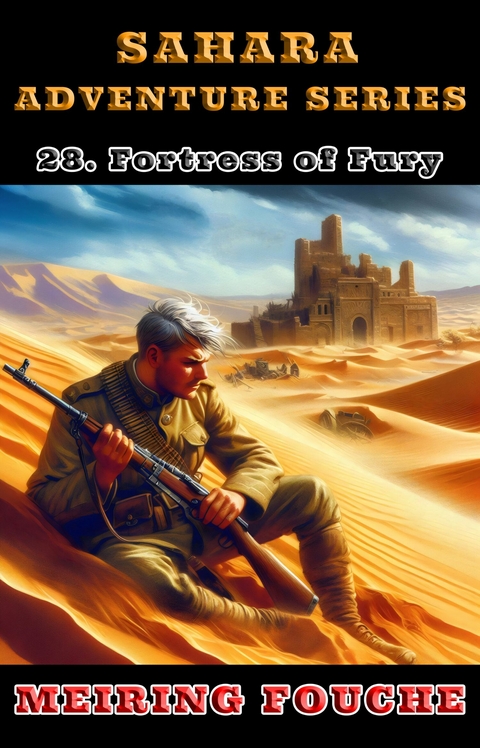
Fortress of Fury (eBook)
109 Seiten
Pieter Haasbroek (Verlag)
978-0-00-077871-0 (ISBN)
One of his men is a traitor.
The endless dunes of the Sahara are the perfect place to bury a secret... and seven Legionnaires.
Sahara desert, 1940-1960. Sergeant Teuns Stegmann, a hardened veteran of the French Foreign Legion, is tasked with turning six raw recruits into soldiers fit for the desert. But this is no ordinary patrol. A strange discovery in the sand lures them deep into an uncharted hell, guided by a recruit whose restless eyes hold a deadly secret.
They are trapped in the forgotten Fortress of Krasj, an ancient bastion that exists on no map. Here, a ghost from Stegmann's past awaits. The ruthless Pierre Bonnet has spent five years plotting a bitter revenge, and he's engineered this perfect cage to make the Legionnaire pay for his sister's death in blood.
Outnumbered, outwitted, and with their water running dry, the training patrol becomes a desperate battle for survival. As Bonnet's savage warriors close in, Stegmann must fight a madman in a brutal game where every shadow hides an executioner. The fortress was built to keep enemies out. Now, it will keep them in.
A blistering page-turner that blends the high-stakes tension of a thriller with the epic scope of a classic adventure, Fortress of Fury is perfect for fans of Wilbur Smith and Alistair MacLean.
Step into this unforgettable twenty-eight Sahara adventure now!
28. FORTRESS OF FURY
Chapter 1
RECRUIT DAVROS
Gratefully, like thirsty children who had stumbled upon water, they stretched themselves out in the benevolent coolness of a high, red, maned dune in an uncharted and virtually impassable region of the Sahara Desert. Although practically children of the desert, they felt almost reverent beneath the terrible beauty of the pristine sand masses that enclosed them here. Here lay the red sand dunes like mountains with deep, dark avenues when the shadows arrived, with sharp crests, almost like the blades of sabres, and with fine ripples against their vast flanks.
They were but a small group, only eight men. A stranger would see at first glance that two of them were veterans, hardened men, and that six were still blushing youths with their rosy cheeks and excited eyes, as if expecting a secret in the Sahara Desert greater than any experience they had yet undergone.
Here, where they had now settled themselves in the coolness of the dune, the few men looked so small and insignificant. The only disturbance to the seemingly boundless sand masses around them were the few rows of tracks leading down the steep dune to the bottom of the avenue where they now lay. They stretched out languidly on the sand, still burning hot from the torment of the Sahara sun, for they had walked far, and they had walked quickly.
Their leader was a tall blond man with alert blue eyes and a powerful yet lithe body like that of a power athlete. He was the only one not lying down. He sat there with his knees drawn up and his arms folded around them. Although he had wandered through the desert for so many days, he still looked fit and trim in the uniform of the French Foreign Legion. His name was Teuns Stegmann, the only South African in the French Foreign Legion. And the only other veteran with him was a large, massive fellow with a shiny bald head and a red complexion, possessing shoulders and arms that would do any heavyweight wrestler credit. His name was Fritz Mundt, a German, and a man reputed to be the strongest in the entire Legion.
The others were young fellows, green fellows, now being tempered on this very excursion by Teuns Stegmann and Fritz Mundt. They were recruits sent barely a month ago from Algiers to the fortress Dini Salam, the foremost garrison of the French Foreign Legion in the southern Sahara.
Here, where Teuns Stegmann now sat, his eyes narrowed against the glare of light reflected by the dune before them, it felt to him as though they had departed from Dini Salam three months ago already. And yet it was scarcely two weeks ago that he received the temporary rank of sergeant with the order to take Fritz Mundt along and lead these six raw recruits into the desert to initiate them into the routine followed on patrols in the Sahara Desert. To cultivate in them a feel for the conditions in the deep Sahara. To familiarise them with the dangers of the desert, with the demands it imposes. To teach them precisely how a soldier of the Foreign Legion must conduct himself when out on patrol in the boundless sandy wasteland of the Sahara.
The South African felt satisfied with the course of events thus far. All six recruits had proved brisk, strong, and diligent. They all possessed astonishing endurance. They were eager to learn, and he and Fritz had taught them everything they could, for there is much to learn in the Sahara. In the Sahara, you learn to keep your eyes open. You learn to determine the course of the sun and the moon. You learn to follow a direction according to the position of the stars. You learn how quickly or how slowly you must move, how much water you must drink in a day, and you learn how to last as long as possible without water.
Here in the Sahara, you learn to look far and wide and meticulously. To understand the meaning of a track or a disturbance in the sand or the faintest movement in the distance, for behind every crest of the Sahara, death can lurk.
Teuns Stegmann felt weary sitting there, for he was thoroughly aware of the responsibility resting on his shoulders. The preservation of a life could depend on the thoroughness of his instruction. He had to rigorously train these men in everything the Sahara could present, and the Sahara could present so many unexpected things. He had to teach these men to be alert, vigilant, and brave. He had to teach them not only to brave the dangers of the desert but also to know how to act when they clashed with the bloodthirsty inhabitants of the desert.
He had to teach them the customs, the tactics, the weaknesses of the Arabs. And the Arab could be just as hard, as cruel, and as inexplicable as the Sahara itself. This he had learned so many times in this wilderness of sand and heat. All this he had to impress upon these young men, and sitting here now, it felt to him as though each of their lives depended personally on him.
Surreptitiously, he surveyed them where they lay, placid young men, exhausted by the march and awaiting the next command. He wondered how brave they would be, or perhaps how cowardly, when the first blood flowed and when they truly had to lie behind the triggers for the first time. He looked at them thoughtfully and wondered what had brought them to the Sahara. Each one of them, he knew, must have a past, for no man comes to the Foreign Legion without having a past. Perhaps through a murder he committed. Perhaps through poverty. Perhaps through great sorrow or great shame. How would he ever know why these six, now under his command, had come to the Legion? And he wondered how loyal they would be to the French Foreign Legion. That was another thing he had to teach them. They must be loyal to the French Legion unto death. It mattered not whether they were French or Belgian or Swiss or German or Bulgarian or Turk. To the French Foreign Legion they must be true in all circumstances, even if it cost them their lives.
It was for this reason that the tall blond South African gazed so pensively at the group now stretched out so nonchalantly and comfortably here on the sand.
Teuns liked them. During their wanderings in this almost unknown part of the Sahara, where the commander of Dini Salam had deliberately sent them, he had already had the chance to observe them well. They seemed like good material to him, all of them, save one.
Among these six, there was one whom Teuns Stegmann did not like. He was a short, rather thin, dark little man, no longer very young. Probably close to forty, with two restless eyes that were almost never still, with a nervous twitch around his hard mouth, and with an unease in his movements as if he were always afraid that something or someone was pursuing him. Sometimes, Teuns had noticed, he made meaningless gestures with his hands. It seemed as though he was always scanning the horizon with his eyes, as if expecting to see someone or hear a sound. He never looked you squarely in the eye, and sometimes his neck twitched from a habit.
Davros, was his name. Recruit Davros, originally from Budapest. Teuns paid special attention to him. Under all circumstances, he watched Davros. What would such a relatively elderly man seek in the French Foreign Legion? What was within him that made him so restless and agitated?
Perhaps a great disaster had befallen him, thought Teuns. But whatever the case, one thing was undeniable. Davros appeared to be a particularly alert and intelligent man. His endurance was astonishing. Teuns had already had to slow the pace a few times when some of the recruits became too exhausted in the sand. But not Davros. He was always at the forefront. He always looked rested and vigorous. His dark eyes always sparkled, even when he was tired. With the greatest patience, he wiped the sweat from his eyes. A striking fellow, thought Teuns. Probably the most striking of the six recruits. A few times he had felt like questioning Davros a little. It felt to him as though he couldn’t trust Davros. Or was he perhaps mistaken? Who would ever know? All he could do was wait until time taught him, for the last thing he wanted to do was let Davros realise that he, Teuns Stegmann, felt distrustful towards him.
When Davros suddenly spoke, Teuns looked quickly at him. This also immediately sharpened his interest in the man again.
“Mon Sergent,” said Davros, “what is that on the crest of the dune?” With his narrow, gnarled hand, the recruit indicated south-westwards towards the crest of the dune.
Teuns felt slightly guilty that a recruit had noticed something he hadn’t.
There was definitely something lying on the dune. What it was, he couldn’t precisely make out. He frowned slightly that he hadn’t noticed it before and wondered if the thing had been lying there all along or if it hadn’t perhaps suddenly appeared there while they were here.
He narrowed his eyes and relied on his experience and his ability to concentrate to figure out what it was. It was something black, something that stirred, and yet, although Teuns’s pulse suddenly quickened, he realised it wasn’t a person. He was also convinced it wasn’t a living animal. What animals would one find in this waterless desert anyway? It certainly wasn’t a camel, a horse, or a mule, or anything of the sort. It was too small for that.
Suddenly the object stirred again and glinted in the late afternoon sun. Glinted and swirled.
And then Teuns realised with a smile what it actually was. It was a vulture. Apparently, it was a dead vulture. The wind that precedes the desert night had already risen, driving the fine, transparent curtain of sand over the dune crests. That wind must have caught the wing of the dead vulture, lifting it so that it shone in the sun.
“You are an observant man, Davros,”...
| Erscheint lt. Verlag | 25.8.2025 |
|---|---|
| Übersetzer | Pieter Haasbroek, Ai |
| Sprache | englisch |
| Themenwelt | Literatur ► Romane / Erzählungen |
| ISBN-10 | 0-00-077871-0 / 0000778710 |
| ISBN-13 | 978-0-00-077871-0 / 9780000778710 |
| Informationen gemäß Produktsicherheitsverordnung (GPSR) | |
| Haben Sie eine Frage zum Produkt? |
 EPUB (Adobe DRM)
Größe: 5,6 MB
Kopierschutz: Adobe-DRM
Adobe-DRM ist ein Kopierschutz, der das eBook vor Mißbrauch schützen soll. Dabei wird das eBook bereits beim Download auf Ihre persönliche Adobe-ID autorisiert. Lesen können Sie das eBook dann nur auf den Geräten, welche ebenfalls auf Ihre Adobe-ID registriert sind.
Details zum Adobe-DRM
Dateiformat: EPUB (Electronic Publication)
EPUB ist ein offener Standard für eBooks und eignet sich besonders zur Darstellung von Belletristik und Sachbüchern. Der Fließtext wird dynamisch an die Display- und Schriftgröße angepasst. Auch für mobile Lesegeräte ist EPUB daher gut geeignet.
Systemvoraussetzungen:
PC/Mac: Mit einem PC oder Mac können Sie dieses eBook lesen. Sie benötigen eine
eReader: Dieses eBook kann mit (fast) allen eBook-Readern gelesen werden. Mit dem amazon-Kindle ist es aber nicht kompatibel.
Smartphone/Tablet: Egal ob Apple oder Android, dieses eBook können Sie lesen. Sie benötigen eine
Geräteliste und zusätzliche Hinweise
Buying eBooks from abroad
For tax law reasons we can sell eBooks just within Germany and Switzerland. Regrettably we cannot fulfill eBook-orders from other countries.
aus dem Bereich