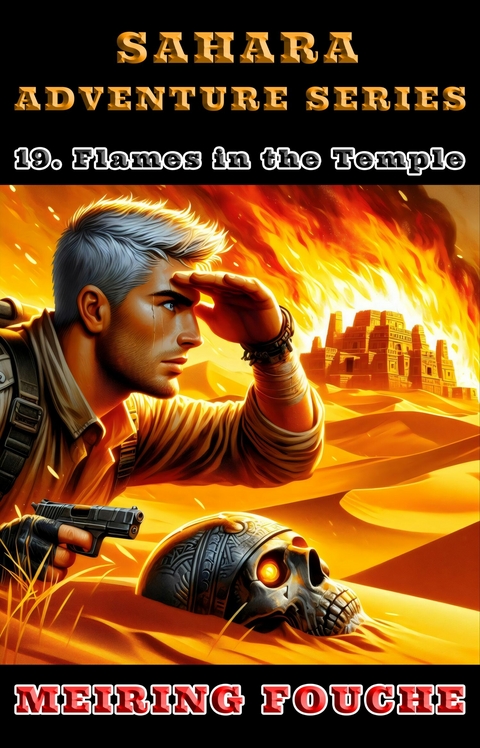
Flames in the Temple (eBook)
106 Seiten
Pieter Haasbroek (Verlag)
978-0-00-077743-0 (ISBN)
Left to die under the scorching sun, their only hope was a lie.
A lie that would lead them to a man more dangerous than the desert itself.
Sahara desert, 1940-1960. When Professor Lesseps and his daughter Marie are betrayed and abandoned in the unforgiving Sahara, their final gamble for survival backfires spectacularly. Their plea for help at a remote Foreign Legion fort lures the heroic Teuns Stegmann into a deadly trap, sprung by a sadistic deserter who will stop at nothing to escape the desert's grasp.
Forced to reveal his true quest, the fabled Treasure of Akbar, the professor unleashes an even greater terror. The secret awakens the wrath of a cruel Touareg sheikh and his unstoppable army, and soon the captives are condemned to a gruesome end upon a sacrificial fire altar where ancient law demands their blood.
With enemies on all sides and hope turning to ash, only one man has the courage to defy a sheikh and challenge an army. But in a land of shifting sands and brutal betrayals, even the bravest hero may be too late to stop the flames.
A relentless adventure packed with the high-stakes action of a classic thriller. Perfect for fans of Wilbur Smith and Clive Cussler, this epic tale of survival, honor, and ancient mystery will leave you breathless.
Step into this unforgettable nineteenth Sahara adventure now!
19. FLAMES IN THE TEMPLE
Chapter 1
THE TRAVELLERS
In the vast, shimmering desolation of the Southern Sahara, where sand dunes rise like immense, glittering mountain ranges from the level plains, the tall sand peaks with their rippled flanks and sharp manes resembling the backs of dragons, only the two camels move.
These two camels do not move at a comfortable trot or a jog, as camels usually do when far from water.
These two mounts proceed nonchalantly, almost on their own accord. Without haste and without direction. They are now moving along the crest of a high dune. Then they halt, then they move on again. But even their movement carries an air of desperation.
The beautiful dark eyes of the young woman, which usually flash and sparkle, which usually laugh, are now dull and expressionless. There is a sharp red glow on her lovely face beneath the shadow of her large sun helmet. Her lips are swollen and cracked. Her hands lie limply on the pommel of the camel saddle. Her body is slumped forward, and it seems as though she might fall from the camel’s back at any moment.
Suddenly, she brings her camel to a halt, turns in the saddle, and looks back at the rider behind her. And as she looks at him, large, glistening tears well up in her eyes. “Father, where are we going?”
The elderly man on the second camel lifts his bowed head slightly, looks out from under his bushy grey eyebrows at his beautiful daughter, and again his heart contracts within him. There is a lump in his throat as he answers. “The gods know, Marie.” He shrugs his shoulders defeatedly. Defeatedly and with the appearance of surrender. “Only the gods know where we are riding. I do not know. I no longer even know if we are travelling south or north.”
“But we shall die, Father. Our water is nearly gone. A few more hours and we shall be without water.”
“I know it. I know it, my Marie.” He scans the sand dunes searchingly. With a powerless yearning, he gazes out over the wasteland of sand upon which the consuming Sahara sun blazes down. His breathing becomes deeper and more agitated. “Yes, only a few more hours, then the water is finished,” he concurs. Through his hot, sweat-drenched body, he feels the cold wave of fear sweep over him. He feels the tremor in his hands, and tears burn in his eyes. She is his only one, this exquisite child, still so young and so vulnerable, and now they are victims of the relentless Sahara. A few more hours, he thinks. Then their water will be gone, and then they will have to die. He closes his eyes against the harsh sunlight and wonders which of them will go first. He, because of his age, or she, because of her youth?
“If only we had a compass,” she sighs.
“Yes,” replies her father, “if only we could determine whether we are moving west or east. Or north or south. But now we have no compass.” The light of bitterness glows again in his eyes.
“What use is it to move further?” she asks. “We might as well stay here and die.”
It is then that a faint gleam enters his eyes. “You have just given me an idea, my dearest Marie,” says the elderly man. “What use is it to move if you do not know where? Why do we not rather stay in one place? It will prevent us from wandering even further astray. It will conserve our strength. It might perhaps help us to be seen by someone, even if it be Arabs.”
In her dark, wine-coloured eyes, interest flickers for a moment. “Then we must seek out the highest point,” she says.
“Precisely.” With his old bony hand, he indicates the high crest of a dune not far from them. “There is the place,” he says. “There we must go and wait. If you are there, they will be able to spot you for miles.”
Without further delay, the girl turns her camel down the dune, and with a great shifting of loose sand, the animal slides down the side of the dune. Her father follows her.
It is already shortly before sunset when they finally reach the crest of the high dune. Exhausted, afraid, defeated, and tormented by thirst. Once again, they search with yearning eyes for the slightest sign of deliverance, but all they see is the vast emptiness of the desert. One dune mass after another, stretching hither and thither as if recklessly flung about by the hand of a giant. They can see far from here. They are now on the highest dune in the vicinity.
When they see nothing, they make their camels lie down and dismount. They eat the last crumbs of food they still possess. They drink the last drops of water. And the drinking of the water becomes a tragic game between them.
First the father takes a sip, then the girl takes a sip. Thus they pass the flask back and forth to each other, because neither wants to drink more than the other. But finally, it is empty. Then they look each other in the eyes and know that they must now simply await the moment when they must die. This little water has not even quenched half their thirst. And this is the last they have drunk. The very last. They know it well, and therefore neither can conceal the fear in their eyes. When the Sahara grips you, your eyes are different from how they usually are.
The old man’s lips tremble as he speaks. Yet there is a strange smile on his face. “Marie,” he says, “we must be brave. You and I must be brave. There are so many who have died more terribly than we shall.”
When she smiles back at him, her lip splits and begins to bleed again. With an almost greedy movement, she licks the blood with her tongue. He quickly looks away. Looks away so as not to witness it.
“We shall be brave, Father. We simply shall not think about it. We shall just be silent and accept and wait.”
He extends his old hand tremblingly and touches her youthful cheek. “We have had a good life together, my Marie, since your Mother went ahead of us,” he says. “Now we can accept death, can we not? The love we had for each other, no one can take that from us. There are those who say that death is a release.”
“We must not talk, Father,” she says, trying to keep her voice calm. “They say it makes one even thirstier.”
“What does it matter?” And now she sees for the first time in his eyes that he has fully accepted that they are going to die. Sees that there is no hope left in him, and it makes her insides clench.
They smile at each other again, and then they lie on their backs in the shadow of the sharp-maned dune where they had sat down to eat and drink together for the last time. She reaches out her hand and takes his old hand in hers. They close their eyes to the world and lie there as if waiting for death to come and deliver them. He presses her hand fervently. “Thank you for all the days together, my Marie.”
And without looking at him, she replies. “Thank you for your love, Father. You have always been a good father to me. Let us rest now, for the night is near.”
They lie there and watch the sun disappear. Watch how the desert becomes soft and friendly, and they feel the first touch of the evening wind. Later still, they witness the arrival of the moon. With admiration, Marie sees how the silver light burnishes everything, making it pure. She is the only one who sees it, for she can hear her father sleeping. He sleeps because he is old and exhausted.
She sits upright and lets the wind caress her cheeks. She looks at him where he lies. Looks at him through her tears, and then she looks again at the moonlit landscape.
It is then that Marie sees it.
A black shadow, narrow and dark and distinct against the slope of the dune. She feels her neck first turn cold and then warm again. There is a tingling throughout her entire body. She is afraid to look towards the crest of the dune where the two camels lie.
But finally, she forces herself to look around. And when she looks, Marie suppresses a scream in her throat. Her hand flies to her sore mouth, and her eyes are large and bright in the soft moonlight.
For there on the crest, silent and black like a statue, utterly motionless like something petrified, sits the rider on his camel.
Marie turns and rises to her knees. Her whole body trembles, and her teeth chatter. She herself does not know whether it is from fear or relief.
The rider apparently does not stir a muscle. He wears an Arab robe that gleams white in the moonlight. But his face is in the shadow of his hood.
When she becomes aware of herself again, Marie is moving through the cool sand towards the crest of the dune. And when she finally straightens up beneath the sharp mane, she stands directly before the rider and tries to make out his face. But that face is hidden in the hood, and only where the eyes are, there are soft patches of light.
“We are friends,” she says tremblingly in Arabic. “We are not enemies. We need water. Water and food.” With her hand, she gestures towards the still figure lower down the dune. “That is my father lying there,” says Marie. “He is old.”
When she finishes speaking, she waits for the stranger to say something, but he just sits there, completely motionless. Then she explains further. “Our guide deserted us. He is an Arab. He is superstitious. That must be why he left.” But then she restrains herself just in time before saying why she and her father are travelling through the desert.
She is startled when the deep, clear voice of the stranger comes distinctly through the moonlit evening. “What are you and your father seeking in the desert?”
And that question is asked not in Arabic but in perfect French.
“You speak French!” she exclaims with relief. Takes a step or two closer.
But he does...
| Erscheint lt. Verlag | 25.8.2025 |
|---|---|
| Übersetzer | Pieter Haasbroek, Ai |
| Sprache | englisch |
| Themenwelt | Literatur ► Romane / Erzählungen |
| ISBN-10 | 0-00-077743-9 / 0000777439 |
| ISBN-13 | 978-0-00-077743-0 / 9780000777430 |
| Informationen gemäß Produktsicherheitsverordnung (GPSR) | |
| Haben Sie eine Frage zum Produkt? |
 EPUB (Adobe DRM)
Größe: 5,4 MB
Kopierschutz: Adobe-DRM
Adobe-DRM ist ein Kopierschutz, der das eBook vor Mißbrauch schützen soll. Dabei wird das eBook bereits beim Download auf Ihre persönliche Adobe-ID autorisiert. Lesen können Sie das eBook dann nur auf den Geräten, welche ebenfalls auf Ihre Adobe-ID registriert sind.
Details zum Adobe-DRM
Dateiformat: EPUB (Electronic Publication)
EPUB ist ein offener Standard für eBooks und eignet sich besonders zur Darstellung von Belletristik und Sachbüchern. Der Fließtext wird dynamisch an die Display- und Schriftgröße angepasst. Auch für mobile Lesegeräte ist EPUB daher gut geeignet.
Systemvoraussetzungen:
PC/Mac: Mit einem PC oder Mac können Sie dieses eBook lesen. Sie benötigen eine
eReader: Dieses eBook kann mit (fast) allen eBook-Readern gelesen werden. Mit dem amazon-Kindle ist es aber nicht kompatibel.
Smartphone/Tablet: Egal ob Apple oder Android, dieses eBook können Sie lesen. Sie benötigen eine
Geräteliste und zusätzliche Hinweise
Buying eBooks from abroad
For tax law reasons we can sell eBooks just within Germany and Switzerland. Regrettably we cannot fulfill eBook-orders from other countries.
aus dem Bereich