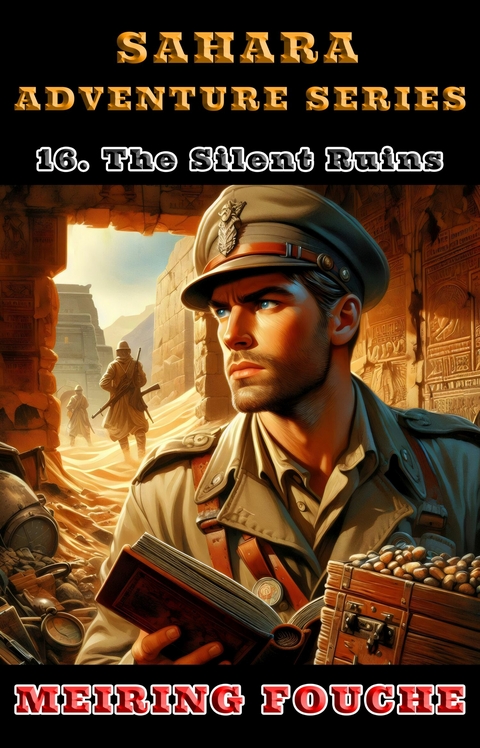
The Silent Ruins (eBook)
101 Seiten
Pieter Haasbroek (Verlag)
978-0-00-077722-5 (ISBN)
Five soldiers of the French Foreign Legion.
One simple escort mission.
A trap that will leave them naked, unarmed, and fighting for their souls under the unforgiving sun.
Sahara desert, 1940-1960. Teuns Stegmann and his four battle-hardened comrades think they've seen it all, but their new assignment, escorting a peculiar scholar into hostile territory, feels wrong from the start. The professor is searching for a lost city, but his shifty eyes and the silent Arabs shadowing their every move hint at a much darker secret.
The search for myth becomes a brutal fight for survival when the trap is sprung. Betrayed and outmaneuvered, the legionnaires are captured by a legendary enemy. Four are left stripped of everything, weapons, clothes, and hope, to die a slow, agonizing death in ancient ruins, while one is forced into an impossible choice. Lead the enemy to a priceless treasure, or condemn his friends to hell on earth.
A relentless classic adventure that plunges into the heart of a high-stakes desert mystery. This gripping action-thriller combines the grit of the French Foreign Legion with a deadly game of cat and mouse. Perfect for fans of Alistair MacLean and Wilbur Smith.
Step into this unforgettable sixteenth Sahara adventure now!
16. RUINS OF DEATH
Chapter 1
THE STRANGER
In the hot, stifling Arabian café in Dini Salam, outpost and garrison town of the French Foreign Legion, the South African Teuns Stegmann slams the Jack of Spades onto the tabletop and then says quietly, “Don’t look now, but we’re being watched.”
His companions around the card table, the large German, Fritz Mundt, the Englishman Jack Ritchie, the Pole Podolski, and the diminutive Italian Petacci, look up questioningly at Teuns.
“I wouldn’t mind being watched by an Arabian beauty,” says the cheerful Petacci, his eyes twinkling.
“Unfortunately, it’s not an Arabian beauty,” says Teuns, taking another sip of the heavy sweet wine, the only refreshment one can buy in this dive. “The fellow sitting watching us looks more like a fox whose tail you’ve chopped off.”
“An Arab?” asks Ritchie.
Teuns shakes his head. “No, he looks to me like one of these scholarly types. Slouching shoulders, thin face, spectacles on his nose, and long hair.”
“Perhaps he’s an imbecile who’s escaped from the asylum,” says the big Fritz Mundt, laughing heartily. “Any European with long hair who shows up here in Dini Salam must certainly have a screw loose.”
“He keeps glancing our way,” says Teuns.
“Keep an eye on the old louse,” warns Podolski. “Perhaps he’s another Arab agent.”
“He looks completely harmless to me,” says Teuns.
“You can never tell, brother,” answers Ritchie, throwing a card onto the table.
“It wouldn’t be bad if we had a bit of excitement again,” opines Fritz Mundt. “Since we last clashed with Koebikof’s bunch, we’ve had nothing to do but swat flies.”
“I think I’m getting old,” yawns Petacci. “I prefer swatting flies in Dini Salam to trekking through the Sahara in this heat of the past month.”
“What’s that creature doing now?” asks Fritz Mundt.
“Looks like he’s truly off his rocker,” says Teuns. “He has a magnifying glass or something, and with it, he sits contemplating a piece of paper on the table. From here, it almost looks like a map.”
“Perhaps the old fellow is searching for the Sabre of Doetra,” Jack Ritchie interjects, sipping his wine. “Is he white?”
“He is white, yes,” says Teuns. “Anyway, forget about the fellow. He’s not even worth a damn.”
“Just note whether he has contact with Arabs,” says Podolski.
“Come, come, fellows,” urges Petacci. “Let’s rather concentrate on the cards. I want to win enough money tonight for my upcoming leave in Algiers.”
Petacci’s words bring them back to reality, and they begin to concentrate on their cards.
They continue playing in silence for a while, concentrating on the cards. But after a while, Teuns cannot help talking about the strange character again. “Odd creature, that one,” says Teuns, the tall, blond South African with his broad shoulders and powerful hands, who is in the French Foreign Legion because Arabs killed his pilot brother during the Second World War.
“It seems to me the fellow is getting on your nerves,” says Fritz Mundt, who is considered the strongest man in the French Foreign Legion.
“He’s so peculiar,” says Teuns. “I can’t stop looking at the fellow. And he’s nothing to look at. As thin as a crow, with those peculiar spectacles on his nose and two enormous jug ears. And then he even has a beard. But it seems to me as though he doesn’t even have a weapon on him.”
“He’ll surely have a weapon in his inside pocket,” says Jack Ritchie.
“I’m watching him,” says Teuns. “He’s fumbled in his inside pockets a few times, but all that comes out are papers. Then the fellow reads something, then he writes something. And he has an enormous briefcase with him.”
“Perhaps that briefcase is full of dynamite instead of documents,” says Podolski.
“And time and again he glances this way, Fritz,” says Teuns. “What business does the fellow have with us?”
Fritz Mundt can no longer contain his curiosity. He turns around and peers over his shoulder. “Surely not that old scarecrow at the fourth table?” asks Fritz.
“The very same,” says Teuns. “You shouldn’t have looked now, Big Man. Now that fellow knows we’re talking about him.”
“He can know, as far as I’m concerned,” answers Fritz, turning back to the table. “I’d kill him with a wine bottle.”
“Has he spoken to an Arab or made a sign to one?” asks Petacci.
“He hasn’t looked left or right, except at us,” says Teuns. “There the fellow is busy with his magnifying glass again. I wish I knew what is written on that paper in front of him.”
“Perhaps he’s also one of these mad types searching for treasure in the Sahara,” says Jack Ritchie.
“Or for a lost city,” adds Petacci, gathering the money he has just won in this round.
“The Sahara sun will burn him to a crisp within two hours,” says Fritz Mundt. “He’s already dried out like a piece of jerky.”
“If the fellow interests you so much,” says Petacci, “why don’t you go ask him who and what he is and why he’s sitting watching us?”
“Let’s play cards,” says Teuns Stegmann. “Petacci is the only one concentrating, and he’s busy cleaning us out.”
But as they play on, Teuns cannot keep his thoughts off this strange foreigner. He is one of those people who immediately capture one’s interest. He is as ugly as the night, as unremarkable as a mouse, and yet there is something about the man that seems mysterious and interesting to Teuns. He is different from other strangers, and Teuns himself cannot explain why. It is just something about the man, perhaps something in the expression in his eyes, or the shape of his hands, that affects you. Teuns is not sure what it is, but of one thing he is certain. That tall, thin, unremarkable fellow is no ordinary man.
And it is not for nothing that he sits in this Arabian café. His surroundings seem lost on him. He apparently does not even realize that it is extremely dangerous for an individual to simply come and sit here in an Arabian café. No man of the Foreign Legion would ever dare to sit here alone and unarmed. Teuns has his four companions with him. And each of them has some weapon under his clothes, perhaps a piece of chain, perhaps a knife or a dagger or whatever, because they have become thoroughly acquainted many times over with the Arab lurkers who frequent these kinds of wine bars and are constantly lying in wait to assault white men.
The fellows begin to concentrate more and more on the card game, and soon the stranger is almost forgotten.
Until they hear a shuffling nearby and look up, surprised.
Standing beside them is the stranger. He is thin and slightly stooped, and he has lively blue eyes behind those thick spectacle lenses, for apparently he is as short-sighted as a mole. Apparently, he also has some defect, for when he shifted his foot, they saw that he limped.
“What is it, old fellow? What do you want from us?” asks Fritz Mundt challengingly. “Why have you been watching us all evening?”
The stranger smiles and then says in a thin voice and in perfect French, “Pardon, legionnaires. I see you are busy with a hand of cards. I regret that I must interrupt.”
“Well, why don’t you clear off then?” asks Podolski.
But it seems as if the man simply shrugs off both Fritz Mundt’s and Podolski’s insults.
“I just came to ask for advice,” he says. “I would like to go into the Sahara, but I need an escort. I wondered if the French Foreign Legion would be willing to help me.”
“Who are you, indeed, to want an escort?” asks Jack Ritchie. “Are you perhaps the King of Albania?”
“No, Monsieur, I am not the King of Albania. I am a French scholar, Professor Lepuy, from the Sorbonne University.”
“Old tomcat,” says Fritz Mundt disparagingly. “And what might you be seeking in the Sahara?”
“That question I shall answer later, Monsieur,” replies the slender stranger.
“Professor Lepuy?” asks Teuns Stegmann with interest.
“Oui, mon ami, Professor Jacques Lepuy, from the Sorbonne University, as I have already said. An archaeologist.”
“Oh, I thought you were a dentist,” mocks Jack Ritchie, bursting into laughter.
“What can we do for you, Professor?” asks Podolski, barely able to contain his laughter at this man who blinks his eyes so incessantly behind the thick spectacle lenses.
“As I say, mon ami,” says the stranger just as amiably, “I would like an escort into the Sahara.”
“Well, why are you bothering us, Professor?” asks Teuns sternly. “You ought to know better than to come asking ordinary legionnaires for help. Why don’t you do things the proper way? Why don’t you go to the commander of Dini Salam?”
“That is what I would like to do,” says Lepuy, shifting his leg again. “All I came to ask you is where I can find the commanding officer and what would be the most convenient time for him.”
“The commander of Dini Salam is Colonel Le Clerq,” informs Petacci. “And the best time to see him is before he’s knocked back his fourth glass of cognac. That is to say, early in the morning, mon Professeur.”
Teuns glares sharply at Petacci for this lack of respect for Colonel Le Clerq. But he can see that the little Italian’s cheeks are red from the wine he has already put away.
“I think it would be best if you speak to Colonel Le Clerq anytime in the...
| Erscheint lt. Verlag | 25.8.2025 |
|---|---|
| Übersetzer | Pieter Haasbroek, Ai |
| Sprache | englisch |
| Themenwelt | Literatur ► Romane / Erzählungen |
| ISBN-10 | 0-00-077722-6 / 0000777226 |
| ISBN-13 | 978-0-00-077722-5 / 9780000777225 |
| Informationen gemäß Produktsicherheitsverordnung (GPSR) | |
| Haben Sie eine Frage zum Produkt? |
 EPUB (Adobe DRM)
Größe: 5,9 MB
Kopierschutz: Adobe-DRM
Adobe-DRM ist ein Kopierschutz, der das eBook vor Mißbrauch schützen soll. Dabei wird das eBook bereits beim Download auf Ihre persönliche Adobe-ID autorisiert. Lesen können Sie das eBook dann nur auf den Geräten, welche ebenfalls auf Ihre Adobe-ID registriert sind.
Details zum Adobe-DRM
Dateiformat: EPUB (Electronic Publication)
EPUB ist ein offener Standard für eBooks und eignet sich besonders zur Darstellung von Belletristik und Sachbüchern. Der Fließtext wird dynamisch an die Display- und Schriftgröße angepasst. Auch für mobile Lesegeräte ist EPUB daher gut geeignet.
Systemvoraussetzungen:
PC/Mac: Mit einem PC oder Mac können Sie dieses eBook lesen. Sie benötigen eine
eReader: Dieses eBook kann mit (fast) allen eBook-Readern gelesen werden. Mit dem amazon-Kindle ist es aber nicht kompatibel.
Smartphone/Tablet: Egal ob Apple oder Android, dieses eBook können Sie lesen. Sie benötigen eine
Geräteliste und zusätzliche Hinweise
Buying eBooks from abroad
For tax law reasons we can sell eBooks just within Germany and Switzerland. Regrettably we cannot fulfill eBook-orders from other countries.
aus dem Bereich