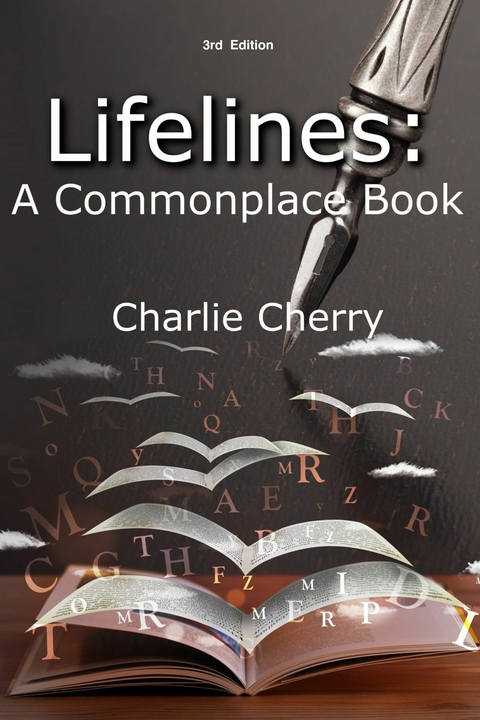
Lifelines: A Commonplace Book (eBook)
1000 Seiten
Bookbaby (Verlag)
979-8-3178-0665-1 (ISBN)
Charlie Cherry is an Emeritus Professor of English at Villanova University and former Editor of QUAKER HISTORY, based at Haverford College. In addition to articles on literature and Higher Education, he is the author of A QUIET HAVEN: QUAKERS AND ASYLUM REFORM and has co-authored/edited five books dealing with rhetoric and Quaker History.
Commonplace Book (also called ZIBALDONE or hodgepodge book) is a collection of favorite sayings or statments of proverbial wisdom. It is a personal collection and varies significantly among individuals. Authors of commonplace books include Seneca the Younger, John Milton, Francis Bacon, Edward Gibbon, George Washington, Thomas Jefferson, W. H. Auden, Nicholson Baker. After a lifetime of reading, the author (a college English teacher) has tried to distill that reading by fixing it for himself, giving some permanence and validating the activity that has most consumed his waking hours. Thus LIFELINES is in some sense an autobiography, a way of recapturing moments of learning, reflection, suprise, insight, basic pleasure provided by creative users of our language.
ABILITY
Ability is what you’re capable of doing.
Motivation determines what you do.
Attitude determines how well you do it.—Lou Holtz (1937- )
To know how to hide one’s ability is a great skill.—Francois de La Rochefoucauld (1613-1680)
Never was ability so much below mediocrity so well rewarded; no, not even when Caligula’s horse was made a consul.—John Randolph (1773-1833) on Richard Rush
From each according to his abilities, to each according to his needs.—Karl Marx (1818-1883)
The greatness of America lies not in being more enlightened than any other nation, but rather in her ability to repair her faults.—Alexis de Tocqueville (1805-1859)
ABORTION
I’ve noticed that everyone who is for abortion has already been born.—Ronald Reagan (1911-2004)
No woman can call herself free who does not control her own body.—Margaret Sanger (1879-1966)
It is a poverty to decide that a child must die so that you may live as you wish . . . .If we can accept that a mother can kill even her own child, how can we tell other people not to kill one another.—Mother Teresa (1910-1997)
I cannot understand anti-abortion arguments that center on the sanctity of life. As a species we’ve fairly comprehensively demonstrated that we don’t believe in the sanctity of life. The shrugging acceptance of war, famine, epidemic, pain, and life-long poverty, shows us that whatever we tell ourselves, we’ve made only the most feeble of efforts to really treat human life as sacred.—Caitlin Moran (1975- )
It seems to me as clear as daylight that abortion would be a crime.—Mahatma Gandhi (1869-1948)
I’m sorry, but all these “life begins at conception” arguments are sheer nonsense. Killing a cluster of cells that has the potential of becoming human life is not the same as killing a human being. Here is a reductio ad absurdum argument for all the extreme pro-lifers. With modern cloning technology, a simple skin cell is a potential baby. Where do pro-life people stand on removing a wart or a mole? Are dermatologists the latest in the long list of baby killers?—“Dialogue is Needed on Abortion,” St. Petersburg Times [Florida], May 20, 2009.
. . .the pro-life movement should focus on seeking to reduce the number of abortions. . . .these hard-liners are fools. Because they want to outlaw all abortions, they refuse to settle for stopping some abortions; the consequence is that they end up preventing no abortions.—Dinesh D’Souza, Letters to a Young Conservative (2002)
ABSENCE
This corner makes me drowsy
like a bad unguent. Your absence is
a need to close my eyes. The cracked Tiffany lamp
a shaded rose you bought at a Brooklyn thrift shop—
now a throbbed Persephone
gone underground.
You are no epitaph but that scarred piano
we used to play. Great music trivializes, when
so much worse hurts, can’t keep my
eyelids open. The hypnotizing rugs that
stare into Alone. My thoughts sway into violent,
black somnambulant, cold death
supplying the madness of your gone. . . .—Jane Mayhall, “Why a Corner in the Apartment Puts Me to Sleep”
Absence diminishes commonplace passions and increases great ones, as the wind extinguishes candles and kindles fire.—Francois de La Rochefoucauld (1613-1680)
Most of what matters in your life takes place in your absence.—Salman Rushdie (1947- )
Your absence has gone through me
Like thread through a needle.
Everything I do is stitched with its color.—W. S. Merwin, “Separation”
It is this great absence
That is like a presence . . . .
Genes and molecules
have no more power to call
him up than the incense of the Hebrews
at their altars. My equations fail
as my words do. What resource have I
other than the emptiness without him of my whole
being, a vacuum he may not abhor?—R. S. Thomas, “The Absence”
How like a winter hath my absence been
From thee, the pleasure of the fleeting year!
What freezings have I felt, what dark days seen!
What old December’s bareness everywhere. . . .—William Shakespeare, Sonnet 97
The joy of life is variety; the tenderest love requires to be renewed by intervals of absence.—Samuel Johnson (1709-1784)
Absence is a house so vast that inside you will pass through its walls and hang pictures on the air.—Pablo Neruda (1904-1973)
ABSURD
Thus I draw from the absurd three consequences, which are my revolt, my freedom, and my passion. By the mere activity of consciousness, I transform into a rule of life what was an invitation to death—and I refuse suicide. I know, to be sure, the dull resonance that vibrates through these days. Yet I have but a word to say: that it is necessary. When Nietzsche writes: “It clearly seems that the chief thing in heaven and on earth is to obey at length and in a single direction: in the long run there results something for which it is worth the trouble of living on this earth as, for example, virtue, art, music, the dance, reason, the mind—something that transfigures, something delicate, mad or divine,” he elucidates the rule of a distinguished code of ethics. But he also points the way of the absurd man. Obeying the flame is both the easiest and the hardest thing to do. However, it is good for man to judge himself occasionally. He is alone in being able to do so.—Albert Camus, The Myth of Sisyphus (1942), pp. 47-48.
. . .Sisyphus is the absurd hero. He is, as much through his passions as through his torture. His scorn of the gods, his hatred of death, and his passion for life won him that unspeakable penalty in which the whole being is exerted toward accomplishing nothing. . . .This universe henceforth without a master seems to him neither sterile nor futile. Each atom of that stone, each mineral flake of that night-filled mountain, in itself forms a world. The struggle itself toward the heights is enough to fill a man’s heart. One must imagine Sisyphus happy (p. 85).
Those who can make you believe absurdities can make you commit atrocities.—Voltaire (1694-1778)
It is absurd to divide people into good and bad. People are either charming or tedious.—Oscar Wilde (1854-1900)
. . .love itself is never absurd, and neither are any of its participants. Despite all the stern orthodoxies of feeling and behavior that a society may seek to impose, love slips past them. You sometimes saw, in the farmyard, improbable forms of attachment—the goose in love with the donkey, the kitten playing safely between the paws of the chained-up mastiff. And in the human farmyard, there existed forms of attachment which were just as unlikely; and yet never, to the participants, absurd.—Julian Barnes, Only One Story (2018), p. 201.
I have complete faith in the continued absurdity of whatever’s going on.—Jon Stewart (1962- )
In this world of utter futility, of futile humility and futile domination, the highest degree that passion, desire, creative urge can attain is a new cloak which both tailors and customers adore on their knees. I am not speaking of the moral point or the moral lesson. There can be no moral lesson in such a world because there are no pupils and no teachers; this world is and it excludes everything that might destroy it, so that any improvement, any struggle, any moral purpose or endeavor, are as utterly impossible as changing the course of a star.—Vladimir Nabokov, “Gogol’s Genius in ‘The Overcoat’” (1981)
ACADEMIC(S) (See EDUCATION)
[academic publishing]: No one reads these books. Everyone just agrees to publish everyone else’s. It’s one big circle jerk. It’s a giant economic agreement. When you think about it, it probably violates the Sherman Act.—Lorrie Moore, “Terrific Mother,” in Birds of America (1998), p. 279.
I expect you’ll be becoming a schoolmaster, sir. That’s what most of the gentlemen does, sir, that gets sent down for indecent behavior.—Evelyn Waugh, Decline and Fall (1928).
I wrote, “The clock is the weapon with which we butcher our lives,” and felt pleased with myself. From the age of twelve and my huge paper route, the largest in the Toledo area, my life has been strictly circumscribed by the clock. There is scarcely a profession more time-conscious than the academic—outside the obvious trains, planes, and buses—given the classes, appointments, committee meetings, faculty meetings, perhaps “meeting meetings” that are organized to stuff lacunae. Even our annual Modern Language Association convention meetings include schedule items such as “5:10-5:35, Getting to Know Each Other Cocktails.”—Jim Harrison, Julip (1994), p. 226.
Elitist is a label for people (like me) who believe that, frequently, egalitarianism is envy masquerading as philosophy. . . .Surely a just society is one in which people deserve their positions, and in which inequalities are reasonably related to reasonable social goals. Justice requires a hierarchy of achievement—unless all achievements are of equal social value, in which case all inequalities are arbitrary and illegitimate “privileges.” Something like that extreme egalitarianism enjoys a vogue in academic circles and helps produce grade inflation.—George F. Will, “D is for Dodo,”...
| Erscheint lt. Verlag | 30.7.2025 |
|---|---|
| Sprache | englisch |
| Themenwelt | Literatur ► Romane / Erzählungen |
| ISBN-13 | 979-8-3178-0665-1 / 9798317806651 |
| Informationen gemäß Produktsicherheitsverordnung (GPSR) | |
| Haben Sie eine Frage zum Produkt? |
 EPUB (Ohne DRM)
Größe: 2,8 MB
Digital Rights Management: ohne DRM
Dieses eBook enthält kein DRM oder Kopierschutz. Eine Weitergabe an Dritte ist jedoch rechtlich nicht zulässig, weil Sie beim Kauf nur die Rechte an der persönlichen Nutzung erwerben.
Dateiformat: EPUB (Electronic Publication)
EPUB ist ein offener Standard für eBooks und eignet sich besonders zur Darstellung von Belletristik und Sachbüchern. Der Fließtext wird dynamisch an die Display- und Schriftgröße angepasst. Auch für mobile Lesegeräte ist EPUB daher gut geeignet.
Systemvoraussetzungen:
PC/Mac: Mit einem PC oder Mac können Sie dieses eBook lesen. Sie benötigen dafür die kostenlose Software Adobe Digital Editions.
eReader: Dieses eBook kann mit (fast) allen eBook-Readern gelesen werden. Mit dem amazon-Kindle ist es aber nicht kompatibel.
Smartphone/Tablet: Egal ob Apple oder Android, dieses eBook können Sie lesen. Sie benötigen dafür eine kostenlose App.
Geräteliste und zusätzliche Hinweise
Buying eBooks from abroad
For tax law reasons we can sell eBooks just within Germany and Switzerland. Regrettably we cannot fulfill eBook-orders from other countries.
aus dem Bereich