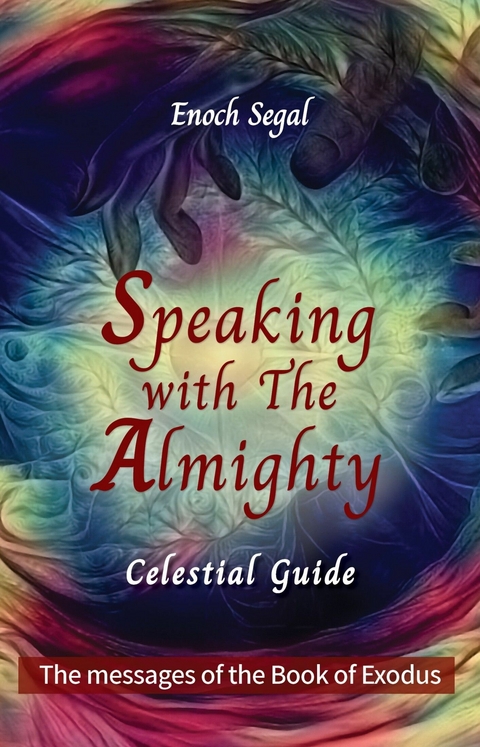
Speaking with the Almighty (eBook)
104 Seiten
Publishdrive (Verlag)
978-0-00-097290-3 (ISBN)
Between epic plagues and a daring escape, The Celestial Guide (TCG) reveals God's subtle hand guiding the Israelites' transformation.
Yet every step begs: who truly pulls the strings?
Was Moses' journey no more than an allegory?
The Third Message: Baby Moses
Enoch: This is how the story of Moses begins.
TCG: True, but what is important right now is to learn about Moses’s
family. Only the person who knew what may come of this people
would’ve understood that it is important to focus on the Levites, sons
of Levy so of Jacob, who has arrived in Egypt with his family.
And who is the only one who could predict the future?
“And there went a man of the house of Levi, and took to wife a daughter of Levi.”
(Exodus 2:1)
Enoch: God naturally; and everything that happens is because of
Pharaoh’s decree to kill all the male-born, right?
TCG: Yes, not a very striking story; an ark made of bulrushes, which can
float and is sent afloat on the Nile with a 3-month old in it, while his
older sister Miriam watches over him.
Enoch: What did they expect to happen? There are no guarantees that
the baby would get out of this safely. There isn’t one even from God.
They know (Moses’s family) that they are willingly risking his life and
the future of their family, should they continue keeping him.
TCG: I agree with you fully. You have understood what the dilemma was
all about. You could say that the boy would not be safe, but the safety
of the family is more important, that is why Miriam was sent to watch
over him, to ensure that he is saved. And see for yourself that they are
not devout people; they never prayed for God to save Moses, it was
their logical decision to send him adrift on the river.
Enoch: Maybe, but they had hope. And who received the ark; was that a
coincidence?
TCG: I’m highly doubtful of that; and who do you think made it happen?
Enoch: God had definitely helped the ark reach its destination, as you
said – he was the “director” of it all.
TCG: You’re a fast learner. It is definitely so, as it is part of the Divine
Plan for the Israelites, who are now struggling and see their children
being annihilated. But, as we had read before, the Egyptians
themselves make it so, and they have their own “squealers” among the
Hebrew brethren. But, there is one important detail which I had told
you in the previous message: “And she had compassion on him, and
said,This is one of the Hebrews' children.” (Exodus 2:6) This is what
Pharaoh’s daughter said; she made a statement here. So this wasn’t the
first time babies “were found” just like that, which means that
Yocehbed’s (Moses’ mother, who we’d learn about later) to send him
adrift on the Nile wasn’t the first to think about it. “Then said his sister to
Pharaoh's daughter, Shall I go and call to thee a nurse of the Hebrew women,
that she may nurse the child for thee?” (Exodus 2:7) Without fear, as it was
already customary apparently, Miriam spoke to Pharaoh’s daughter
and offered a Hebrew wetnurse, Miriam as well as Pharaoh’s daughter
understood one another. And who could be the wetnurse…?
Enoch: Well, it was a game here, as if Yocehbed wasn’t his mother.
TCG: “And Pharaoh's daughter said to her, Go. And the maid (a maid, not a
child – hence why she had the audacity to address Pharaoh’s daughter) went
and called the child's mother. And Pharaoh's daughter said unto her, Take this
child away, and nurse it for me, and I will give thee thy wages. And the
women took the child, and nursed it.” (Exodus 2:8-9) So that’s how you
play the game there, gentlemen. Pharaoh’s daughter pays her for
doing her job, so to speak.
Enoch: And Pharaoh’s daughter adopts Moses as her son, without telling
her father, as by doing so she has defied the high decree her father
had made.
TCG: “And the child grew, and she brought him unto Pharaoh's daughter, and he
became her son. And she called his name Moses: and she said, Because I drew
him out of the water.” (Exodus 2:10) The name also implies “saviour”
(M-S-H root in Hebrew stands for “move” and “taken”, which is exactly
what saviours do – they take people away from danger), Enoch – have
you noticed? I did. Though it could be purely metaphorical, that his
name as well as his job in Egypt as well as for the Israelites, is the
same. Without him knowing it, he would become the prince of Egypt
and the saviour of the Hebrews, the supreme-leader. God’s second in
command, just like Joseph was Pharaoh, the God of Egypt’s, second in
command. That is the metaphor. It all now entwines.
Enoch: So Moses is actually a “fifth column” is Pharaoh’s court, who
knows nothing of it, hehe.
TCG: More like a “Trojan Horse”, hehe.
The Fourth Message: Who made thee a prince and a judge over us
Enoch: Ok, Moses grows up and becomes a young man.
TCG: Yes, the bible skips forwards but doesn’t update us on what has happened from the time Moses was a babe until he became 20 or so, the age he is at the beginning of the story.
Enoch: What do you mean? What is supposed to happen?
TCG: Moses grows up to be an Egyptian prince. That means that he learns the martial ways, works out, hunts, and learns how to lead, which is what any other man in his position would’ve needed to learn.
Enoch: Ok, that is crystal-clear, so what? Do you want to address the killings?
TCG: 20 years prior, what happened in Egypt exactly, with Pharaoh’s decree to kill all the Hebrew children, assuming they continue multiplying?
Enoch: I didn’t pay attention to it, because it wasn’t explicitly said.
TCG: If they had told the story, questions would’ve been asked, like what happened in The Holocaust (and elsewhere), where was God in all of this. Anyhow, tens of thousands if not hundreds of thousands of babies were slaughtered over a period of twenty years in a daily massacre. And that, my esteemed colleague, called “a Holocaust”. The first one. That is why the holiday of Passover is also called The Holiday of Freedom: from bondage to salvation. But has the massacre abruptly ended? What about the female slaves, which were spared of this massacre? What rights did they have? How many have died in bondage? How many were massacred in a period of 20 years?
Enoch: I am speechless.
TCG: “And it came to pass in those days, when Moses was grown, that he went out unto his brethren, and looked on their burdens: and he spied an Egyptian smiting an Hebrew, one of his brethren.” (Exodus 2:11) The bible tells us what Moses had felt; he felt the suffering of his brethren, but could it be that someone had told him he was a Hebrew or was he just empathetic to their suffering?
Enoch: What do you think?
TCG: See it as my own speculation, as I have no further information about this. Moses knew he was the son of a Hebrew woman or he understood from implication only or was told about it because he most-probably asked his mother how he was different than everyone else.
Enoch: True, but that is merely speculation; how do you know it to be true?
TCG: “And he looked this way and that way, and when he saw that there was no man, he slew the Egyptian, and hid him in the sand.” That is what Moses did to the wicked Egyptian, who was torturing the Hebrew.
“And when he went out the second day, behold, two men of the Hebrews strove together: and he said to him that did the wrong, Wherefore smitest thou thy fellow? And he said, Who made thee a prince and a judge over us? intendest thou to kill me, as thou killedst the Egyptian? And Moses feared, and said, Surely this thing is known.” (Exodus 2:13-14) When the Hebrews strove, Moses doesn’t do a thing; he is now being blackmailed by the Hebrew, who apparently saw him killing the Egyptian. To me it means that a Hebrew does not kill a Hebrew, and Moses now knows that his only option is to escape. And what does the Hebrew do? Turn him in to Pharaoh.
Enoch: How do you know that? Where is that implied?
TCG: “Now when Pharaoh heard this thing, he sought to slay Moses. But Moses fled from the face of Pharaoh, and dwelt in the land of Midian: and he sat down by a well.” (Exodus 2:15) Now, how exactly did Pharaoh hear of this killing of no one was there to tell him?
So Moses runs away to Midian, as it wasn’t under Egyptian control. The High Priest of Midian had therefore 7 daughters, all of them were shepherds.
We know that Egypt was an agricultural society. These daughters come to water their herds, while other herdsmen badger them and banish them and their herds from the well. Why do you think Moses came to their defence?
Enoch: He’s a goody-two-shoes.
TCG: Moses intervenes because he detests injustice and would always support the weak. He waters the herds and the girls return to their home. Then Moses is...
| Erscheint lt. Verlag | 1.6.2025 |
|---|---|
| Sprache | englisch |
| Themenwelt | Literatur ► Romane / Erzählungen |
| ISBN-10 | 0-00-097290-8 / 0000972908 |
| ISBN-13 | 978-0-00-097290-3 / 9780000972903 |
| Informationen gemäß Produktsicherheitsverordnung (GPSR) | |
| Haben Sie eine Frage zum Produkt? |
 EPUB (Adobe DRM)
Größe: 640 KB
Kopierschutz: Adobe-DRM
Adobe-DRM ist ein Kopierschutz, der das eBook vor Mißbrauch schützen soll. Dabei wird das eBook bereits beim Download auf Ihre persönliche Adobe-ID autorisiert. Lesen können Sie das eBook dann nur auf den Geräten, welche ebenfalls auf Ihre Adobe-ID registriert sind.
Details zum Adobe-DRM
Dateiformat: EPUB (Electronic Publication)
EPUB ist ein offener Standard für eBooks und eignet sich besonders zur Darstellung von Belletristik und Sachbüchern. Der Fließtext wird dynamisch an die Display- und Schriftgröße angepasst. Auch für mobile Lesegeräte ist EPUB daher gut geeignet.
Systemvoraussetzungen:
PC/Mac: Mit einem PC oder Mac können Sie dieses eBook lesen. Sie benötigen eine
eReader: Dieses eBook kann mit (fast) allen eBook-Readern gelesen werden. Mit dem amazon-Kindle ist es aber nicht kompatibel.
Smartphone/Tablet: Egal ob Apple oder Android, dieses eBook können Sie lesen. Sie benötigen eine
Geräteliste und zusätzliche Hinweise
Buying eBooks from abroad
For tax law reasons we can sell eBooks just within Germany and Switzerland. Regrettably we cannot fulfill eBook-orders from other countries.
aus dem Bereich