


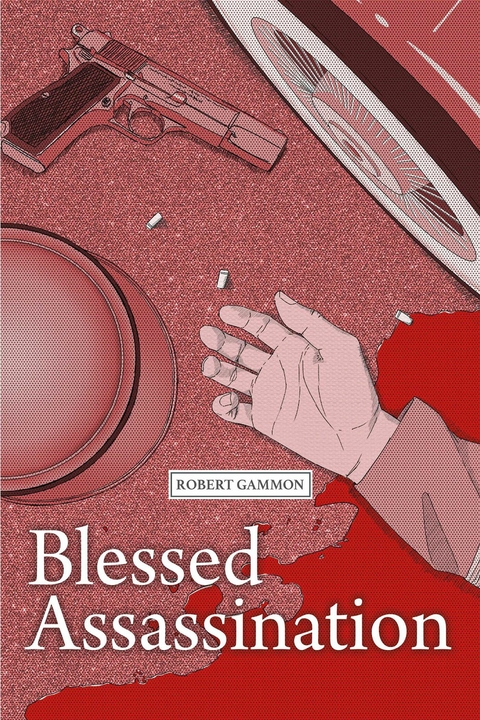
Blessed Assassination (eBook)
348 Seiten
Bookbaby (Verlag)
979-8-3178-0346-9 (ISBN)
Use 'Original' text but exclude text that begins with: A CONVERSATION WITH ROBERT GAMMON
In 1933, during one of the most terrifying periods in history, with the world in the mire of the Great Depression and sleepwalking towards World War II, John, an investigative journalist from The Washington Post, witnesses the "e;blessed assassination"e; of the president of Peru. In the midst of a civil war, international conflicts, hounded by the police and even by his own American embassy, and saving the woman he loves, John risks his life, facing powerful enemies, to uncover a sinister plot with global ramifications that precedes the president's assassination. Following considerable research about a country he loves, Robert Gammon's novel reveals historical events leading up to the president's assassination, across the street from where Robert lived in Lima. If you enjoyed Ken Follet's Century Trilogy or Nobel Prize winner Mario Vargas Llosa's Fierce Times or Feast of the Goat, you'll enjoy Blessed Assassination. The novel, based on true events, transports readers to a different world, to another era. The shocking events of the 1930s may seem distant, but today we are once again experiencing similar crises, autocracies, and populism. After a boozy night, John is woken up the following morning by his assistant, Pedro, who breaks the news that President Sanchez-Cerro, an army strong-man, has been shot. The president's life was saved by his friend and adjutant, Lieutenant Colonel Gonzalo Vargas, Pedro's father. And the young would-be assassin turns out to be Pedro's cousin, who is sentenced to death. Before being employed by The Washington Post, John first arrived in Peru when his father's patron, Mr James Randall III, an important Boston businessman, enticed him to join an economic mission advising the Peruvian government. But Randall expected John to help him with his murky business plans, corrupting Peruvian officials. John has a passionate affair with Yolanda, a bright Peruvian lawyer from a humble family toiling on Peru's largest sugar cane plantation. Randall demands that John spies on the sugar cane plantation and help him buy it at a distressed low price. John refuses and quarrels violently with Randall, who swears revenge. John discovers a mysterious report from Randall, scheming to become USA Vice President and then replace the President by foul means. Randall intends allocating business to USA multinational companies backing him, and control Latin American governments. Also, Randall would avoid war by colluding with totalitarians like Hitler, Mussolini and even Imperial Japan, curbing the Russian Communist menace to international business. Army strong-man Sanchez-Cerro, supported by local and foreign businessmen, had won presidential elections defeating Haya, Latin America's most influential radical politician his ideas feared by conservative politicians and businessmen alike. But Haya accused him of electoral fraud. Sanchez-Cerro's regime soon turns authoritarian, banning democratic opposition led by Haya's party. Sanchez-Cerro accuses Haya of attempting to assassinate him and imprisons Haya in horrendous conditions. Fearing for his life, Haya's supporters' revolt, after overrunning an army barracks where John and Pedro save a badly injured Gonzalo. John, Pedro and Gonzalo, together with Yolanda, find refuge in a friend's house. Yolanda's brother is a rebel leader and he and Pedro are arrested with hundreds of rebels and face being lined up in front of a firing squad when the army puts down the rebellion after days of bloody fighting. Peru is in the grips of civil war. Now, John makes dead enemies not only of Randall but also the Sanchez-Cerro regime, for revealing to a horrified world public opinion in The Washington Post the regime's massacre of civilians. Gonzalo Vargas is torn between his horror at the abominable massacre by the army in Trujillo and his loyalty to Sanchez-Cerro, his long-time friend and fellow career officer.
Chapter 2
The telephone rang and rang in the next room. John opened his eyes, fumbled for his watch and cursed – midday already. Another splitting headache. How much had he drunk last night? Another bout lost against the demon whisky, but at least he hadn’t got caught up in another brawl. The phone echoed painfully inside his head as he pleaded for it to cease. But it wouldn’t.
He stumbled out of bed, flung the door open, struggled to the table and picked up the receiver. His mouth was dry and sickly. Still drowsy, he failed to muster words as he heard:
“John? Listen, they’ve shot the president!”
“Pedro? What the hell…? When… where…?”
“This morning, in Miraflores.”
“Christ! Is he dead?”
“I don´t know. They’ve taken him to Clínica Delgado.”
“Where’s that?”
“It’s in Miraflores, near the main church.”
“Okay, Pedro, get a taxi and pick me up… and don’t forget the camera.”
John sat down, puffed out and rubbed his eyes. Recent events had provided abundant material for his reports in The Washington Post, but this was hugely different. The president of Peru, shot? What on earth would happen now? The Post’s international editor would be clamouring for news.
He freshened up and dressed. As he lit a cigarette, a car horn blared from the street below. Looking down, he saw Pedro waving from the waiting taxi.
Downstairs, Pedro wore a long face and red eyes.
“John, they’ve also shot my father.”
“What…?”
“He was in church, with Sánchez-Cerro. His adjutant phoned me a moment ago. My father put himself in the way of the gunman and took one of the shots.”
The cabby hadn’t missed a word.: “Ah, sir, then your father is the hero they’re talking about. I heard on the radio that an army officer, a Lieutenant Colonel Vargas, saved the president.”
“Have you heard if they’re dead?” asked Pedro.
“No sir. I only heard they took them both to Clínica Delgado in Miraflores.”
“Okay, take us to Clínica Delgado” ordered John.
“But, sir, they won’t let you in,” said the cabby.
“Just take us there, quick. We’ll get in,” said John. The cabby shrugged and pressed on the gas pedal.
They whizzed along Avenida Arequipa, the long road linking the centre of Lima with Miraflores, John patted Pedro on the shoulder. “Don’t worry buddy, your father will be okay.” Pedro pressed his lips and sniveled.
The brakes screeched as they stopped outside Clínica Delgado. John and Pedro jumped out and rushed up the steps, but the entrance was blocked by a dozen policemen, keeping the gathering crowd at bay.
“I’m the son of Lieutenant Colonel Vargas. I’ve come to see him,” said Pedro.
“Nobody is allowed into the hospital. Go away!” said a sweaty, plump policeman, pushing him back.
John flashed his Washington Post correspondent’s credentials at the policeman: “International press. We’ve come to report. You must allow us in.”
“It’s okay, they can come in” said a young army officer, coming out of the hospital from behind the police cordon.
Lieutenant Colonel Vargas’ adjutant led Pedro and John into the hospital. Inside, nurses ran around like headless chickens.
“How’s my father? Is he dead?”
“No, no, he’s alive. Come with me,” said the officer.
They rushed along a hallway, through one set of double doors, then another and the adjutant stopped. He knocked on a door, opened it and led them in.
Lieutenant Colonel Gonzalo Vargas lay on a bed in hospital pyjamas. Pedro smiled, rushed over to his father and embraced him.
“Papa, how are you? What happened?”
“I got hit in the leg…” said Gonzalo, pointing, “…when the crazy kid shot the president. But I’m alright.”
“Is the president dead?” asked John.
“Thank God he’s still alive, but they’re operating on him right now,” said Gonzalo.
“A nurse told me the president was very lucky. His glasses case, in his pocket, saved him,” said the adjutant. “It lessened the bullet’s impact, diverting it away from his heart. Your father is a hero, Pedro. If he hadn’t put himself in the way the president would be dead now.”
“But who is this kid? Was he alone?” asked John.
Gonzalo pursed his lips before speaking: “José Melgar.”
“Whaaat? I don’t believe it!” said Pedro.
John stared at Pedro: “Who´s José Melgar?”
“My cousin… José is my little cousin…Why on earth would he do this, papa?” said Pedro, gaping at his father.
“Pedro, in Military Intelligence we had his name on a list. I couldn’t believe it either, but his mother told me he got mixed up with friends in APRA.”
John’s eyes opened wide. This was privileged access to two key sources in the assassination attempt: Pedro’s father, and Pedro himself. He pulled out his notebook and started scribbling.
APRA – of course, they’d be obvious suspects. APRA had lost the presidential elections. APRA’s leader, Víctor-Raúl Haya, alleged that Sánchez-Cerro had won fraudulently. Then, APRA’s elected representatives were banished from Congress, imprisoned or exiled abroad, together with journalists and other opposition politicians. Sánchez-Cerro now ruled autocratically, to the relief of the ruling classes, terrified that Haya’s radical ideas would bring upheaval to Peru, like the Russian or Mexican revolutions.
Gonzalo sighed: “Since José’s father died, the family hardly makes ends meet. Jose’s mother lost her job at the telephone company. It was given to someone from Sánchez-Cerro´s Unión Revolucionaria political party. And José complained that two of his friends’ fathers, a schoolteacher and a policeman, were arrested and deported, accused of belonging to APRA. José came home one day shouting he’d had enough of adults moaning about Sánchez-Cerro but doing nothing.”
“But what’s happened to José?” asked Pedro.
“I heard he was injured, smashed his head. They took him to hospital, then to prison, to the Panóptico,” said the adjutant. The Panóptico – the fortress prison in central Lima. At least he’d be safe from Sánchez-Cerro supporters wanting to lynch him but also secluded from APRA faithful trying to free him.
John left Pedro at the hospital with his father and grabbed a cab back into Lima. He had a scoop for The Washington Post. John was the only remaining foreign correspondent in Peru and the outside world relied on him to know the uncensored truth about the country’s descent into despotism.
Approaching the Panóptico prison, John saw a crowd gathering outside. Suddenly, shots rang out and people backed off. Then, more shots. Were guards repelling shots fired from the crowd?
“Damn it, I shouldn’t have come this way” said the cabby: “Those are APRA supporters, coming to free that kid, Melgar. This will end in a bloodbath.”
The taxi driver reversed, heading away from the crowd, as riders galloped up to the Panóptico’s gates. The mounted police charged the crowd. Those who didn’t get out of the way were knocked over, like skittles in a bowling alley. With people fleeing in panic, the riders chose not to pursue them.
After retreating, the crowd held its ground and massed in front of the enormous, new Palacio de Justicia building, under construction opposite the Panóptico, across a wide avenue. Protestors pelted the police with stones and bricks from the building site, shouting defiant obscenities. But the grim prison walls, six metres (19 feet) high, just ignored them, in unperturbed silence, its gateway an enormous mouth which had swallowed young José Melgar. Over the years, many poor souls had been devoured after finding themselves on the wrong side of the law, or the ruling regime.
What the hell would happen now? Seated at his desk, in front of his typewriter and a blank sheet of paper, John scratched his head. How to explain the unfolding drama to his Washington Post readers?
John Fitzgerald had arrived in Peru less than two years earlier, from his native Boston, Massachusetts. After graduating in history from Harvard, he’d faced the Great Depression and the question of how on earth to make a living. His father, an Irish immigrant who’d lost his wife to pneumonia, struggled to become a university lecturer: steady job, reasonable salary, but John couldn’t burden his old man.
John was well built, with light brown hair and lively green eyes which lit up in conversation. A ready smile distracted from a scar under his chin, gashed during another scuffle in his rundown Irish-immigrant neighbourhood in West End, Boston. Sharpening his fists at the local boxing gym ensured he could see off anyone in a street fight. Yet acquaintances remarked on his polite tongue and willingness to help those in need – uncommon on the rough streets of the West End –. John wasn’t sure whether his strict Catholic upbringing, with catechism drilled into him by a stern schoolteacher, Father Joseph, had been an asset or a drawback.
Unsure if God had answered his prayers, John welcomed the one stroke of luck. His father introduced him to his patron, Mr. James W. Randall III,...
| Erscheint lt. Verlag | 18.7.2025 |
|---|---|
| Sprache | englisch |
| Themenwelt | Literatur ► Krimi / Thriller / Horror |
| ISBN-13 | 979-8-3178-0346-9 / 9798317803469 |
| Informationen gemäß Produktsicherheitsverordnung (GPSR) | |
| Haben Sie eine Frage zum Produkt? |
 EPUB (Ohne DRM)
Größe: 2,6 MB
Digital Rights Management: ohne DRM
Dieses eBook enthält kein DRM oder Kopierschutz. Eine Weitergabe an Dritte ist jedoch rechtlich nicht zulässig, weil Sie beim Kauf nur die Rechte an der persönlichen Nutzung erwerben.
Dateiformat: EPUB (Electronic Publication)
EPUB ist ein offener Standard für eBooks und eignet sich besonders zur Darstellung von Belletristik und Sachbüchern. Der Fließtext wird dynamisch an die Display- und Schriftgröße angepasst. Auch für mobile Lesegeräte ist EPUB daher gut geeignet.
Systemvoraussetzungen:
PC/Mac: Mit einem PC oder Mac können Sie dieses eBook lesen. Sie benötigen dafür die kostenlose Software Adobe Digital Editions.
eReader: Dieses eBook kann mit (fast) allen eBook-Readern gelesen werden. Mit dem amazon-Kindle ist es aber nicht kompatibel.
Smartphone/Tablet: Egal ob Apple oder Android, dieses eBook können Sie lesen. Sie benötigen dafür eine kostenlose App.
Geräteliste und zusätzliche Hinweise
Buying eBooks from abroad
For tax law reasons we can sell eBooks just within Germany and Switzerland. Regrettably we cannot fulfill eBook-orders from other countries.
aus dem Bereich


