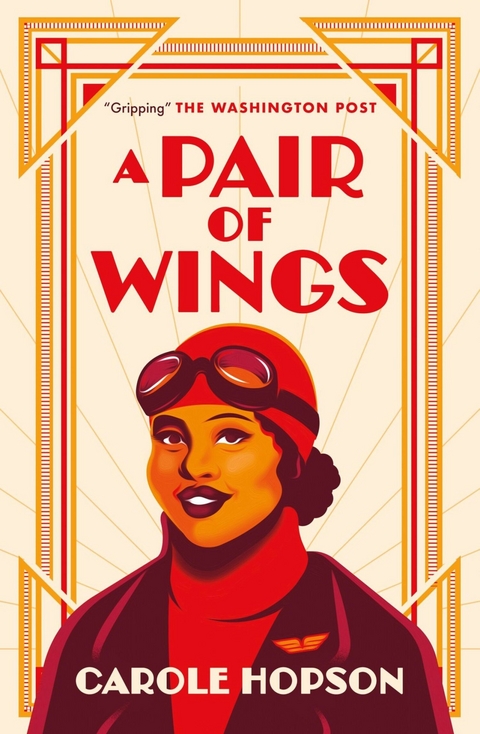
A Pair of Wings (eBook)
383 Seiten
CASSAVA REPUBLIC (Verlag)
978-1-913175-81-8 (ISBN)
CAROLE HOPSON is a captain on the Boeing 737 for United Airlines, based in Newark, New Jersey. After a twenty-year career as a journalist and executive for iconic brands like the National Football League, Foot Locker, and L'Oréal, Carole followed her dream to become a pilot. A century after Bessie Coleman soared over seemingly insurmountable obstacles, Black women in the U.S. account for less than one percent of all professional pilots. Inspired by Bessie's spellbinding accomplishments, Carole founded the Jet Black Foundation, a 501(c)(3) organization dedicated to sending one hundred Black women to flight school by the year 2035.
The plane rattled, as if with fever.
The engine spit once, and then, like a ruptured heart, my Curtiss OX-5 engine burst, spewing hot oil from both sides of its chest. My own heart pounded in unison. My plane was shaking violently and as I rumbled through the air, one last rivet held the tin cover firmly on the engine. That tiny bolt pulsated like a bead of rain on a snare. I watched it as it finally gave way. It popped like a cork, setting free a giant square of sheet metal.
As the tin peeled back from the cowling, it became a blade, separating a column of air around itself, slowing down, then accelerating around the path it cut as it sliced right over my head. I ducked just in time to avoid a beheading. For a split second, I thought that the wicked sound of the giant razor slicing the air above my ear might be the last sound I’d ever hear.
I said a silent prayer that the flying razor would land far away from any living thing.
My goggles were now splattered with oil. I tried to wipe the lenses with my gloved hand, and through the smudge, I could see nothing but hills in every direction. But then, in the distance, I thought I could make out what looked to be a level field, and with a plan to put her down gently—engine out, no big deal—at the glide speed of fifty miles per hour, I grew confident that I could make it. I’d just set her down nice and easy like, directly into a headwind to give myself maximum lift.
Alone in the cockpit, with only myself to rely on, I began speaking directions aloud and counting on the science I knew by heart: because of the wing’s humped shape, it cuts through the air in a way that produces a positive—or upward—pressure under the flat bottom of the wing and a negative—or reduced—downward pressure on the hump on the top of the wing. This relative difference in pressure, while small, is big enough to produce lift.
With less than a thousand feet to go, my scientific meditations stopped abruptly. The field I had been aiming for no longer appeared static. As I descended, I could see that it wasn’t a field at all. It was a playground; the doors of the building attached to it were flung wide, as dozens of children fanned out in every direction, their barrettes and brass buttons flashing in the sun.
I ruled out what not to do. Any turn I made would be disastrous. A slow-speed turn would mean one wing awkwardly pointed downward and the other wing up. A deadly spiral would come next. I would strike the ground wingtip first, and a wicked cartwheel would splinter the plane, grinding everything below me to bits. At five hundred feet, distance, gravity, and the inescapable laws of nature added up to hard facts and a set of desperate calculations. There were only two things I could think of that would give me enough distance to glide past the schoolyard. Next to me, I had strapped body-sized rucksacks filled with Coast Tire leaflets. The heavy weight of the paper was dragging my speed, and so I unbuckled my seat belt, unbuckled the sacks, and heaved them over the side, providing a couple of knots of airspeed and adding a fraction of a minute to the time I had left in the air.
The milliseconds clapped by in my head. Only two hundred feet to go, and I was descending fast, close enough to the ground to see a boy’s cap fly off his head, the plaits bouncing atop a redheaded little girl. I could see light glinting from another girl’s spectacles as she bent and scooped up a fallen child—a slighter girl in a blue-and-white gingham sailor dress. A nun in a habit was trying to herd the children back into the building, but to no avail—the little ones were scrambling everywhere, scattering like billiard balls. At a hundred feet above them, I was now near enough that the shadow of my wings devoured the children’s sunlight. The sound of their screams flooded my ears. The children’s terror rattled me.
In my peripheral vision, I saw the schoolhouse flag waving gently in the breeze, indicating the direction of the wind. If I could land with it at my back, I might add a couple of yards to my landing distance. In a normal situation, a tailwind is the least desirable wind with which to land. A tailwind pushes, forcing the plane to roll, sometimes past the end of an airstrip. A tailwind can push you into a chicken coop, into a pigpen, or, worse yet, into a grain silo, or even off a cliff. But I was already smack-dab in the middle of a worst-case scenario, so I snatched the last opportunity I had. Every foot counted. At this point, every inch counted. Cartwheel be damned, I threw my boot into the rudder and sliced right. A gust of wind obliged.
Within seconds, there were no more choices. At fifty feet, I tugged on the stick, pulling it back as far into my body as it could go, but the travel had been exhausted. There was no more air left. The earth rushed up at me, then swallowed both me and my aeroplane whole.
***
I heard their footsteps before I saw them.
My lids and lashes batted away dirt and blades of saw grass, and my eyes opened on a sky so blue and a sun so bright that it hurt to look up. Flat on my back in a pool of gasoline, somehow all I could smell were strawberries. I twisted a bit, thinking that if I could only free my right leg I would be able to crawl away, although to where I had no idea. But like my aeroplane, I had been spiked into the ground, unable to move, let alone feel any sensation in my useless limb.
It took every effort to lift my head in order to see who or what was approaching, and when I raised my arm to wipe away what I thought was sweat clouding my vision, my hand came away dripping with blood. This new discovery meant that I now had one working leg and one working eye, through which I could see a woman approaching where I lay.
As she got closer, I recognized her as the nun I’d seen on the playground. Her flowing robes were black as crude, and under her white wimple her face was a cameo of distress. I had been raised a Southern Baptist deep in Texas, and nuns like this woman were frightening to me, completely foreign in their look and having unknowable power. On her heels, bobbing up and down and holding some sort of brown bag, was a man shorter than she, in a black priest’s robe. Atop his Roman collar and slung around his neck was a glossy stethoscope that at first I had taken for a snake. Beads of perspiration glistened on both their brows as they knelt down in a black-and-white heap next to where I lay trapped and buried under debris. Wood spars had snapped into spiked stakes and flying wires were tangled in the grass, forming a dozen fox noose traps that caught feet and fingers. Fuel leaked. They panted from their efforts. There was dread in their eyes.
They began removing shards, working together to pull and remove the heavy OX-5 engine that had pinned my leg deep into the ground. When they finally cleared the debris, I could see my mangled leg, twisted grotesquely and pointed in an entirely unnatural direction, like a half- ripped-off rag doll’s. The toe of my right boot was buried in soil up to the arch of my foot, while my heel saluted the sky.
What was revealed beneath the heavy metal was a thigh that had been sliced nearly in half. The bone had ripped the skin wide open, and surrounding the wicked wound was a flap of brown skin, filleted back and badly frayed at the edges; flesh hung down like a banana peel. No longer stanched by the heavy engine, plumes of blood pulsated in a red fountain.
Prying me out of the wreckage, with what remained of a shattered leg, did not appear to be a straightforward undertaking. But the priest fashioned two tourniquets from the fabric that he ripped from the petticoat beneath the nun’s skirts. He tied one around my upper thigh; the other he knotted tightly above my knee where, even so, blood stubbornly continued to seep through the cloth. Above the knob of my knee, the priest used his collar to create a strap to secure the bandage. Finally, the blood hydrant stopped, but the gaping wounds still leaked. We were all three covered in my blood—their robes were soaked and their fingertips stained.
At first, they worked gingerly, methodically, to break through the wreckage. But as I began to lose more blood, their work became more urgent. The only thing that was clear from their conversation was that they did not want me to understand what they were saying. They spoke in code.
The priest was soft spoken and whispered something inaudible, but the response from the nun made it clear she had had enough. Tiring of their discretion and sounding more like a man’s, the nun’s harsh, deep voice rose as if from a well, somewhere far below her throat.
“Should we just sever it?” She breathed heavily.
With every minute the situation worsened. In the time it might take to dig me out with their bare hands and carve me away from the wreckage, I could bleed to death. But if they amputated my leg in order to free my body, it would not necessarily improve the chances for my survival. If they sacrificed my limb, the doctor whispered to the nun, “She may still bleed to death right here in the dirt.”
They made a choice. The latter was the best course. The doctor rooted around in his dusty old medicine bag that, up close, looked like a boxer’s glove, scratched and worn. From it, he tossed bottles of pills to the ground, followed by vials of liquids, some of which shattered into more shards. Finally, he drew out a hideous instrument, whose steel handle glinted in the sunlight. The wicked blade was curved like a miniature scythe. “I don’t have everything I need,” he confessed to the nun. “Holy Mary Mother of God,” he pleaded. “What I need is a bone saw, and I don’t even have any...
| Erscheint lt. Verlag | 8.7.2025 |
|---|---|
| Verlagsort | London |
| Sprache | englisch |
| Themenwelt | Literatur ► Romane / Erzählungen |
| Schlagworte | 1920s Aviation • African American History • American aviator • Aviation Adventure • Bessie Coleman • Female Aviator Story • historical fiction • inspirational fiction • Trailblazer Stories • women pilots |
| ISBN-10 | 1-913175-81-2 / 1913175812 |
| ISBN-13 | 978-1-913175-81-8 / 9781913175818 |
| Informationen gemäß Produktsicherheitsverordnung (GPSR) | |
| Haben Sie eine Frage zum Produkt? |
 EPUB (Wasserzeichen)
DRM: Digitales Wasserzeichen
Dieses eBook enthält ein digitales Wasserzeichen und ist damit für Sie personalisiert. Bei einer missbräuchlichen Weitergabe des eBooks an Dritte ist eine Rückverfolgung an die Quelle möglich.
Dateiformat: EPUB (Electronic Publication)
EPUB ist ein offener Standard für eBooks und eignet sich besonders zur Darstellung von Belletristik und Sachbüchern. Der Fließtext wird dynamisch an die Display- und Schriftgröße angepasst. Auch für mobile Lesegeräte ist EPUB daher gut geeignet.
Systemvoraussetzungen:
PC/Mac: Mit einem PC oder Mac können Sie dieses eBook lesen. Sie benötigen dafür die kostenlose Software Adobe Digital Editions.
eReader: Dieses eBook kann mit (fast) allen eBook-Readern gelesen werden. Mit dem amazon-Kindle ist es aber nicht kompatibel.
Smartphone/Tablet: Egal ob Apple oder Android, dieses eBook können Sie lesen. Sie benötigen dafür eine kostenlose App.
Geräteliste und zusätzliche Hinweise
Buying eBooks from abroad
For tax law reasons we can sell eBooks just within Germany and Switzerland. Regrettably we cannot fulfill eBook-orders from other countries.
aus dem Bereich