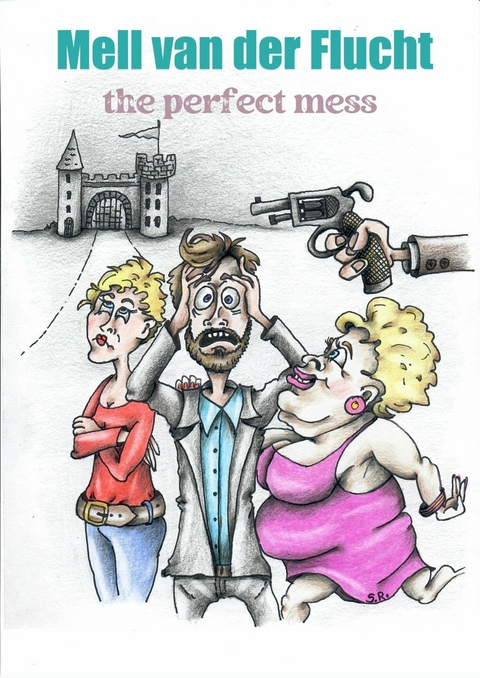
Mell van der Flucht (eBook)
644 Seiten
neobooks Self-Publishing (Verlag)
978-3-7575-9706-1 (ISBN)

Sabine Reitenbach lives on Germany's Baltic coast and works in retail. A lifelong creative, she designs cartoons and writes satirical fiction full of quirky characters and dark humor. Her debut, 'The Perfect Mess,' was born during lockdown - bold , surprising, and delightfully offbeat.
Sabine Reitenbach lives on Germany's Baltic coast and works in retail. A lifelong creative, she designs cartoons and writes satirical fiction full of quirky characters and dark humor. Her debut, "The Perfect Mess," was born during lockdown - bold , surprising, and delightfully offbeat.
From the distance into chaos
Mell van der Flucht steered his black Jeep Cherokee over the motorway asphalt and was about to fall asleep for the umpteenth time. He had been travelling on Germany's roads towards the North Sea since sunrise and felt like he had wasted half of this time in service areas or parking bays. The drivers of the furniture van insisted on their statutory break times, which they seemed to triple. Mell's mood was correspondingly bad. They were just putting on their indicators again to turn off at a lay-by. Annoyed, he followed them. He thought that five coffee breaks were more than excessive. Without these stops, he would have reached Dünhausen long ago. But now it was what it was. Surely, he could have planned everything better. The choice of removal company, for example, if he had had more time for the preparations. Just six weeks ago, he had been in Provence to take on an unexpected inheritance. Now he owned an old château with a large lavender plantation.
The news of his inheritance had reached him in Australia. He had spent the last twelve years there on a cattle station. And before that, he led the excitingly boring standard life of an average German.
Back then, everything was running smoothly until the morning when everything suddenly changed. He entered his office at eight o'clock on the dot, only to leave an hour later, never to be seen again.
"Staff cuts, we are very sorry!" As a consolation, he received a considerable severance payment. He would not have to lift a finger for the next twenty years. A week later, just as unexpectedly, his wife gave him notice and eloped with the colleague who had tried to console him with the severance pay. He actually wanted to celebrate his fortieth birthday that day, but in view of the new circumstances, he celebrated his farewell to life instead. His friend Etzel, whom he had known since childhood, did his best to get him out of this hole. When good persuasion didn't help and Mell announced that he was going to throw himself off a bridge, he suggested a new life for him - in Australia, for example.
He took his friend's advice to heart. He asked if Etzel would perhaps move into his luxurious bungalow with pool, sauna and fireplace while he was away. "Of course," said Etzel. He had always been keen on the house. Now, after twelve years in the outback, Mell was travelling again. The last fifty kilometres to his destination of Dünhausen lay ahead of him.
"Dünhausen? Where's that supposed to be?"
"Somewhere on the North Sea coast," Etzel had replied. "Small village, nice and quiet, just like you wanted."
Mell wouldn't have moved back into his house for anything in the world. There were too many bad memories attached to it. Somewhere, then. Somewhere on the North Sea. At least he knew that somewhere was called Dünhausen.
Due to his lack of time in inheritance matters, he had commissioned Etzel to find a flat somewhere in Germany that met his requirements and expectations and also to organise the move.
The fact that his journey took him into the unknown and that he had never seen the place or his future home did not bother him in the slightest. As a self-proclaimed globetrotter, he was used to travelling in unfamiliar territory. After the turbulent years, he now longed for harmony and wanted nothing more than to finally find his harbour and put an end to the nomadic life.
The architectural style of the apartment block on Weg der Kapitäne 1A was nothing exciting, just the usual, like all new buildings. Smooth, white façade, balconies with glass surrounds, practical and quickly built high, with a view of the Wadden Sea. The two-year-old complex consisted of four residential units. Three of them had been let since completion. Mell's future flat, a spacious penthouse, had been empty ever since and had never been occupied.
Psychologist Susa Seeliger and retired civil servant Hans-Werner Kodslowski lived on the ground floor. Uschi Bratbäcker and her daughter Angelika lived above Mr Kodslowski.
The tenants had neither sought nor found each other and preferred to avoid each other. Communication within the stairwell community took place in writing on a notice board right next to the building entrance and included the following topics: the strict house rules, complaints about disturbance of the peace or unpleasant food odours due to a lack of ventilation. There were also references to improper waste disposal and poorly cleaned stairwell windows due to the wrong cleaning agent. The house rules also stated which cleaning agent was to be used, but apart from Kodslowski, nobody used it.
Immediately after moving in, Hans-Werner Kodslowski's first measure was to introduce this bourgeoisie, because in his opinion, life simply ran better in an orderly fashion. Since this cork wall w Susa Seeliger had set up a small practice next to her living area. She looked after people who were fed up with the monotony of Dünhausen, couldn't find a partner or were completely overwhelmed by the daily demands. There were more than enough people with these worries in Dünhausen.
As almost every one of her clients (she avoided the word ‘client’ because she didn't consider these people to be ill, but rather frustrated and comfortable) bothered her with the same problems, she was usually bored and consequently provided half-hearted and questionable life coaching. Susa didn't follow the mainstream and always had a different opinion. For her neighbours, she was ‘the rebel’. In the 1980s, she and a few hippies hijacked houses on Hamburg's Hafenstrasse, lived in a commune, got wild and colourful and smoked pot. "Rent-free living for all!" was all the rage back then. Today, she pays her rent well. The fact that she looked ten years younger at the age of fifty-eight, didn't care about coffee gossip and village gossip, ignored the house rules and found them superfluous, made her an outsider. She enjoyed this position. Because someone always got upset.
If not Pedant Kodslowski, then the neurotic Uschi Bratbäcker, from above, with her inconspicuous daughter Angelika. The mere fact that Susa had never been married was a breeding ground for conspiracies and at the same time mental occupational therapy for the ailing brain cells of her neighbours – as she often liked to put it. But Susa was not a child of sadness. She had devoured men by the dozen and had a hell of a lot of fun with them.
Hans-Werner Kodslowski lived in the eternal yesteryear and was not exactly the kind of neighbour you would like to have. As a former senior civil servant at the Dünhausen public order office, he had his own personal idea of a regular life, which was extremely dusty and petty bourgeois. Kodslowski boasted that he was a person of the old school, something he felt his neighbours were far removed from. Especially Susa Seelinger, for whom, in his opinion, the word "virtue" was a term from a dictionary of foreign words. He had been retired for two years. Thanks to his substantial pension, he had no financial worries. He was more worried about no longer being able to control village affairs. Because for him, once a public order officer, always a public order officer! Until after his death.
Sleeping in late and lazing around were a thorn in his side. Even now, in retirement, his alarm clock rang at six o'clock on the dot every morning. A quick breakfast, a shower and then to the kitchen window to report parking offences to the police. In the late morning, he would patrol the footpath with a bag of chilli powder to stop dogs from ‘pooping’. Kodslowski hated dogs.
As a neat freak, he mourned his office in the town hall every day and thought his successor was a greenhorn who didn't know his job. In the meantime, he was known throughout Dünhausen for his love of order and pedantry, very popular with the police and hated all the more by parking offenders and dog owners. Even the front garden of the residential complex looked as barren as Kodslowski himself. Sterile, neat and low-maintenance. But only when everything was in its place and organised was he happy with himself and his little world.
One floor up, Uschi Bratbäcker lived in a rose-coloured dream world, letting herself be guided by her obsessive neuroses and at the same time dominating the life of her completely helpless, forty-year-old daughter Angelika. She deliberately pronounced her name in an English way, calling her "Andschelika" – just because, to her ears, it sounded more intriguing and exotic. She had often been annoyed that she hadn't given her daughter a nicer name when she was born. Chantalle or Jolina, for example. For her, it was important to represent something special in Dünhausen in order to leave a footprint in certain circles – which did not exist in Dünhausen. Uschi Bratbäcker had been widowed for many years. During his lifetime, her late husband had made good provisions and left her a substantial life insurance policy. In addition, there was his monthly pension, which she knew how to invest very well, including in guardian angels, dream catchers and other esoteric mumbo jumbo. She had a penchant for superstition. She was regularly visited by guardian spirits, demons and other unlucky creatures who made her life more difficult, but also gave her hope. For example, black cats, broken mirrors and randomly flying bird feathers were decisive for how the day developed or ended.
She struggled with the fact that she was born as Uschi Vick in the Ruhr area in 1951 – rather than as someone with a noble title, a "von"...
| Erscheint lt. Verlag | 3.7.2025 |
|---|---|
| Reihe/Serie | Mell van der Flucht |
| Verlagsort | Berlin |
| Sprache | deutsch |
| Themenwelt | Literatur ► Romane / Erzählungen |
| Schlagworte | Crime • Funny • Gossip • Humor • humorous • quirky • Satire • staircase-gossip • Tension |
| ISBN-10 | 3-7575-9706-0 / 3757597060 |
| ISBN-13 | 978-3-7575-9706-1 / 9783757597061 |
| Informationen gemäß Produktsicherheitsverordnung (GPSR) | |
| Haben Sie eine Frage zum Produkt? |
 EPUB (Wasserzeichen)
E-Book Endkundennutzungsbedinungen des Verlages
DRM: Digitales Wasserzeichen
Dieses eBook enthält ein digitales Wasserzeichen und ist damit für Sie personalisiert. Bei einer missbräuchlichen Weitergabe des eBooks an Dritte ist eine Rückverfolgung an die Quelle möglich.
Dateiformat: EPUB (Electronic Publication)
EPUB ist ein offener Standard für eBooks und eignet sich besonders zur Darstellung von Belletristik und Sachbüchern. Der Fließtext wird dynamisch an die Display- und Schriftgröße angepasst. Auch für mobile Lesegeräte ist EPUB daher gut geeignet.
Systemvoraussetzungen:
PC/Mac: Mit einem PC oder Mac können Sie dieses eBook lesen. Sie benötigen dafür die kostenlose Software Adobe Digital Editions.
eReader: Dieses eBook kann mit (fast) allen eBook-Readern gelesen werden. Mit dem amazon-Kindle ist es aber nicht kompatibel.
Smartphone/Tablet: Egal ob Apple oder Android, dieses eBook können Sie lesen. Sie benötigen dafür eine kostenlose App.
Geräteliste und zusätzliche Hinweise
Buying eBooks from abroad
For tax law reasons we can sell eBooks just within Germany and Switzerland. Regrettably we cannot fulfill eBook-orders from other countries.
aus dem Bereich