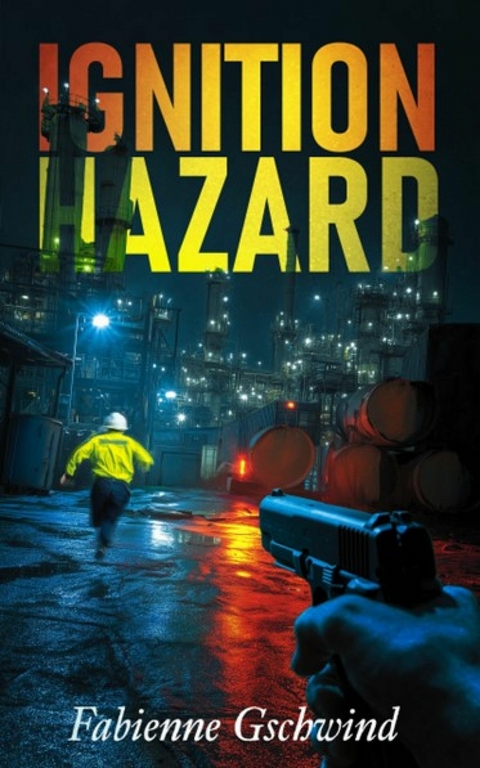
Ignition Hazard (eBook)
305 Seiten
epubli (Verlag)
978-3-8197-5686-3 (ISBN)
F. Gschwind is a researcher and lecturer with two decades of experience in chemical research and a longstanding passion for writing science fiction novels.
F. Gschwind is a researcher and lecturer with two decades of experience in chemical research and a longstanding passion for writing science fiction novels.
*
It was Monday morning, and Timea had returned to Maasburg.
Since the new production building of the formerly independent PolyNeo startup wasn’t finished yet, she was temporarily assigned to a set of provisional container offices. The actual research lab and a small pilot production unit were located a few steps away, in a hall belonging to the university. The move into the new facility was planned for about two months from now. Everything was a bit improvised—fitting for a company that had just been acquired and was simultaneously expanding into a tech park.
Present at her onboarding were Garry, the CEO of PolyNeo, and someone from EncapX HR Europe. He had already studied Timea’s résumé and emphasized—more than once—how thrilled EX (as EncapX referred to itself internally) was to have her on board with such expertise.
Then they got down to business: salary, bonuses, benefits. Everything was significantly above what PolyNeo had originally offered. And as a cherry on top, they promised her a relocation agent who would handle everything—from the move to registering with the local waste disposal service.
Timea was more than satisfied. She signed the contract—on the condition that she would only start in three months.
She didn’t want to just vanish from her current company, but instead take the time to properly train her successor. And she had a few vacation days she was determined to use up.
EX had no issue with that. The new building wouldn’t be ready for occupancy before April anyway, and the lab operations wouldn’t begin before June. Perfect timing.
On the train back to Copenhagen, Timea had time to reflect—on her career, her choices… and her resignation letter. That one was easy to write.
She had studied classical chemistry in Karlsruhe, and later moved to the Technical University of Munich for her PhD—a solid upgrade. And that was where something unexpected happened: she stumbled upon the field of industrial safety. It all began with a calorimetry experiment. The equipment was sitting in the lab, but no one really knew how to operate it—or worse, how to interpret the data. So she booked a workshop with the manufacturer.
That was the beginning of the end. Or rather, the beginning of the fun.
She quickly learned that calorimetry wasn’t some esoteric side discipline—it was a central tool for assessing how dangerous a chemical reaction could be. With the right method, one could not only predict explosions, but actually prevent them—if you knew what you were doing.
The workshop leader was an experienced safety expert who mentioned a real accident in nearly every third sentence. Time and again, he let his gaze slowly wander across the seminar room, lowered his voice, and spoke in a tone reminiscent of a psychological horror thriller:
“And here’s an example from Basel… just imagine what could have gone wrong – and what almost did: The calorimeter revealed, at the very last moment, a barely considered reverse reaction pathway. Just 10 degrees of overheating would have been enough to generate so much gas that the 250-liter reactor would have literally exploded.
Had we not immediately changed the production plans, the facility would have detonated right in the middle of a residential area in Basel. Windows within hundreds of meters would have shattered, toxic fumes would have spread over the city like during the Sandoz disaster. Injuries, fatalities, millions in damages, and decades of lost reputation – all because of a tiny detail that was almost overlooked. That single experiment, five hours in the calorimeter – it saved the company from millions in losses and a catastrophic disaster.”
Timea hung on his every word like others binge a Netflix series.
Back in Munich, she signed up for more courses, devoured everything the library had on industrial safety, and was soon put in charge of updating all the institute’s safety documentation. The actual safety officer had lost interest and delegated the entire job to her—and Timea was too curious to say no. The department paid for her training without asking too many questions. Why not? Anyone who voluntarily reads standards is either dangerous—or a total asset.
One thing led to another: she completed her doctorate focusing on safety-critical analytical methods like calorimetry, TGA, and DSC—measurement techniques that sounded like things you probably shouldn’t Google.
The university hired her directly after graduation, initially to oversee lab safety. Shortly after, she also became the institute’s radiation protection officer and took over laser safety management.
Over time, she was responsible for anything that glowed, radiated, or burned.
The best part? The university had a training budget—and she used it like an addict.
She attended workshop after workshop: HAZOP, ATEX, FMEA, SIL, safety culture, functional safety, quantitative risk assessment—every acronym and catastrophe simulation she could find.
One of the companies running these courses took notice. A young woman who not only remembered all the test answers, but also every real-world case study? That stood out. They offered her a job.
She hadn’t planned on switching jobs—but the offer was too good.
The company was a spin-off from Ghent University: a small, highly specialized safety consultancy with its own lab. The five founders were all seasoned veterans—twenty years in the field, gravelly voices, each of them knowing at least seven ways to blow up an average toilet using supermarket products.
Timea said yes immediately. She wanted to learn from the best.
And she did. For an entire year, she focused on analyzing dust explosion behavior—an underrated hazard in industry. Because it’s not just gasoline or gas that can explode: even fine dust—like flour, plastic, or metal powder—can detonate under the right conditions.
Timea ran systematic tests to determine how easily a substance could ignite, how much pressure it would generate, and whether it could trigger a chain reaction. She learned that a single spark or a hot surface was enough to turn an entire production hall into an inferno—if the dust was fine enough and properly dispersed.
She slowly began advising her own clients. Her colleagues were fantastic, the projects diverse.
Five years later, she was a recognized expert. She had mastered thermal analytics, understood dust explosions, battery thermal behavior, solvents, and toxic process gases. She had worked on projects in the pharmaceutical, cosmetics, food, metal, and polymer industries.
Her favorite project? A polymer plant with a fluorination unit: deadly gases, toxic solvents, explosive dust clouds, highly exothermic reactions. A nightmare for most—but for Timea, an adrenaline rush.
Because yes: Timea was an adrenaline junkie.
Much to her supervisors’ dismay, she had discovered extreme sports. Paragliding was her gateway. Then came skydiving, wingsuits, formation jumps. She even tried BASE jumping—until her Belgian employer banned it. A safety expert who jumps off bridges? That was a PR problem.
Timea just shrugged. She knew the stats. She’d already lost three friends.
But the control during a jump, the clarity in free fall—that was her release valve.
n Belgium, she eventually gave it up – the landscape was simply too flat. Instead, she stuck with skydiving and took up kitesurfing: the Belgian coast was perfect, with a tram running along its entire length. She could let herself drift with the wind, then hop on the tram to return to her starting point. With her dripping wetsuit, folded sail, and board in hand, she didn’t exactly make friends on the tram, but since she was never banned from riding, she just kept going.
She’d never seen a psychologist, but she suspected she was on the emotionally colder end of the spectrum. Other people’s feelings often struck her as overblown—whether in novels, films, or among friends.
Only during extreme sports did she really feel something.
Maybe she was different. Maybe not. But she was comfortable with it—most of the time.
Since her semester abroad in Bern, with five to six jumps each weekend, she’d been convinced: nothing clears your mind like a well-calculated leap. Timea stayed calm where others panicked.
Or, as Olivia once said:
“You really should’ve been a bomb disposal technician.”
As soon as she started in Maasburg, she planned to take up BASE jumping again—but she wouldn’t tell anyone. She wasn’t risking another ban. Luckily, nobody had asked about hobbies during the job interview. She wouldn’t lie—but she wouldn’t start legal battles with her employer either.
Maybe she’d just go back to riding motorcycles instead. The Eifel region wasn’t far—and its curves were legendary. Her old bike was still at her parents’ place.
Maybe it was time for an upgrade—something with real power.
Back in Copenhagen, she stepped into her apartment.
The coming months would be intense, she thought—and went down to the basement to check how many moving boxes she had left.
She had only moved in two years ago. The little spin-off in Ghent had been bought by a British chemical multinational. At first, it all sounded exciting: ruthenium, gallium chemistry, catalysts, specialty metals.
England would’ve suited her just fine.
But instead, she and three colleagues were transferred to Copenhagen—into a business unit where safety experts were only allowed to do one thing.
No cross-functional projects. No diversity of tasks.
Timea was assigned to “metal oxide powders for ship catalysts”—tiny particles used in...
| Erscheint lt. Verlag | 3.7.2025 |
|---|---|
| Verlagsort | Berlin |
| Sprache | englisch |
| Themenwelt | Literatur ► Krimi / Thriller / Horror ► Krimi / Thriller |
| Schlagworte | Industry • Research • Safety • Virus Lab |
| ISBN-10 | 3-8197-5686-8 / 3819756868 |
| ISBN-13 | 978-3-8197-5686-3 / 9783819756863 |
| Informationen gemäß Produktsicherheitsverordnung (GPSR) | |
| Haben Sie eine Frage zum Produkt? |
 EPUB (Ohne DRM)
Digital Rights Management: ohne DRM
Dieses eBook enthält kein DRM oder Kopierschutz. Eine Weitergabe an Dritte ist jedoch rechtlich nicht zulässig, weil Sie beim Kauf nur die Rechte an der persönlichen Nutzung erwerben.
Dateiformat: EPUB (Electronic Publication)
EPUB ist ein offener Standard für eBooks und eignet sich besonders zur Darstellung von Belletristik und Sachbüchern. Der Fließtext wird dynamisch an die Display- und Schriftgröße angepasst. Auch für mobile Lesegeräte ist EPUB daher gut geeignet.
Systemvoraussetzungen:
PC/Mac: Mit einem PC oder Mac können Sie dieses eBook lesen. Sie benötigen dafür die kostenlose Software Adobe Digital Editions.
eReader: Dieses eBook kann mit (fast) allen eBook-Readern gelesen werden. Mit dem amazon-Kindle ist es aber nicht kompatibel.
Smartphone/Tablet: Egal ob Apple oder Android, dieses eBook können Sie lesen. Sie benötigen dafür eine kostenlose App.
Geräteliste und zusätzliche Hinweise
Buying eBooks from abroad
For tax law reasons we can sell eBooks just within Germany and Switzerland. Regrettably we cannot fulfill eBook-orders from other countries.
aus dem Bereich