Marathon D’Écriture (eBook)
256 Seiten
Publishdrive (Verlag)
978-1-0683910-4-0 (ISBN)
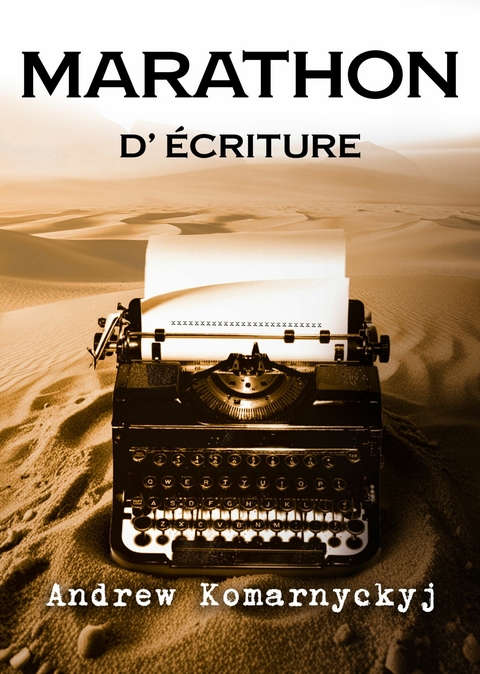
In the solitude of his room, Alan Bland confronts the shattering loss of his enigmatic best friend, known only as X. Armed with a typewriter and a heart on tenterhooks, Alan embarks on a marathonian six-day, six-night challenge, pouring out a torrent of memories to unravel the man who was both his confidant and rival.
X, a figure cloaked in unsettling secrecy, formed one pinnacle of a tangled love triangle with Alan and the elusive Amara, a woman whose allure proved both magnetic and devastating. As Alan recounts their fraught romance, he lays bare the wounds of Amara's choice.
As the hours blur and exhaustion takes hold, Alan's prose frays, veering into fevered, semi-conscious revelations. Exhausted and close to death, after hitting the wall, he makes a supreme effort at the climax of his tale to finally reveal the startling truth about X.
For readers of Andrew Komarnyckyj's sharp wit and literary finesse, as seen in his novel Ezra Slef, Marathon d'Écriture delivers a darkly romantic and intellectually provocative tale, laced with mordant humour and profound insight, a journey that will resonate with all those who have ever wrestled with the ghosts of love, secrecy, memory and death.
105.
Amara: Why do you do it?
Me: It must be some inner tension I can’t resolve.
Amara: We all have those. Me more than anyone.
106.
Why am I writing a book about you, X? Given that I’m aching to write a bestseller it is a waste of time particularly as it will never be published. I say that with certainty for 2 reasons.
First because no publisher would touch this work not even with the aid of the longest bargepole available on the planet. I do not blame the publishers for this. The work is not publishable. It has no commercial value whatsoever and I question its literary merit. What does that leave to entice a publisher? (To answer this rhetorical question: fuck all.)
Second, because of the first reason, I don’t intend to submit the work to literary agents or to publishers. It would be too soul-destroying to do so. I would be unable to countenance the avalanche of rejections that would plummet like a hailstorm of boulders onto my head.
The inevitable conclusion must be that my motive for writing about you is nothing more than my own satisfaction, X. It is a work of self-indulgence.
That said it has a laudable purity of purpose much modern writing lacks.
Unlike my peers in the writing game, I have no need to embroider events to make them seem more exciting than they really were. Or are.
I can stick to the truth plain and simple.
That means there is only one way this manuscript is ever likely to become acquainted with a printing press. Namely when I die. Which would be fitting as it is a work mainly about a dead man and me.
X, I’m sure you have a question if you are reading this book over my shoulder. Namely: what is the connection between my death and the publication of this MS?
It is this: when a writer dies, or an artist, or a poet, it is often the case that critics see something in his work they failed to see while he still drew breath. The work remains the same as it always was. No better and no worse. But for some unfathomable reason the critics see the work in a more favourable light following the death of its creator. Prior to the creator’s death it may have been (and probably was) dull boring monotonous and bland (like me).
Following the creator’s death it becomes edgy and exhilarating and unmissable (like X).
The standout example of the transformative power of death over art is of course Van Gogh. But there are many others.
Hypothetically, then, when I have expired, my worthless back-catalogue of discarded unpublished writing may at last acquire some commercial value. Someone rummaging among my documents might come across this MS about you X and decide to jump on the bandwagon set in motion by my death and publish it.
It is a sobering thought that the most effective way a writer can add value to his books is by dying.
107.
If you have a body of artistic work that no-one has yet discovered then you must have added some value to the world when you died X. Your work if it exists will now be worth something once it comes to light.
But your death extracted much value from the world. This planet is a far poorer place without you. Any work of art you have created (I include writing in the category of art) will never bring as much value to this planet as you did.
No matter how much your art, if it exists, is worth your death has created a loss as glaring as a quarry-sized sinkhole on the main street running through the middle of town. Your (hypothetical) body of art will do little other than inform us how big a loss your presence is.
You can never be replaced.
I remain in bits.
108.
This raises a question I have often considered but never explored on paper.
How do we define art? Where does it begin, where does it end?
The answers to these questions seem obvious. Indeed at one time they were obvious. Art began and ended with painting sculpture architecture and writing (as in fiction). To this list technology added photographs and moving pictures.
Things are different now.
Marcel Duchamp was one of many who ushered in the change. Because of him it has become possible to think of a urinal as a work of art. You may protest that his ‘found art’ is merely a category of sculpture. It is not. It opens up the possibility that anything at all might be considered art. My discarded razor blades for instance. Even a turd. Yes, an artist has passed off canned turds (his own) as art and sold them for eye-watering amounts of money. As far as I know none of the art-lovers who bought them has yet opened one.
What has this to do with X? Bear with me. All will become clear.
A case could be made that a military aircraft is a beautiful thing. These things are engines of death but they have a sinister beauty. Does this make them art? If not what if you get several of them parked up in an aesthetic pattern on an airfield. Does this make them art? If it does not what if someone takes a photograph of that pattern? Does the photograph convert the warplane scene into art?
If I place an obsolete warplane onto a pedestal and call it a sculpture is it now transformed into a work of art? The answer to this last question is a definite yes.
Something I have often grappled with: Can a crime be a work of art? A brutish act of violence is not art. But what about a well-planned heist involving no violence, instead relying on the ingenuity and virtuoso skills of the criminal?
In such a case, could a crime be art?
If not, what if the criminal(s) involved videoed the crime. Would the video be considered art?
And now we come to the clincher.
Can a person’s life be considered art if he or she lives it large? (I offer no explanation of the word ‘large’ in this context. As the reader you may supply your own definition. Make the most of this opportunity. I will cut you no such slack anywhere else in my manuscript.)
X lived it very large indeed. I think we can agree on that much.
I would submit that his very life is or was art, his outrageous deeds being his body of work that makes it art.
In short: X lived a life that was art and he was a performance artist although he never once credited himself with such an accolade.
109.
If you disagree with the previous chapter you must at least allow that my written record of X’s life, my simulacrum of it, is a work of art and due to the quality of the material he has provided me with it may be considered a work of the highest possible art. Not due to my efforts you understand nor any skill I may possess as a writer.
The level of art in this document stems entirely from the quality of the life it records.
110.
The joints in my fingers are aching. I always knew R.S.I. could be a problem. Ignoring the pain I soldier on.
111.
Although I had no idea what X’s job was I knew all about his sideline. He told me his sideline made him more money than his regular job. I asked him why he didn’t give up his job and stick to his sideline.
My job is my vocation, he said. It is most important to me.
What is your job exactly? (This was not the first time I had put that question to him.)
Sorry Alan you will never know. I’d love to tell you but I can’t.
His sideline BTW was a YouTube channel in which he offered pop advice on psychological matters. He was a remarkable front man, a natural in front of a camera. His talent and knowledge brought him 100s of 1,000s of viewers/subscribers.
He did it anonymously, using his wizardry with technology to change his appearance and voice. I was the only person other than Amara who he told about his sideline.
112.
We must now take a brief but vital intermission to consider the work of the cultural theorist and philosopher Jean Baudrillard.
Baudrillard had a brilliant insight one he expressed perfectly in his treatise ‘Simulacres et Simulation’ (1981). I read the original French version. (The English version is called Simulacra and Simulation.)
I will try and do justice to Baudrillard’s thoughts in a paragraph. No doubt I will fail but I may at least convey the essence of his theory.
He used the word simulacrum (plural: simulacra) to mean anything that represents reality. A novel an autobiography a painting a sculpture a short story a history a biography a movie a news report on television or in a newspaper (or latterly on the internet) these things are all simulacra.
As we will see simulacra do far more than merely represent reality.
Before we look further at simulacra we will go back in time and find out what Plato had to say on the subject (for the idea of simulacra is not in itself new. Plato thought about and wrote about them).
Plato famously came up with the example of a group of people living their entire lives in a cave. The group never saw the outside world. They saw only the shadows of the outside world cast on the wall of the cave. Such a group of people Plato said would believe that the shadows were reality. Only by stepping beyond the mouth of the cave would they see reality and appreciate that the shadows were mere shadows nothing more.
Baudrillard’s wonderful insight was that in the modern world our representations of reality are overwhelming. They overpower our senses and infest our brains to such a degree that our simulacra are now more real to us than the realities they represent.
How do you know what is happening in another part of your country? Or even your town? From a simulacrum delivered on the internet or your television or radio or the newspaper or indeed word of mouth (perhaps the oldest simulacrum of all).
What is your actual first-hand knowledge of events in the world around you? It...
| Erscheint lt. Verlag | 1.7.2025 |
|---|---|
| Sprache | englisch |
| Themenwelt | Literatur ► Krimi / Thriller / Horror |
| Schlagworte | Andrew Komarnyckyj author • complex love stories • Contemporary gothic romance fiction • Dark romance novel Marathon d'Écriture • intense Forbidden love stories • Modern romance literature • Romance with dark themes |
| ISBN-10 | 1-0683910-4-9 / 1068391049 |
| ISBN-13 | 978-1-0683910-4-0 / 9781068391040 |
| Informationen gemäß Produktsicherheitsverordnung (GPSR) | |
| Haben Sie eine Frage zum Produkt? |
 EPUB (Ohne DRM)
Digital Rights Management: ohne DRM
Dieses eBook enthält kein DRM oder Kopierschutz. Eine Weitergabe an Dritte ist jedoch rechtlich nicht zulässig, weil Sie beim Kauf nur die Rechte an der persönlichen Nutzung erwerben.
Dateiformat: EPUB (Electronic Publication)
EPUB ist ein offener Standard für eBooks und eignet sich besonders zur Darstellung von Belletristik und Sachbüchern. Der Fließtext wird dynamisch an die Display- und Schriftgröße angepasst. Auch für mobile Lesegeräte ist EPUB daher gut geeignet.
Systemvoraussetzungen:
PC/Mac: Mit einem PC oder Mac können Sie dieses eBook lesen. Sie benötigen dafür die kostenlose Software Adobe Digital Editions.
eReader: Dieses eBook kann mit (fast) allen eBook-Readern gelesen werden. Mit dem amazon-Kindle ist es aber nicht kompatibel.
Smartphone/Tablet: Egal ob Apple oder Android, dieses eBook können Sie lesen. Sie benötigen dafür eine kostenlose App.
Geräteliste und zusätzliche Hinweise
Buying eBooks from abroad
For tax law reasons we can sell eBooks just within Germany and Switzerland. Regrettably we cannot fulfill eBook-orders from other countries.
aus dem Bereich