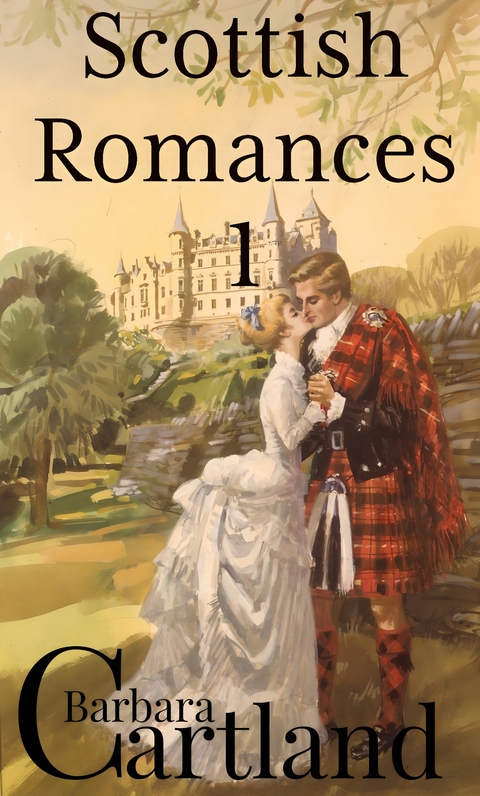
Scottish Romances 1 (eBook)
900 Seiten
Barbara Cartland eBooks Ltd (Verlag)
978-0-00-085148-2 (ISBN)
Scottish Romances
Four spellbinding tales of passion, danger, and destiny set against the wild beauty of Scotland
Step into a world where ancient clans, windswept glens, and hidden castles come alive in four of Barbara Cartland's most atmospheric Scottish romances. This richly woven anthology gathers together timeless stories of love that blossoms amidst feuding clans, lost treasures, and secrets buried in the Highlands.
In A Chieftain Finds Love, a young singer returns to her ancestral home to recover her voice-only to uncover a plot that threatens her family's legacy and her heart. The Chieftain Without a Heart follows a reluctant Duke who must confront his past-and his capacity to love-when a bold act of defiance forces him into a dangerous alliance.
The Curse of the Clan brings intrigue and redemption as a proud nobleman seeks to break an ancient curse-only to find that love may be the only force strong enough to change fate. In The Secret of the Glen, a spirited heroine faces a cruel eviction and a terrifying mystery that haunts a Highland estate, while discovering that courage and love can outshine even the darkest secrets.
With her signature blend of romance, history, and emotional intensity, Barbara Cartland captures the grandeur and heartbreak of a bygone era. From rugged moors and castle ruins to moonlit lochs and sweeping tartan kilts, this collection offers a captivating escape into a world where love always finds a way-no matter the odds.
Whether you're a longtime Cartland devotee or a new reader discovering her magic for the first time, Barbara Cartland Highland Romances is the perfect collection to #EscapeYourDay and lose yourself in the enchantment of Scotland's most romantic legends.
The Chieftain Without a Heart
The Duke of Strathnarn arrived in Scotland in a furious temper. He had left his home when he was sixteen because of the brutality of his father and had no intention of ever returning. But a letter from his Comptroller relates news which is so serious that he is obliged to go North.
On arrival at the Castle he discovers his nephew and heir is the prisoner of a neighbouring clan who are the age-old enemies of the McNarns. The Kilcraig Chieftain will only negotiate with the Chieftain of the McNarns and the Duke is forced to visit him at his castle.
How to avoid humiliation and the public disgrace of his clan, how the Duke has to agree to a bargain which fills him with horror and how it brings violence, drama and finally romance to his castle and to himself, is told in this 225th book by Barbara Cartland.
AUTHOR’S NOTE
The word tartan is derived from the French Tartalne and the first written reference to Highland dress occurs in the Saga of Magnus Barefoot in 1093.
In 1538 James V ordered himself the first Highland suit ever worn by a member of the Royal Family. Until the nineteenth century it was the custom of the women of the house to weave whatever tartan was required by the family.
When the Dress Act of 1746 made it illegal for Highlanders to wear a kilt or a tartan, to play the pipes or carry arms in place of swords, they carried sticks as a substitute for the dirk, a shorter knife was adopted called a skean dhu. This was small enough to be concealed in a, pocket or stuck in the top of a stocking.
When in 1822 King George IV decided to visit his Scottish Kingdom, a journey no crowned King had made since Charles I, he wore full Highland regalia, the Royal Stewart tartan.
All the details of his reception and engagements in Edinburgh are correct and come from A Historical Account of His Majesty’s Visit to Scotland published in 1822.
CHAPTER ONE
1822
“Thank God we are in calm waters!”
Lord Hinchley poured himself a glass of brandy and drank it in one draught.
“You have been fortunate,” his companion replied, “I have known the sea to be far worse than it has been on this voyage.”
“Then the Lord knows that I will not come to this outlandish spot again! As it is, I am fully prepared to believe it is the Devil’s country, peopled only by barbarians!”
“A popular English misconception about Scotland!” the Duke of Strathnarn said cynically.
Lord Hinchley threw himself down in a chair which was no longer swinging from side to side in the comfortable Saloon of the ship in which they had been buffeted about in an unpleasantly rough North Sea for the last seven days.
“If you ask me,” he said confidentially, “you were extremely wise when you shook the soil of Scotland from your feet and came South. You have made a mistake, as I have told you before, Taran, in returning.”
The Duke’s face darkened and he went to the porthole to stare out at the tree-covered land past which the ship was sailing on its way up the Firth of Tay.
He had no intention of explaining, even to his closest friend, that every instinct in his body rebelled at the thought of coming back to the land he had left in a fury twelve years earlier.
He had been only sixteen at the time and the cruelty of his father, which had not only bruised his body, but humiliated his pride, made him swear that for the rest of his life he would never have anything to do with Scotland or its people.
He remembered how he had crept aboard the first available ship in Perth harbour and, unable to afford more than the poorest passage, had suffered intolerably in the airless stinking hold below decks.
But his late mother’s relatives in London had welcomed him with open arms.
They had sent him to a famous public school and afterwards to Oxford University and, as the Marquis of Narn sponsored by his grandfather, who had been in attendance on the Prince Regent, he found life both civilised and enjoyable.
He had in fact almost forgotten that Scotland even existed.
When his grandfather died, he left him a large estate and a great deal of money. Basking in the friendship of the Regent, now King George IV, London provided him with everything he wanted and everything he enjoyed.
It had come like a bombshell three months ago to hear that his father was dead and he was now not only the Duke of Strathnarn but also Chieftain of the Clan McNarn.
Somehow he had always believed his father to be indestructible.
When he thought of him, which was seldom, he had seemed ageless and terrifying, like one of the ancient giants described in the ballads he had listened to the bard singing when he was a child.
He was silent for so long that Lord Hinchley, rising to pour himself another brandy said,
“You look depressed, Taran, and that glowering expression on your face is grim enough to frighten your Clansmen or whatever you call them.”
“And a good thing if they are frightened,” the Duke replied, “because in that case they are more likely to obey me.”
Even as he spoke he knew that he was libelling the McNarns for the Clansmen invariably obeyed their Chiefs. In fact he remembered his father saying once, ‘a Chief stands halfway between his own people and God’.
Then he told himself, almost by way of reassurance. that the days of such servitude were over and now that a Chief no longer had the power of life and death over his people their feelings for him would obviously not be the same.
“Well, all I can say,” Lord Hinchley remarked as he sipped his brandy, “is that if I have to travel back in the Royal George with His Majesty I shall lie down in my cabin and drink myself insensible until we reach Tilbury.”
“It will be calmer on your return,” the Duke said automatically as if he was thinking of something else, “and as the King is a good sailor, he will expect you to be on your feet, telling him how much the Scots appreciated his visit.”
“The question is – will they?” Lord Hinchley asked. “I blame Walter Scott for inspiring the Monarch with this urgent desire to come to Edinburgh. If the Scots have any sense, they will cut him down with their claymores and stick their dirks into him!”
The Duke did not speak and Lord Hinchley continued,
“My grandfather served in the Cumberland Army which took part in the Battle of Culloden. His description of the manner in which the Scots were massacred and the cruelties inflicted on the survivors afterwards should make any Englishman think twice before he braves the vengeance which is undoubtedly still seething in their breasts.”
“It was a long time ago,” the Duke remarked.
“I would not mind betting that you they have not forgotten,” Lord Hinchley replied.
“I think you are right about that.”
“Of course I am right!” Lord Hinchley said positively. “All barbaric people have their feuds, their vendettas, their curses, which are carried on from generation to generation.”
“You are very voluble on the subject,” the Duke remarked.
“When His Majesty told me I was to come here as an advance guard and see that he was properly received when he arrives in Edinburgh, I took the trouble to mug up some of the facts about Scotland and the Scottish.”
Lord Hinchley paused before he added,
“I don’t mind telling you, Taran, the English behaved damned badly to the wretched people they conquered, entirely because they were better organised and carried muskets.”
The Duke did not reply and after a moment Lord Hinchley said,
“My grandfather used to relate to me when I was a small boy how the Clans were mown down at Culloden as they marched hungry and wet after a night in the open across bad terrain, their Chiefs leading them straight into the gunfire.”
The Duke rose to his feet with what was an angry gesture.
“For God’s sake, William, stop trying to make my flesh creep about battles that happened long before we were born. We have both been pressured into coming on this cursed voyage and the quicker we do what we have to do and return home the better!”
There was so much anger in the Duke’s voice that his friend looked at him curiously.
Then he said,
“I had the idea that this, in fact, is your home.”
He saw the Duke’s fingers clench as if he had touched him on the raw. Then, because he was extremely fond of his friend, he said in a soothing tone,
“Have another drink. There is nothing like good French brandy to make the world seem a pleasanter place.”
The Duke filled his glass from the crystal decanter that had a broad flat bottom so that it would not fall off the table with the roll of the ship.
As he felt the fiery liquid seeping through his body, he knew that instead of soothing him and bringing him some comfort it merely accentuated his anger and apprehension at what lay ahead.
He had had no intention when his father died of returning to Scotland. He had cut himself off from the McNarns when he had run away with his back crossed and bleeding from the weals inflicted by his father’s whip.
If they liked to think of him as a renegade they could do so. He did not intend to concern himself with anyone’s feelings but his own.
After he left University, he had found that with plenty of money to spend and with looks which made women gravitate towards him like moths to a lighted candle, he had no time to think of anything but his own pleasure.
The Prince Regent liked to have young bucks and beaux around him encouraging them in the extravagances of dress that he affected himself.
It was a fashion that had been set by his friend Beau Brummell to which he...
| Erscheint lt. Verlag | 1.7.2025 |
|---|---|
| Sprache | englisch |
| Themenwelt | Literatur ► Romane / Erzählungen |
| ISBN-10 | 0-00-085148-5 / 0000851485 |
| ISBN-13 | 978-0-00-085148-2 / 9780000851482 |
| Informationen gemäß Produktsicherheitsverordnung (GPSR) | |
| Haben Sie eine Frage zum Produkt? |
 EPUB (Adobe DRM)
Kopierschutz: Adobe-DRM
Adobe-DRM ist ein Kopierschutz, der das eBook vor Mißbrauch schützen soll. Dabei wird das eBook bereits beim Download auf Ihre persönliche Adobe-ID autorisiert. Lesen können Sie das eBook dann nur auf den Geräten, welche ebenfalls auf Ihre Adobe-ID registriert sind.
Details zum Adobe-DRM
Dateiformat: EPUB (Electronic Publication)
EPUB ist ein offener Standard für eBooks und eignet sich besonders zur Darstellung von Belletristik und Sachbüchern. Der Fließtext wird dynamisch an die Display- und Schriftgröße angepasst. Auch für mobile Lesegeräte ist EPUB daher gut geeignet.
Systemvoraussetzungen:
PC/Mac: Mit einem PC oder Mac können Sie dieses eBook lesen. Sie benötigen eine
eReader: Dieses eBook kann mit (fast) allen eBook-Readern gelesen werden. Mit dem amazon-Kindle ist es aber nicht kompatibel.
Smartphone/Tablet: Egal ob Apple oder Android, dieses eBook können Sie lesen. Sie benötigen eine
Geräteliste und zusätzliche Hinweise
Buying eBooks from abroad
For tax law reasons we can sell eBooks just within Germany and Switzerland. Regrettably we cannot fulfill eBook-orders from other countries.
aus dem Bereich