


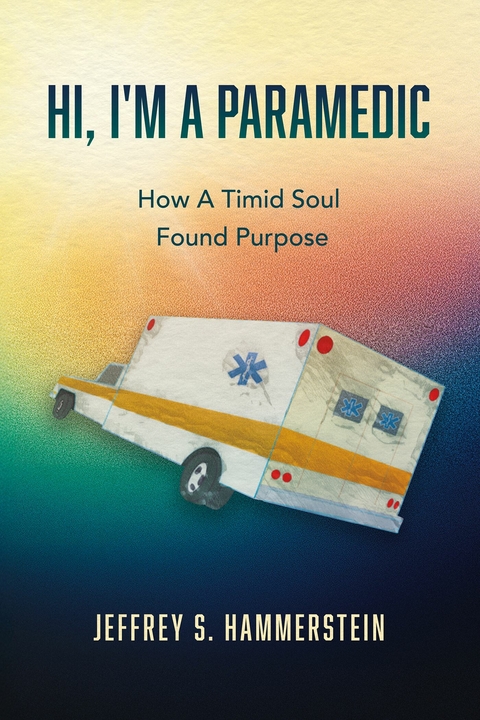
Hi, I'm A Paramedic (eBook)
416 Seiten
Bookbaby (Verlag)
979-8-3178-0315-5 (ISBN)
Jeffrey Hammerstein is a retired paramedic who spent 35 years working within the Wake County EMS System in Raleigh, North Carolina after growing up in Evansville, Indiana. In addition to serving as a paramedic on an ambulance, Jeffrey also worked as a field training officer, district chief, and EMS public information officer. Jeffrey retired from Wake County EMS in 2021 as Assistant Chief of Community Outreach and has worked on chronicling his journey through his career since.
"e;Hi, I'm a paramedic"e; is a phrase that launches conversations with countless people who call 9-1-1 for an ambulance. But what kind of person becomes a paramedic, and what's it like to be one? Most of the time it's not the dramatic calls that play out like a TV story, but rather the calls in between that reveal the nuances of humanity and wind up etched into the memories of the responders. Follow the career arc of an easily frightened kid who grew up determined to be a paramedic the sheepish child who always needed reassurance that everything would be okay, who then grew into the person trying to be that reassurance. Experience the aspiring young responder's first collisions with the reality of death and despair while learning how to take care of people who call 9-1-1, and ride through the fears, failures, and wins that come along the way. Listen in as that responder creates an original rock and roll band with lyrics hinting at the stressors of emergency response to help cope. Experience and appreciate learning to interact with people across an enormous range of backgrounds, means, and stations in life while struggling with the unmet expectations of how some in EMS chose to talk about people different from them. "e;Hi, I'm A Paramedic"e; puts you in the ambulance for a ride through the phases of a paramedic's career; from the infatuation with the new, to the seasoned veteran facing the inevitable burnout, to the evolution into leadership and an accounting of what it means to have had the privilege to serve as a paramedic. Immerse in a narrative written not as a collection of high-shock war stories, but rather a revelation of the real-life impact on the heart, mind, and soul of the paramedic, the patient, and the families of both. Who is this book for? It's for other responders to commiserate with. It's for the families and friends of responders to gain insight into what we're exposed to on a regular and long-term basis. It's for anyone fascinated or intrigued about what really happens out there. It's for anyone with a timid soul trying to figure out how to find their voice.
Chapter 2
Origin Of A Paramedic
A lot of paramedics talk about their experiences with injury or illness as the reason for getting to EMS. Others talk about family traditions in healthcare or emergency services. My reasons were none of those. Mine were more about growing up like a frightened rabbit.
I was never exposed to any real danger in Evansville, my average-sized hometown on the banks of the Ohio River. My siblings and I were just like a lot of Hoosier kids in the ‘70s. We spent the summers riding bikes, playing records, and pretending the streets and alleys around our house were the Indianapolis Motor Speedway.
But a feeble streak ran through me, and being afraid was something I was intimate with. I depended emotionally on the people who convinced me everything would be okay. Though I could never have articulated it at that age, it was part of the mysterious pull toward emergency medical care.
Crying was easy as a shy, sensitive kid. I was scared of everyone. Scared to be in a fight, so I never was. Scared of a car engine running with the hood up or the smell of gasoline, as oddly satisfying as it is. I was scared our car was going to explode when my father pulled over to check on a tire vibration.
My fear of explosions was legitimately elevated by one of my friend’s backyard chemical experiments.
“Hold the bottle while I put the balloon over the top. The fluid in the balloon will mix with the powder, and the gas will inflate the balloon,” he said. “Now I’ll light this paper towel around the bottom of the balloon, and it’ll make the coolest explosion as it floats off.”
He lit the paper towel, and it smoldered as the balloon drifted away. Then it boomed with a dramatic explosion of orange fire and black smoke for us kids to enjoy.
“That was cool!” I said.
“Let’s do it again!” He held the balloon and lit the paper towel for another grand show; me anxious, him scoffing at my fragility. But instead of floating off and exploding several feet away, the flames touched the balloon as he held it. The explosion of deep orange flame wrapped in heavy black smoke, about two feet in diameter, happened in his face. His upper body disappeared from view.
The flames boiled out and the smoke slowly drifted clear to reveal his face blankly staring at me. It was too soon for him to feel anything, so he just froze like a cartoon character who just had something blow up in his face. His eyebrows and hair were singed. His face and hands were black with soot. We both stood motionless.
Alas, he was not a cartoonist’s rendering, he was flesh and blood. Pain like he’d never experienced seared over his hands and arms. Miraculously, his face fared well, save the sooty mask, but he’d leave the hospital with bandages hiding the burns on his hands and forearms.
It wasn’t just people and explosions that scared me. I feared animals, including small, loving dogs. As far as I knew, all dogs wanted to chew me to the bone. Any bark was a notification that the dog intended to kill me. A clear statement that if my chain breaks, that gate opens, or you come within a block of my yard without my owner around, you, my friend, are a dead boy.
I was scared of snakes. Of bees. Of bluejays. I was scared of thunderstorms and tornados, even in fair weather. I was scared of nuclear war. I was scared of gas spilling over a mower during refueling, so I waited thirty minutes for the engine to cool before adding gas while I cut a yard for four dollars.
I was alarmed by the veins of my mother’s hands. That meant she was old, and death awaited, never mind she was thirty-something.
“Are you going to die,” I asked through tears.
“No. These are called veins. They help circulate blood through our body, which helps us stay alive. It’s normal to see them on an adult,” she said.
I wasn’t so sure. But when my cousin Chris showed up with a battery-powered police car that had a flashing light, I became distracted.
I wasn’t an unhappy kid; I was cheerful by default. I was just scared of everything unless someone was there to reassure me.
Becoming a paramedic seemed to fly headfirst into everything about me. As a paramedic, you’re exposed, for decades, to some of the worst of the human condition, and exposed on a reliably constant basis. It’s relentless. We regularly face tragedy, fear, anger, hate, violence, misery, and general suffering on a scale and in a variety that my childhood mind could not have conjured. Thank goodness.
The idea of EMS can appeal to a lot of kids. Most people appreciate the excitement of flashing lights and sirens, and “coming to the rescue!” Most would agree society depends on the men and women who choose to be emergency responders, and the profession is valued. So, who doesn’t want to be adored by the community for coming to the rescue?
A paramedic wasn’t the only thing I wanted to be. Predictability finds comfort here. I would have loved to be a police officer for the same purpose of bringing protection and reassurance to someone who was afraid. But nope. I was scared of people. No way.
A truck driver? I was captivated by semis. I’d be glued to the window looking for them on Highway 41 on our way to my Grandma Mack’s house in Indianapolis or heading to the Indianapolis Motor Speedway. What could be cooler than driving a big Roadway truck? It would be even cooler to drive a Kenworth or a Peterbilt. The ‘70s models are works of art. Mom let me buy a poster of a Kenworth cabover called “Sugar Shack.” It’s just occurring to me as I write what that nickname meant. But for a child, it was just a cool truck.
I’d give anything to be a pilot. Dad used to take us to Evansville Dress Regional Airport to watch airplanes. It had the classic mid-century terminal with the cookie-cutter control tower on top. It had the slow, steady flash of the white and green airfield beacon sweeping across far-reaching swaths from atop the tower. It was the ‘70s, so the airport terminal would be unrecognizable today. You could drop money in a life insurance vending machine as you boarded a flight, but we could also stand a few feet from where the jets nosed up outside. There was only a chest-high fence separating us. No barbed wire. No metal detector. No jet bridge. No distance. But no way. I was scared of flying then, so I couldn’t be a pilot.
Okay, I want to drive an Indycar. Dad took us to the Indianapolis Motor Speedway on practice and qualifying days. We couldn’t afford the race itself, but admission to time trials wasn’t so bad. I first went to the track in 1970. Getting to the upper level of the first turn means climbing up steps that go over the roof of the main stands. That means exterior steps that are several stories off the ground. More frighteningly, there are no riser panels in the metal steps, only treads. The consequence is that I could see right through the steps to the ground so far below. I was gripped with fear, and it manifested in crying. That was my modus operandi; be scared, cry. At least enduring the fear paid dividends. The reward was sitting high over Turn 1 at Indianapolis, the most storied section of real estate in motorsports.
So why not be an Indy car driver at the world’s greatest racetrack? No way, man. Those guys get killed. Especially back then. Too dangerous. I’m scared.
Fire engines were cool, but being a firefighter never drew me.
That left paramedic. Didn’t that have it all? I could be a rescuer with the excitement of lights and sirens but for bigger reasons than the glitzy visuals. My home at 756 S. Rotherwood in Evansville was half a block from Bellemeade Avenue, a major route for ambulance traffic to St. Mary’s Hospital a mile and a half due east. The frequent whine of sirens moving toward us from the west on the way to St. Mary’s called me. Nothing in life can go on until I see it pass by.
The draw of lights and sirens was incalculable, but it was what they represented. Not just the physical ambulance, police car, or fire engine. They represented the rescuer, a person the community needs. But it’s deeper than pretending to be some stupid superhero. I wasn’t moved, beyond my toddler years, by comic book superheroes, and I didn’t seek to emulate them. The deeper meaning is founded in that scared, timid child who was so intimidated by everyone and everything.
You’re too sensitive.
You need to toughen up.
You need thicker skin.
You can’t let this stuff bother you.
You’re a pansy.
That’s me telling myself. I was all those things and still am in so many ways, but it translated into empathy. It lent me capacity to sense the fear, distress, uncertainty, and lack of control in others because I felt those things myself so often. It was the idea of being someone that another could lean on to help them in their fear or distress. That was the underlying current luring me into being an emergency responder, which was represented at that age by the repetitive flash of the Twin Sonics light bar on an approaching ambulance or police car.
I had no reason to...
| Erscheint lt. Verlag | 1.7.2025 |
|---|---|
| Sprache | englisch |
| Themenwelt | Literatur ► Biografien / Erfahrungsberichte |
| ISBN-13 | 979-8-3178-0315-5 / 9798317803155 |
| Informationen gemäß Produktsicherheitsverordnung (GPSR) | |
| Haben Sie eine Frage zum Produkt? |
 EPUB (Ohne DRM)
Größe: 6,9 MB
Digital Rights Management: ohne DRM
Dieses eBook enthält kein DRM oder Kopierschutz. Eine Weitergabe an Dritte ist jedoch rechtlich nicht zulässig, weil Sie beim Kauf nur die Rechte an der persönlichen Nutzung erwerben.
Dateiformat: EPUB (Electronic Publication)
EPUB ist ein offener Standard für eBooks und eignet sich besonders zur Darstellung von Belletristik und Sachbüchern. Der Fließtext wird dynamisch an die Display- und Schriftgröße angepasst. Auch für mobile Lesegeräte ist EPUB daher gut geeignet.
Systemvoraussetzungen:
PC/Mac: Mit einem PC oder Mac können Sie dieses eBook lesen. Sie benötigen dafür die kostenlose Software Adobe Digital Editions.
eReader: Dieses eBook kann mit (fast) allen eBook-Readern gelesen werden. Mit dem amazon-Kindle ist es aber nicht kompatibel.
Smartphone/Tablet: Egal ob Apple oder Android, dieses eBook können Sie lesen. Sie benötigen dafür eine kostenlose App.
Geräteliste und zusätzliche Hinweise
Buying eBooks from abroad
For tax law reasons we can sell eBooks just within Germany and Switzerland. Regrettably we cannot fulfill eBook-orders from other countries.
aus dem Bereich


