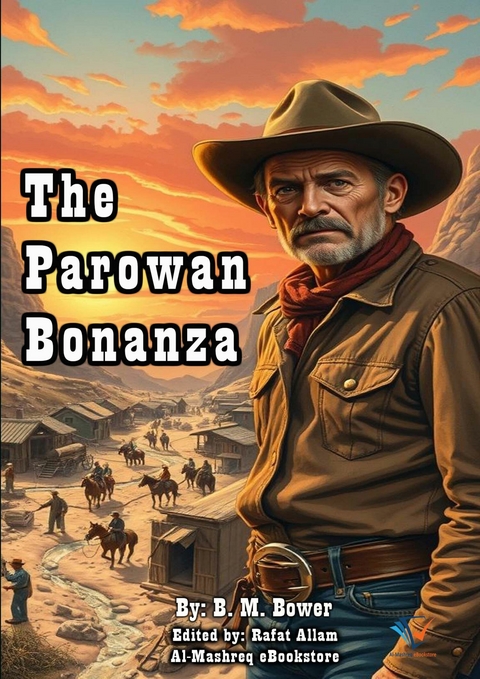
The Parowan Bonanza (eBook)
200 Seiten
Al-Mashreq Ebookstore (Verlag)
978-0-11-424771-3 (ISBN)
Bertha Muzzy Sinclair-Cowan, better known by her pen name B. M. Bower, was a pioneering American author renowned for her Western novels. She began her writing career in the early 1900s, achieving significant success with her first novel, Chip of the Flying U (1906), which introduced readers to the fictional Flying U Ranch and its cowboys. Bower's authentic portrayal of ranch life, drawn from her experiences in Montana, set her work apart in the Western genre. Over her career, she authored more than 60 novels and numerous short stories, many of which were adapted into films. Her use of a gender-neutral pen name allowed her to navigate the male-dominated literary landscape of her time. Bower's contributions significantly shaped the Western genre, and her works continue to be celebrated for their humor, realism, and pioneering spirit.
II. — MUSIC HATH CHARMS
JUST before sundown, while Bill and his burros and Hezekiah were plodding down the highway toward the sporadic camp called Cuprite, a big touring car came roaring up behind and passed Hopeful Bill in a smothering cloud of yellow dust. Bill observed that it was loaded with luggage and stared after it with that aimless interest which the empty desert breeds in men. A coyote on a hilltop, a strange track in the trail, human beings traveling that way,—it matters little what trivial thing breaks the monotony of plodding through desert country.
Bill could remember when this same road was peopled with men rushing here and there after elusive fortune. Good men and bad, honest men and thieves, the dust never settled to lie long upon the yellow trail. That last two years had made a difference. The tide was fast ebbing, and men were rushing elsewhere in search of the millions they coveted.
"Get a move on!" Bill called to Wise One, at the head of the pack train, with the strange burro tied behind at a sufficient length of rope to protect him from Wise One's heels, which were likely to lift unexpectedly. Luella repeated the command three times without stopping, and the burros shuffled a bit faster in the lowering dust cloud kicked up by the speeding car.
Farther on, Wise One stopped short, backing up from an object in the trail. Bill went forward to investigate, and lifted from the ground a black leather case such as musicians use to hold band instruments. Bill undid the catches and looked in upon a shining, silver object with a gold-lined, bell-shaped mouth and many flat discs all up and down its length. He gazed up the road, already veiled with the purplish haze that comes to the desert before dusk, when the sun has dipped behind a mountain. The car was gone, hidden completely from sight by a low ridge.
"They'll be back," Bill observed tranquilly, and tied the case securely upon the pack of Angelface. "They're bound to miss a thing like that. Anyway, I'll probably run across 'em somewhere."
"Hate to hang till yuh do," remarked Luella, who had evidently been adding to her repertoire in Goldfield while no one thought she was taking heed; which is the way of parrots the world over.
"I don't know about that, now," Bill grinned. "Anyway, if it was mine, I know I'd miss it. I always did want to play a horn."
"Aw, cut it out!" Luella advised him shrewishly. "Git a move on!" Which pertinent retort may possibly explain why Hopeful Bill Dale looked upon the parrot as a real companion. He swore that the bird understood what he said and conversed intelligently, so far as her vocabulary permitted. And her vocabulary, while simple, seemed sufficient for her needs.
Instead of turning aside to a certain spring and camping there for the night, Bill camped near the road where he could not miss seeing and being seen, if any came that way. It was quite a tramp to the spring, so he took a couple of desert water bags and mounted Wise One, leaving the other two burros to follow, and trusting his supplies to the care of Hezekiah and the parrot.
He was not approached that night, nor the next day. Cars passed him, it is true, hurrying through dust clouds from either direction; but never the automobile that had lost the horn. So Bill arrived, in the course of time, at his camp, richer—or poorer, according to viewpoint—by one band instrument of doubtful name and unknown possibilities.
In spring the desert is beautiful. Bill loved the desert flowers, vivid pinks and blues and yellows, dainty of form, sweet as honeycomb. He loved the desert lights, as delicately vivid as were the flowers growing out of the sandy soil, shyly snuggled against some stiff, scraggy bush. Cottontails romped through the sage in the afterglow that lingers long in that high altitude, and Bill let them go unmolested, and gave Hezekiah a lecture. He did not believe in killing just because one can, and there was meat in camp already. From the juniper bushes above the spring the quail were calling. "Shut-that-door! Shut-that-door!"—or so Bill and Luella interpreted the call. Farther up on the hillside, doves were crying mournfully. And Bill knew that higher, on the very top of the butte, mountain sheep, deer and antelope were hiding their bandy-legged young away from the prowling coyotes and "link cats" that were less conscientious than Bill when the chance came for a killing.
Yet this was the desert, against which men rail. There was no mistaking. Out there stood a barrel cactus, almost within reach of a gaunt yucca whose awkward, spiny limbs were rigidly upheld like bloated arms,—colloquially called Joshua trees because they seemed always to be imploring the sun. Down in the valley a dry lake lay baked yellow, hard as cement, with dust devils whirling dizzily down its bald length when Bill looked that way. On the map you will see that valley. It is officially known as the Amargosa Desert. And over the ridge which wore a mystic veil of blended violet and amethyst, Death Valley lay crouched low amongst the hills. The maps call that amethyst and violet pile the Funeral Mountains; and away to the east, Bill could see the faint blue line of Skull Mountains and the Specter Range standing bold behind the Skeleton Hills; proof enough that this was the desert, since it bore the sinister names given it by those who knew too little and dared too much.
It could be cruel,—but not crueller than the cities. It could be lonely, though not so lonely as a multitude. The air was clean and sweet and of that heady quality that only altitude can give. Bill squatted on his heels by his camp fire, just about four thousand feet above sea level,—higher than that above the floor of Death Valley, whose rim he could see, whose poison springs he knew, whose terrible breath he had drawn into his nostrils.
From now on the geography will remain closed and you must take my word for it. And when I tell you that the great, blunt-topped butte behind him was Parowan Peak, don't look for it on the map; you'll never find it. It's a great, wild country, a beautiful, savage country, and if you don't love it you will fear it greatly. And fear it is that rouses the sleeping devil of the desert and sets the bones of men bleaching under the arid sky.
Hopeful Bill Dale knew the desert, and loved it, and made friends with it. He plucked a bright red "Indian paintbrush" from beside a rock and held it up to Luella, watching him cock-eyed from her crude perch of juniper laid across two forked sticks driven into the sand. Luella took the flower in one claw, looked it over and dropped it disdainfully.
"Aw, cut it out! Let's eat," she suggested.
"You're on," Bill replied amiably, turning fried potatoes out of the frying pan. "Come and get it, old girl."
Luella was not a flying bird, except under stress of great emotion. Now she leaned head downward, her beak closing upon a knob where a small branch had been lopped off the stick. Turning like an acrobat, she went down with the aid of beak and claws, and pigeon-toed over to Bill's crude table, crawled upon a convenient rock and waited solemnly for her first helping of fried potato, which she ate daintily, holding it in one claw.
"I've got a surprise for you, old girl," Bill began, when the edge of their hunger had dulled a bit. "That horn we picked up in the road,—it's mine now, by right of discovery. You saw how I stuck to the Goldfield road and made an extra day's journey of the trip, just in case that car came back, hunting for the horn. Lord knows where they are, by now. So I figure the thing belongs to me. After supper, I'm going to open her up and give you some music."
"Hate to hang till yuh do," Luella observed pessimistically. "Let's eat."
Bill dipped a piece of bread in his coffee and gave it to her, unmoved by her pessimism. "One thing a fellow needs out here alone is distraction," he went on. "You're getting so you know more than I do—leave you to tell it—and you're more human than lots of folks. You've reached the point where I can't seem to teach you anything more, Luella. You could almost hold down a claim alone, except for the cooking and maybe swinging a single-jack. So I figure a little diversion will come in about right."
"You're on," said Luella. "Git a move on."
So that is how Hopeful Bill Dale conceived the idea of becoming a musician, thus making use of the opportunity which Providence—or something not so kind—had thrown in his way. It may seem a trivial thing, but trivial things have a fashion of tripping one's feet in the race for happiness, or perchance proving to be the one factor that makes success certain. Bill washed his dishes and tidied his camp, and then he opened the instrument case and for the first time removed the shining thing within. Luella, once more back on her perch, watched him distrustfully.
"Luck's own baby boy!" he ejaculated under his breath. "Here's a book goes with it. 'Progressive Method for the Saxophone.' Saxophone, hunh? I always did want to learn one, Luella; believe it or not. Well, let's go."
"Aw, cut it out!" Luella advised him gloomily, but Bill was absorbed in putting together the instrument and in reading certain directions on the first page of the book.
Followed a muttered monologue, accompanied by certain unusual grimaces and gestures.
"'Upper and lower lips slightly over the teeth—chin must be down—lips drawn back as when...
| Erscheint lt. Verlag | 14.6.2025 |
|---|---|
| Sprache | englisch |
| Themenwelt | Literatur ► Fantasy / Science Fiction |
| Literatur ► Romane / Erzählungen | |
| Schlagworte | Adventure • Ambition • American West • betrayal • B.M. Bower • Boomtown • Doris Hunter • Early 20th Century • frontier life • gold prospecting • Hopeful Bill • Human nature • Mining • Nevada desert • optimism • Parowan • Resilience • Romance • Wealth • western fiction |
| ISBN-10 | 0-11-424771-4 / 0114247714 |
| ISBN-13 | 978-0-11-424771-3 / 9780114247713 |
| Informationen gemäß Produktsicherheitsverordnung (GPSR) | |
| Haben Sie eine Frage zum Produkt? |
 EPUB (Adobe DRM)
Kopierschutz: Adobe-DRM
Adobe-DRM ist ein Kopierschutz, der das eBook vor Mißbrauch schützen soll. Dabei wird das eBook bereits beim Download auf Ihre persönliche Adobe-ID autorisiert. Lesen können Sie das eBook dann nur auf den Geräten, welche ebenfalls auf Ihre Adobe-ID registriert sind.
Details zum Adobe-DRM
Dateiformat: EPUB (Electronic Publication)
EPUB ist ein offener Standard für eBooks und eignet sich besonders zur Darstellung von Belletristik und Sachbüchern. Der Fließtext wird dynamisch an die Display- und Schriftgröße angepasst. Auch für mobile Lesegeräte ist EPUB daher gut geeignet.
Systemvoraussetzungen:
PC/Mac: Mit einem PC oder Mac können Sie dieses eBook lesen. Sie benötigen eine
eReader: Dieses eBook kann mit (fast) allen eBook-Readern gelesen werden. Mit dem amazon-Kindle ist es aber nicht kompatibel.
Smartphone/Tablet: Egal ob Apple oder Android, dieses eBook können Sie lesen. Sie benötigen eine
Geräteliste und zusätzliche Hinweise
Buying eBooks from abroad
For tax law reasons we can sell eBooks just within Germany and Switzerland. Regrettably we cannot fulfill eBook-orders from other countries.
aus dem Bereich