


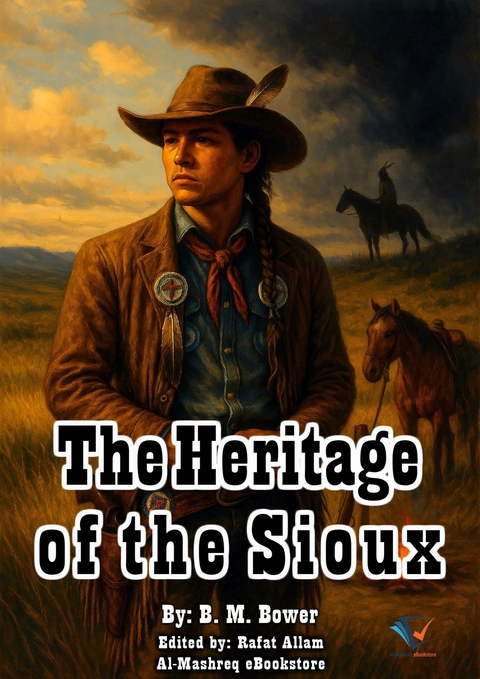
Heritage of the Sioux (eBook)
200 Seiten
Arabookverse Ltd (Verlag)
978-0-09-899357-6 (ISBN)
Bertha Muzzy Sinclair-Cowan, better known by her pen name B. M. Bower, was a pioneering American author renowned for her Western novels. She began her writing career in the early 1900s, achieving significant success with her first novel, Chip of the Flying U (1906), which introduced readers to the fictional Flying U Ranch and its cowboys. Bower's authentic portrayal of ranch life, drawn from her experiences in Montana, set her work apart in the Western genre. Over her career, she authored more than 60 novels and numerous short stories, many of which were adapted into films. Her use of a gender-neutral pen name allowed her to navigate the male-dominated literary landscape of her time. Bower's contributions significantly shaped the Western genre, and her works continue to be celebrated for their humor, realism, and pioneering spirit.
In The Heritage of the Sioux, B.M. Bower delves into the complexities of cultural identity and personal ambition. The story follows Annie-Many-Ponies, a young Sioux woman navigating life on a New Mexico ranch. As she captures the admiration of those around her, including director Luck Lindsay and ranch hand Applehead, Annie grapples with her heritage and the challenges of assimilation. Bower's narrative offers a poignant exploration of the intersections between tradition and progress in the American West.
II. —THE DAUGHTER OF A CHIEF
IN spite of Andy Green's plea for delay until they knew what Luck meant to do, Applehead went on with his energetic preparations for a spring roundup of his own. Some perverse spirit seemed to possess him and drive him out of his easy-going shiftlessness. He offered to hire the Happy Family by the day, since none of them would promise any permanent service until they heard from Luck. He put them to work gathering up the saddle-horses that had been turned loose when Luck's picture was finished, and repairing harness and attending to the numberless details of reorganizing a ranch long left to slipshod make-shifts.
The boys of the Flying U argued while they worked, but in spite of themselves the lure of the mesa quickened their movements. They were supposed to wait for Luck before they did anything; and they all knew that. But, on the other hand, Luck was supposed to keep them informed as to his movements; which he had not done. They did not voice one single doubt of Lucks loyalty to them, but human nature is more prone to suspicion than to faith, as every one knows. And Luck had the power and the incentive to "double-cross" them if he was the kind to do such a thing. He was manager for their little free-lance picture company which did not even have a name to call itself by. They had produced one big feature film, and it was supposed to be a cooperative affair from start to finish. If Luck failed to make good, they would all be broke together. If Luck cleared up the few thousands that had been their hope, why—they would all profit by the success, if Luck—
I maintain that they showed themselves of pretty good metal, in that not even Happy Jack, confirmed pessimist that he was, ever put the least suspicion of Luck's honesty into words. They were not the kind to decry a comrade when his back was turned. And they had worked with Luck Lindsay and had worked for him. They had slept under the same roof with him, had shared his worries, his hopes, and his fears. They did not believe that Luck had appropriated the proceeds of The Phantom Herd and had deliberately left them there to cool their heels and feel the emptiness of their pockets in New Mexico, while he disported himself in Los Angeles; they did not believe that—they would have resented the implication that they harbored any doubt of him. But for all that, as the days passed and he neither came nor sent them any word, they yielded more and more to the determination of Applehead to start out upon his own business, and they said less and less about Luck's probable plans for the future.
And then, just when they were making ready for an early start the next morning; just when Applehead had the corral full of horses and his chuckwagon of grub; just when the Happy Family had packed their war-bags with absolute necessities and were justifying themselves in final arguments with Andy Green, who refused point-blank to leave the ranch—then, at the time a dramatist would have chosen for his entrance for an effective "curtain," here came Luck, smiling and driving a huge seven-passenger machine crowded to the last folding seat and with the chauffeur riding on the running board where Luck had calmly banished him when he skidded on a sharp turn and came near upsetting them.
Applehead, stowing a coil of new rope in the chuck-wagon, took off his hat and rubbed his shiny, pink pate in dismay. He was, for the moment, a culprit caught in the act of committing a grave misdemeanor if not an actual felony. He dropped the rope and went forward with dragging feet—ashamed, for the first time in his life, to face a friend.
Luck gave the wheel a twist, cut a fine curve around the windmill and stopped before the house with as near a flourish as a seven-passenger automobile loaded from tail-lamp to windshield can possibly approach.
"There. That's the way I've been used to seeing cars behave," Luck observed pointedly to the deposed chauffeur as he slammed the door open and climbed out. "You don't have to act like you're a caterpillar on a rail fence, to play safe. I believe in keeping all four wheels on the ground—but I like to see 'em turn once in awhile. You get me?" He peeled a five-dollar banknote off a roll the size of his wrist, handed it to the impressed chauffeur and dismissed the transaction with a wave of his gloved hand. "You're all right, brother," he tempered his criticism, "but I'm some nervous about automobiles."
"I noticed that myself," drawled a soft, humorous voice from the rear. "This is the nearest I ever came to traveling by telegraph."
Luck grinned, waved his hand in friendly greeting to the Happy Family who were taking long steps up from the corral, and turned his attention to the unloading of the machine. "Howdy, folks!—guess yuh thought I'd plumb lost the trail back," he called to them over his shoulder while he dove after suitcases, packages of various sizes and shapes, a box or two which the Happy Family recognized as containing "raw stock," and a camera tripod that looked perfectly new.
From the congested tonneau a tall, slim young woman managed to descend without stepping on anything that could not bear being stepped upon. She gave her skirts a little shake, pushed back a flying strand of hair and turned her back to the machine that she might the better inspect her immediate surroundings.
Old Dave Wiswell, the dried little man who never had much to say, peered at her sharply, hesitated and then came forward with his bony hand outstretched and trembling with eagerness. "Why, my gorry! If it ain't Jean Douglas, my eyes are lyin' to me," he cried.
"It isn't Jean Douglas—but don't blame your eyes for that," said the girl, taking his hand and shaking it frankly. "Jean Douglas Avery, thanks to the law that makes a girl trade her name for a husband. You know Lite, of course—dad, too."
"Well, well—my gorry! I should say I do! Howdy, Aleck?" He shook the hand of the old man Jean called dad, and his lips trembled uncertainly, seeking speech that would not hurt a very, very sore spot in the heart of big Aleck Douglas. "I'm shore glad to meet yuh again," he stuttered finally, and let it go at that "And how are yuh, Lite? Just as long and lanky as ever—marriage shore ain't fattened you up none. My gorry! I shore never expected to see you folks away down here!"
"Thought you heard me say when I left that the Great Western had offered to get me Jean Douglas for leading lady," Luck put in, looking around distractedly for a place to deposit his armload of packages. "That's one thing that kept me—waiting for her to show up. Of course a man naturally expects a woman to take her own time about starting—"
"I like that!" Jean drawled. "We broke up housekeeping and wound up a ranch and traveled a couple of thousand miles in just a week's time. We—we almost hit the same gait you did from town out here today!"
Rosemary Green came out then, and Luck turned to greet her and to present Jean to her, and was pleased when he saw from their eyes that they liked each other at first sight. He introduced the Happy Family and Applehead to her and to her husband, Lite Avery, and her father. He pulled a skinny individual forward and announced that this was Pete Lowry, one of the Great Western's crack cameramen; and another chubby, smooth-cheeked young man he presented as Tommy Johnson, scenic artist and stage carpenter. And he added with a smile for the whole bunch, "We're going to produce some real stuff from now on, believe me, folks!"
In the confusion and the mild clamor of the absence-bridging questions and hasty answers, two persons had no part. Old Applehead, hard-ridden by the uneasy consciousness of his treason to Luck, leaned against a porch post and sucked hard at the stem of an empty pipe. And just beyond the corner out of sight but well within hearing, Annie-Many-Ponies stood flattened against the wall and listened with fast-beating pulse for the sound of her name, spoken in the loved voice of Wagalexa Conka. She, the daughter of a chief and Luck's sister by tribal adoption—would he not miss her from among those others who welcomed him? Would he not presently ask: "Where is Annie-Many-Ponies?" She knew just how he would turn and search for her with his eyes.
She knew just how his voice would sound when he asked for her. Then, after a minute—when he had missed her and had asked for her—she would come and stand before him. And he would take her hand and say to that white woman; "This is my Indian sister, Annie-Many-Ponies, who played the part of the beautiful Indian girl who died so grandly in The Phantom Herd. This is the girl who plays my character leads." Then the white girl, who was to be his leading woman, would not feel that she was the only woman in the company who could do good work for Luck.
Annie-Many-Ponies had worked in pictures since she was fifteen and did only "atmosphere stuff" in the Indian camps of Luck's arranging. She was wise in the ways of picture jealousies. Already she was jealous of this slim woman with the dark hair and eyes and the slow smile that always caught one's attention and held it. She waited. She wanted Wagalexa Conka to call her in that kindly, imperious voice of his—the voice of the master. This leading woman would see, then, that here was a girl more beautiful for whom Luck Lindsay felt the affection of family ties.
She waited, flattened against the wall, listening to every word that was spoken in that buzzing group. She saw the last bundle taken from the machine, and she saw Luck's head and shoulders disappear within the tonneau, making sure that it was the last bundle and that nothing had been overlooked. She saw the driver climb in, slam the fore-door shut after him and bend above the starter. She...
| Erscheint lt. Verlag | 14.6.2025 |
|---|---|
| Sprache | englisch |
| Themenwelt | Literatur ► Fantasy / Science Fiction |
| Literatur ► Historische Romane | |
| Literatur ► Romane / Erzählungen | |
| Schlagworte | American West • Annie-Many-Ponies • Applehead • assimilation • B.M. Bower • cross-cultural relationships • Cultural Identity • Early 20th Century • frontier life • Heritage • Luck Lindsay • native american protagonist • New Mexico Ranch • Personal ambition • Resilience • Self-discovery • Sioux heritage • societal expectations • tradition vs. progress • western fiction |
| ISBN-10 | 0-09-899357-7 / 0098993577 |
| ISBN-13 | 978-0-09-899357-6 / 9780098993576 |
| Informationen gemäß Produktsicherheitsverordnung (GPSR) | |
| Haben Sie eine Frage zum Produkt? |
 EPUB (Adobe DRM)
Kopierschutz: Adobe-DRM
Adobe-DRM ist ein Kopierschutz, der das eBook vor Mißbrauch schützen soll. Dabei wird das eBook bereits beim Download auf Ihre persönliche Adobe-ID autorisiert. Lesen können Sie das eBook dann nur auf den Geräten, welche ebenfalls auf Ihre Adobe-ID registriert sind.
Details zum Adobe-DRM
Dateiformat: EPUB (Electronic Publication)
EPUB ist ein offener Standard für eBooks und eignet sich besonders zur Darstellung von Belletristik und Sachbüchern. Der Fließtext wird dynamisch an die Display- und Schriftgröße angepasst. Auch für mobile Lesegeräte ist EPUB daher gut geeignet.
Systemvoraussetzungen:
PC/Mac: Mit einem PC oder Mac können Sie dieses eBook lesen. Sie benötigen eine
eReader: Dieses eBook kann mit (fast) allen eBook-Readern gelesen werden. Mit dem amazon-Kindle ist es aber nicht kompatibel.
Smartphone/Tablet: Egal ob Apple oder Android, dieses eBook können Sie lesen. Sie benötigen eine
Geräteliste und zusätzliche Hinweise
Buying eBooks from abroad
For tax law reasons we can sell eBooks just within Germany and Switzerland. Regrettably we cannot fulfill eBook-orders from other countries.
aus dem Bereich


