


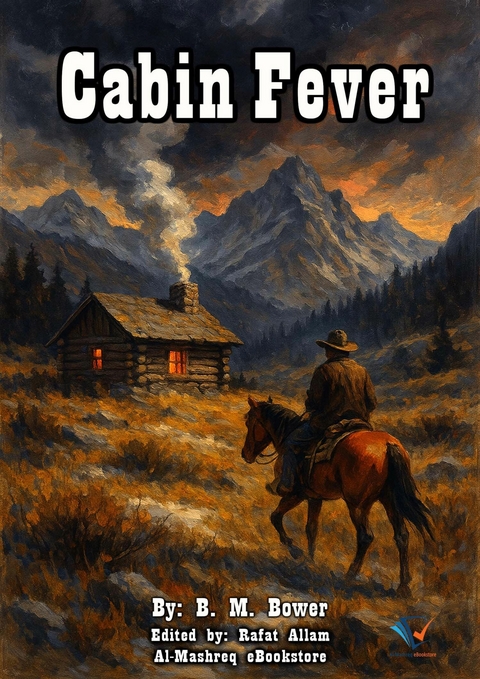
Cabin Fever (eBook)
200 Seiten
Al-Mashreq Ebookstore (Verlag)
978-0-00-472230-6 (ISBN)
Bertha Muzzy Sinclair-Cowan, better known by her pen name B. M. Bower, was a pioneering American author renowned for her Western novels. She began her writing career in the early 1900s, achieving significant success with her first novel, Chip of the Flying U (1906), which introduced readers to the fictional Flying U Ranch and its cowboys. Bower's authentic portrayal of ranch life, drawn from her experiences in Montana, set her work apart in the Western genre. Over her career, she authored more than 60 novels and numerous short stories, many of which were adapted into films. Her use of a gender-neutral pen name allowed her to navigate the male-dominated literary landscape of her time. Bower's contributions significantly shaped the Western genre, and her works continue to be celebrated for their humor, realism, and pioneering spirit.
III. — TEN DOLLARS AND A JOB FOR BUD
TO withhold for his own start in life only one ten-dollar bill from fifteen hundred dollars was spectacular enough to soothe even so bruised an ego as Bud Moore carried into the judge's office. There is an anger which carries a person to the extreme of self-sacrifice, in the subconscious hope of exciting pity for one so hardly used. Bud was boiling with such an anger, and it demanded that he should all but give Marie the shirt off his back, since she had demanded so much—and for so slight a cause.
Bud could not see for the life of him why Marie should have quit for that little ruction. It was not their first quarrel, nor their worst; certainly he had not expected it to be their last. Why, he asked the high heavens, had she told him to bring home a roll of cotton, if she was going to leave him? Why had she turned her back on that little home, that had seemed to mean as much to her as it had to him?
Being kin to primitive man, Bud could only bellow rage when he should have analyzed calmly the situation. He should have seen that Marie too had cabin fever, induced by changing too suddenly from carefree girlhood to the ills and irks of wifehood and motherhood. He should have known that she had been for two months wholly dedicated to the small physical wants of their baby, and that if his nerves were fraying with watching that incessant servitude, her own must be close to the snapping point; had snapped, when dusk did not bring him home repentant.
But he did not know, and so he blamed Marie bitterly for the wreck of their home, and he flung down all his worldly goods before her, and marched off feeling self-consciously proud of his martyrdom. It soothed him paradoxically to tell himself that he was "cleaned"; that Marie had ruined him absolutely, and that he was just ten dollars and a decent suit or two of clothes better off than a tramp. He was tempted to go back and send the ten dollars after the rest of the fifteen hundred, but good sense prevailed. He would have to borrow money for his next meal, if he did that, and Bud was touchy about such things.
He kept the ten dollars therefore, and went down to the garage where he felt most at home, and stood there with his hands in his pockets and the corners of his mouth tipped downward—normally they had a way of tipping upward, as though he was secretly amused at something—and his eyes sullen, though they carried tiny lines at the corners to show how they used to twinkle. He took the ten-dollar bank note from his pocket, straightened out the wrinkles and looked at it disdainfully. As plainly as though he spoke, his face told what he was thinking about it: that this was what a woman had brought him to! He crumpled it up and made a gesture as though he would throw it into the street, and a man behind him laughed abruptly. Bud scowled and turned toward him a belligerent glance, and the man stopped laughing as suddenly as he had begun.
"If you've got money to throw to the birds, brother, I guess I won't make the proposition I was going to make. Thought I could talk business to you, maybe—but I guess I better tie a can to that idea."
Bud grunted and put the ten dollars in his pocket.
"What idea's that?" "Oh, driving a car I'm taking south. Sprained my shoulder, and don't feel like tackling it myself. They tell me in here that you aren't doing anything now—" He made the pause that asks for an answer.
"They told you right. I've done it."
The man's eyebrows lifted, but since Bud did not explain, he went on with his own explanation.
"You don't remember me, but I rode into Big Basin with you last summer. I know you can drive, and it doesn't matter a lot whether it's asphalt or cow trail you drive over."
Bud was in too sour a mood to respond to the flattery. He did not even grunt.
"Could you take a car south for me? There'll be night driving, and bad roads, maybe—"
"If you know what you say you know about my driving, what's the idea—asking me if I can?"
"Well, put it another way. Will you?"
"You're on. Where's the car? Here?" Bud sent a seeking look into the depths of the garage. He knew every car in there. "What is there in it for me?" he added perfunctorily, because he would have gone just for sake of getting a free ride rather than stay in San Jose over night.
"There's good money in it, if you can drive with your mouth shut. This isn't any booster parade. Fact is—let's walk to the depot, while I tell you." He stepped out of the doorway, and Bud gloomily followed him. "Little trouble with my wife," the man explained apologetically. "Having me shadowed, and all that sort of thing. And I've got business south and want to be left alone to do it. Darn these women!" he exploded suddenly.
Bud mentally said amen, but kept his mouth shut upon his sympathy with the sentiment.
"Foster's my name. Now here's a key to the garage at this address." He handed Bud a padlock key and an address scribbled on a card. "That's my place in Oakland, out by Lake Merritt. You go there to-night, get the car, and have it down at the Broadway Wharf to meet the 11:30 boat—the one the theater crowd uses. Have plenty of gas and oil; there won't be any stops after we start. Park out pretty well near the shore end as close as you can get to that ten-foot gum sign, and be ready to go when I climb in. I may have a friend with me. You know Oakland?"
"Fair to middling. I can get around by myself."
"Well, that's all right. I've got to go back to the city— catching the next train. You better take the two-fifty to Oakland. Here's money for whatever expense there is. And say! put these number plates in your pocket, and take off the ones on the car. I bought these of a fellow that had a smash—they'll do for the trip. Put them on, will you? She's wise to the car number, of course. Put the plates you take off under the seat cushion; don't leave 'em. Be just as careful as if it was a life-and-death matter, will you? I've got a big deal on, down there,and I don't want her spilling the beans just to satisfy a grudge—which she would do in a minute. So don't fail to be at the ferry, parked so you can slide out easy. Get down there by that big gum sign. I'll find you, all right."
"I'll be there." Bud thrust the key and another ten dollars into his pocket and turned away. "And don't say anything—"
"Do I look like an open-faced guy?"
The man laughed. "Not much, or I wouldn't have picked you for the trip." He hurried down to the depot platform, for his train was already whistling, farther down the yards.
Bud looked after him, the corners of his mouth taking their normal, upward tilt. It began to look as though luck had not altogether deserted him, in spite of the recent blow it had given. He slid the wrapped number plates into the inside pocket of his overcoat, pushed his hands deep into his pockets, and walked up to the cheap hotel which had been his bleak substitute for a home during his trouble. He packed everything he owned— a big suitcase held it all by squeezing—paid his bill at the office, accepted a poor cigar, and in return said, yes, he was going to strike out and look for work; and took the train for Oakland.
A street car landed him within two blocks of the address on the tag, and Bud walked through thickening fog and dusk to the place. Foster had a good-looking house, he observed. Set back on the middle of two lots, it was, with a cement drive sloping up from the street to the garage backed against the alley. Under cover of lighting a cigarette, he inspected the place before he ventured farther. The blinds were drawn down—at least upon the side next the drive. On the other he thought he caught a gleam of light at the rear; rather, the beam that came from a gleam of light in Foster's dining room or kitchen shining on the next house. But he was not certain of it, and the absolute quiet reassured him so that he went up the drive, keeping on the grass border until he reached the garage. This, he told himself, was just like a woman—raising the deuce around so that a man had to sneak into his own place to get his own car out of his own garage. If Foster was up against the kind of deal Bud had been up against, he sure had Bud's sympathy, and he sure would get the best help Bud was capable of giving him.
The key fitted the lock, and Bud went in, set down his suitcase, and closed the door after him. It was dark as a pocket in there, save where a square of grayness betrayed a window. Bud felt his way to the side of the car, groped to the robe rail, found a heavy, fringed robe, and curtained the window until he could see no thread of light anywhere; after which he ventured to use his flashlight until he had found the switch and turned on the light.
There was a little side door at the back, and it was fastened on the inside with a stout hook. Bud thought for a minute, took a long chance, and let himself out into the yard, closing the door after him. He walked around the garage to the front and satisfied himself that the light inside did not show. Then he went around the back of the house and found that he had not been mistaken about the light. The house was certainly occupied, and like the neighboring houses seemed concerned only with the dinner hour of the inmates. He went back, hooked the little door on the inside, and began a careful inspection of the car he was to drive.
It was...
| Erscheint lt. Verlag | 14.6.2025 |
|---|---|
| Sprache | englisch |
| Themenwelt | Literatur ► Fantasy / Science Fiction |
| Literatur ► Romane / Erzählungen | |
| Schlagworte | cabin fever • domestic struggle • Emotional resilience • family dynamics • Frontier • Isolation • marriage • Mental Health • Montana • Personal Growth • pioneer life • psychological tension • ranch life • Relationship Challenges • rural setting • Self-discovery • snowbound • Solitude • Survival • Winter |
| ISBN-10 | 0-00-472230-2 / 0004722302 |
| ISBN-13 | 978-0-00-472230-6 / 9780004722306 |
| Informationen gemäß Produktsicherheitsverordnung (GPSR) | |
| Haben Sie eine Frage zum Produkt? |
 EPUB (Adobe DRM)
Kopierschutz: Adobe-DRM
Adobe-DRM ist ein Kopierschutz, der das eBook vor Mißbrauch schützen soll. Dabei wird das eBook bereits beim Download auf Ihre persönliche Adobe-ID autorisiert. Lesen können Sie das eBook dann nur auf den Geräten, welche ebenfalls auf Ihre Adobe-ID registriert sind.
Details zum Adobe-DRM
Dateiformat: EPUB (Electronic Publication)
EPUB ist ein offener Standard für eBooks und eignet sich besonders zur Darstellung von Belletristik und Sachbüchern. Der Fließtext wird dynamisch an die Display- und Schriftgröße angepasst. Auch für mobile Lesegeräte ist EPUB daher gut geeignet.
Systemvoraussetzungen:
PC/Mac: Mit einem PC oder Mac können Sie dieses eBook lesen. Sie benötigen eine
eReader: Dieses eBook kann mit (fast) allen eBook-Readern gelesen werden. Mit dem amazon-Kindle ist es aber nicht kompatibel.
Smartphone/Tablet: Egal ob Apple oder Android, dieses eBook können Sie lesen. Sie benötigen eine
Geräteliste und zusätzliche Hinweise
Buying eBooks from abroad
For tax law reasons we can sell eBooks just within Germany and Switzerland. Regrettably we cannot fulfill eBook-orders from other countries.
aus dem Bereich


