Chip of the Flying U (eBook)
200 Seiten
Arabookverse Ltd (Verlag)
978-0-01-180130-8 (ISBN)

Bertha Muzzy Sinclair-Cowan, better known by her pen name B. M. Bower, was a pioneering American author renowned for her Western novels. She began her writing career in the early 1900s, achieving significant success with her first novel, Chip of the Flying U (1906), which introduced readers to the fictional Flying U Ranch and its cowboys. Bower's authentic portrayal of ranch life, drawn from her experiences in Montana, set her work apart in the Western genre. Over her career, she authored more than 60 novels and numerous short stories, many of which were adapted into films. Her use of a gender-neutral pen name allowed her to navigate the male-dominated literary landscape of her time. Bower's contributions significantly shaped the Western genre, and her works continue to be celebrated for their humor, realism, and pioneering spirit.
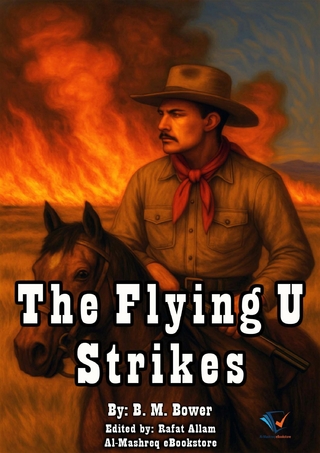
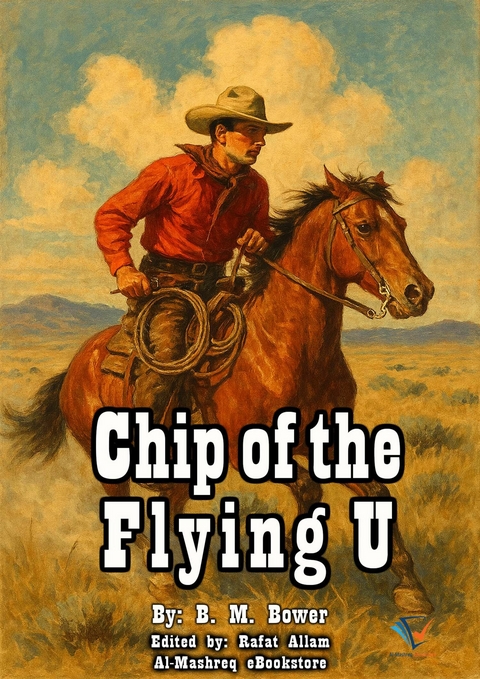
In Chip of the Flying U, B. M. Bower introduces readers to the Flying U Ranch and its charismatic cowboy, Chip Bennett. The arrival of Della Whitmore, a progressive female doctor, challenges traditional gender roles and ignites a heartfelt romance. This novel intertwines humor, love, and the rugged realities of ranch life in early 1900s Montana.
1. THE OLD MAN'S SISTER.
THE weekly mail had just arrived at the Flying U ranch. Shorty, who had made the trip to Dry Lake on horseback that afternoon, tossed the bundle to the "Old Man" and was halfway to the stable when he was called back peremptorily.
"Shorty! O-h-h, Shorty! Hi!"
Shorty kicked his steaming horse in the ribs and swung round in the path, bringing up before the porch with a jerk.
"Where's this letter been?" demanded the Old Man, with some excitement. James G. Whitmore, cattleman, would have been greatly surprised had he known that his cowboys were in the habit of calling him the Old Man behind his back. James G. Whitmore did not consider himself old, though he was constrained to admit, after several hours in the saddle, that rheumatism had searched him out—because of his fourteen years of roughing it, he said. Also, there was a place on the crown of his head where the hair was thin, and growing thinner every day of his life, though he did not realize it. The thin spot showed now as he stood in the path, waving a square envelope aloft before Shorty, who regarded it with supreme indifference.
Not so Shorty's horse. He rolled his eyes till the whites showed, snorted and backed away from the fluttering, white object.
"Doggone it, where's this been?" reiterated James G., accusingly.
"How the devil do I know?" retorted Shorty, forcing his horse nearer. "In the office, most likely. I got it with the rest to- day."
"It's two weeks old," stormed the Old Man. "I never knew it to fail—if a letter says anybody's coming, or you're to hurry up and go somewhere to meet somebody, that letter's the one that monkeys around and comes when the last dog's hung. A letter asking yuh if yuh don't want to get rich in ten days sellin' books, or something, 'll hike along out here in no time. Doggone it!"
"You got a hurry-up order to go somewhere?" queried Shorty, mildly sympathetic.
"Worse than that," groaned James G. "My sister's coming out to spend the summer—t'-morrow. And no cook but Patsy—and she can't eat in the mess house—and the house like a junk shop!"
"It looks like you was up against it, all right," grinned Shorty. Shorty was a sort of foreman, and was allowed much freedom of speech.
"Somebody's got to meet her—you have Chip catch up the creams so he can go. And send some of the boys up here to help me hoe out a little. Dell ain't used to roughing it; she's just out of a medical school—got her diploma, she was telling me in the last letter before this. She'll be finding microbes by the million in this old shack. You tell Patsy I'll be late to supper—and tell him to brace up and cook something ladies like—cake and stuff. Patsy'll know. I'd give a dollar to get that little runt in the office—"
But Shorty, having heard all that it was important to know, was clattering down the long slope again to the stable. It was supper time, and Shorty was hungry. Also, there was news to tell, and he was curious to see how the boys would take it. He was just turning loose the horse when supper was called. He hurried back up the hill to the mess house, performed hasty ablutions in the tin wash basin on the bench beside the door, scrubbed his face dry on the roller towel, and took his place at the long table within.
"Any mail for me?" Jack Bates looked up from emptying the third spoon of sugar into his coffee.
"Naw—she didn't write this time, Jack." Shorty reached a long arm for the "Mulligan stew."
"How's the dance coming on?" asked Cal Emmett.
"I guess it's a go, all right. They've got them coons engaged to play. The hotel's fixing for a big crowd, if the weather holds like this. Chip, Old Man wants you to catch up the creams, after supper; you've got to meet the train to-morrow."
"Which train?" demanded Chip, looking up. "Is old Dunk coming?"
"The noon train. No, he didn't say nothing about Dunk. He wants a bunch of you fellows to go up and hoe out the White House and slick it up for comp'ny—got to be done t'-night. And Patsy, Old Man says for you t' git a move on and cook something fit to eat; something that ain't plum full uh microbes."
Shorty became suddenly engaged in cooling his coffee, enjoying the varied emotions depicted on the faces of the boys.
"Who's coming?"
"What's up?"
Shorty took two leisurely gulps before he answered:
"Old Man's sister's coming out to stay all summer—and then some, maybe. Be here to-morrow, he said."
"Gee whiz! Is she pretty?" This from Cal Emmett.
"Hope she ain't over fifty." This from Jack Bates.
"Hope she ain't one of them four-eyed school-ma'ams," added Happy Jack—so called to distinguish him from Jack Bates, and also because of his dolorous visage.
"Why can't some one else haul her out?" began Chip. "Cal would like that job—and he's sure welcome to it."
"Cal's too dangerous. He'd have the old girl dead in love before he got her over the first ridge, with them blue eyes and that pretty smile of his'n. It's up to you, Splinter—Old Man said so."
"She'll be dead safe with Chip. He won't make love to her," retorted Cal.
"Wonder how old she is," repeated Jack Bates, half emptying the syrup pitcher into his plate. Patsy had hot biscuits for supper, and Jack's especial weakness was hot biscuits and maple syrup.
"As to her age," remarked Shorty, "it's a cinch she ain't no spring chicken, seeing she's the Old Man's sister."
"Is she a schoolma'am?" Happy Jack's distaste for schoolma'ams dated from his tempestuous introduction to the A B C's, with their daily accompaniment of a long, thin ruler.
"No, she ain't a schoolma'am. She's a darn sight worse. She's a doctor."
"Aw, come off!" Cal Emmett was plainly incredulous.
"That's right. Old Man said she's just finished taking a course uh medicine—what'd yuh call that?"
"Consumption, maybe—or snakes." Weary smiled blandly across the table.
"She got a diploma, though. Now where do you get off at?"
"Yeah—that sure means she's a doctor," groaned Cal.
"By golly, she needn't try t' pour any dope down me," cried a short, fat man who took life seriously—a man they called Slim, in fine irony.
"Gosh, I'd like to give her a real warm reception," said Jack Bates, who had a reputation for mischief. "I know them Eastern folks, down t' the ground. They think cow-punchers wear horns. Yes, they do. They think we're holy terrors that eat with our six-guns beside our plates—and the like of that. They make me plum tired. I'd like to—wish we knew her brand."
"I can tell you that," said Chip, cynically. "There's just two bunches to choose from. There's the Sweet Young Things, that faint away at sight of a six-shooter, and squawk and catch at your arm if they see a garter snake, and blush if you happen to catch their eye suddenly, and cry if you don't take off your hat every time you see them a mile off." Chip held out his cup for Patsy to refill.
"Yeah—I've run up against that brand—and they're sure all right. They suit me," remarked Cal.
"That don't seem to line up with the doctor's diploma," commented Weary.
"Well, she's the other kind then—and if she is, the Lord have mercy on the Flying U! She'll buy her some spurs and try to rope and cut out and help brand. Maybe she'll wear double-barreled skirts and ride a man's saddle and smoke cigarettes. She'll try to go the men one better in everything, and wind up by making a darn fool of herself. Either kind's bad enough."
"I'll bet she don't run in either bunch," began Weary. "I'll bet she's a skinny old maid with a peaked nose and glasses, that'll round us up every Sunday and read tracts at our heads, and come down on us with both feet about tobacco hearts and whisky livers, and the evils and devils wrapped up in a cigarette paper. I seen a woman doctor, once—she was stopping at the T Down when I was line-riding for them—and say, she was a holy fright! She had us fellows going South before a week. I stampeded clean off the range, soon as my month was up."
"Say," interrupted Cal, "don't yuh remember that picture the Old Man got last fall, of his sister? She was the image of the Old Man—and mighty near as old."
Chip, thinking of the morrow's drive, groaned in real anguish of spirit.
"You won't dast t' roll a cigarette comin' home, Chip," predicted Happy Jack, mournfully. "Yuh want t' smoke double goin' in."
"I don't think I'll smoke double going in," returned Chip, dryly. "If the old girl don't like my style, why the walking isn't all taken up."
"Say, Chip," suggested Jack Bates, "you size her up at the depot, and, if she don't look promising, just slack the lines on Antelope Hill. The creams 'll do the rest. If they don't, we'll finish the job here."
Shorty tactfully pushed back his chair and rose. "You fellows don't want to git too gay," he warned. "The Old Man's just beginning to forget about the calf-shed deal." Then he went out and shut the door after him. The boys liked Shorty; he believed in the old adage about wisdom being bliss at certain times, and the boys were...
| Erscheint lt. Verlag | 14.6.2025 |
|---|---|
| Sprache | englisch |
| Themenwelt | Literatur ► Fantasy / Science Fiction |
| Literatur ► Historische Romane | |
| Literatur ► Romane / Erzählungen | |
| Schlagworte | Art and Creativity • Chip Bennett • Community • cowboy life • cultural norms • Della Whitmore • Early 20th Century • Flying U Ranch • Frontier challenges • Gender dynamics • Humor • Independence • Love Story • Montana • Personal Transformation • ranching • Romance • Rural America • strong female lead • Traditional Values • western setting |
| ISBN-10 | 0-01-180130-1 / 0011801301 |
| ISBN-13 | 978-0-01-180130-8 / 9780011801308 |
| Informationen gemäß Produktsicherheitsverordnung (GPSR) | |
| Haben Sie eine Frage zum Produkt? |
 EPUB (Adobe DRM)
Kopierschutz: Adobe-DRM
Adobe-DRM ist ein Kopierschutz, der das eBook vor Mißbrauch schützen soll. Dabei wird das eBook bereits beim Download auf Ihre persönliche Adobe-ID autorisiert. Lesen können Sie das eBook dann nur auf den Geräten, welche ebenfalls auf Ihre Adobe-ID registriert sind.
Details zum Adobe-DRM
Dateiformat: EPUB (Electronic Publication)
EPUB ist ein offener Standard für eBooks und eignet sich besonders zur Darstellung von Belletristik und Sachbüchern. Der Fließtext wird dynamisch an die Display- und Schriftgröße angepasst. Auch für mobile Lesegeräte ist EPUB daher gut geeignet.
Systemvoraussetzungen:
PC/Mac: Mit einem PC oder Mac können Sie dieses eBook lesen. Sie benötigen eine
eReader: Dieses eBook kann mit (fast) allen eBook-Readern gelesen werden. Mit dem amazon-Kindle ist es aber nicht kompatibel.
Smartphone/Tablet: Egal ob Apple oder Android, dieses eBook können Sie lesen. Sie benötigen eine
Geräteliste und zusätzliche Hinweise
Buying eBooks from abroad
For tax law reasons we can sell eBooks just within Germany and Switzerland. Regrettably we cannot fulfill eBook-orders from other countries.
aus dem Bereich