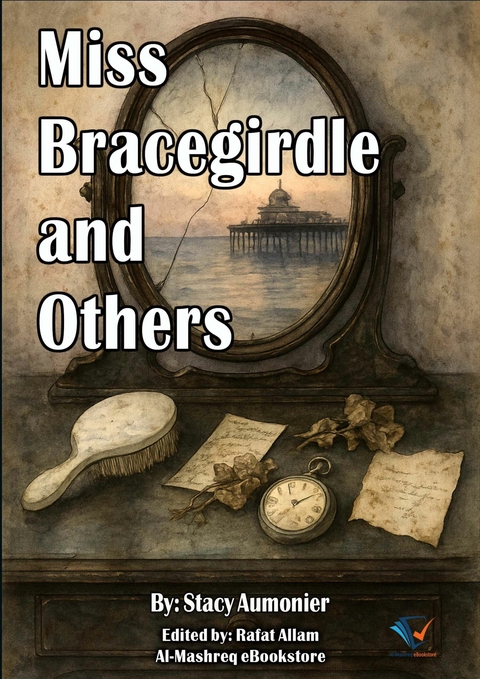
Miss Bracegirdle and Others (eBook)
200 Seiten
Al-Mashreq Ebookstore (Verlag)
978-0-17-629139-6 (ISBN)
Stacy Aumonier was a British writer and stage performer, acclaimed for his short stories that delved into the intricacies of human nature and society. Coming from a family with a rich artistic heritage, he initially pursued painting before turning to writing. Between 1913 and 1928, Aumonier published over 85 short stories, six novels, and several essays. His works were celebrated for their wit, insight, and emotional depth. Notably, Nobel laureate John Galsworthy praised Aumonier as 'one of the best short-story writers of all time.' Despite his untimely death from tuberculosis at the age of 51, Aumonier's literary contributions have left a lasting impact on British literature.
2. WHERE WAS WYCH STREET?
In the public bar of the "Wagtail," in Wapping, four men and a woman were drinking beer and discussing diseases. It was not a pretty subject, and the company was certainly not a handsome one. It was a dark November evening, and the dingy lighting of the bar seemed but to emphasize the bleak exterior. Drifts of fog and damp from without mingled with the smoke of shag. The sanded floor was kicked into a muddy morass not unlike the surface of the pavement. An old lady down the street had died from pneumonia the previous evening, and the event supplied a fruitful topic of conversation. The things that one could get! Everywhere were germs eager to destroy one. At any minute the symptoms might break out. And so—one foregathered in a cheerful spot amidst friends and drank forgetfulness.
Prominent in this little group was Baldwin Meadows, a sallow-faced villain with battered features and prominent cheek-bones, his face cut and scarred by a hundred fights. Ex-seaman, ex-boxer, ex-fish-porter—indeed, to everyone's knowledge, ex-everything. No one knew how he lived. By his side lurched an enormous coloured man who went by the name of Harry Jones. Grinning above a tankard sat a pimply faced young man who was known as "the Agent." Silver rings adorned his fingers. He had no other name, and most emphatically no address, but he "arranged things" for people, and appeared to thrive upon it in a scrambling, fugitive manner. The other two people were Mr. and Mrs. Dawes. Mr. Dawes was an entirely negative person, but Mrs. Dawes shone by virtue of a high, whining, insistent voice, keyed to within half a note of hysteria.
Then, at one point, the conversation suddenly took a peculiar turn. It came about through Mrs. Dawes mentioning that her aunt, who died from eating tinned lobster, used to work in a corset shop in Wych Street. When she said that, "the Agent," whose right eye appeared to survey the ceiling, whilst his left eye looked over the other side of his tankard, remarked:
"Where was Wych Street, ma?"
"Lord!" exclaimed Mrs. Dawes. "Don't you know, dearie? You must be a young 'un, you must. Why, when I was a gal everyone knew Wych Street. It was just down there where they built the Kingsway, like."
Baldwin Meadows cleared his throat and said:
"Wych Street used to be a turnin' runnin' from Long Acre into Wellington Street."
"Oh, no, old boy," chipped in Mr. Dawes, who always treated the ex-man with great deference. "If you'll excuse me, Wych Street was a narrow lane at the back of the old Globe Theatre, that used to pass by the church."
"I know what I'm talkin' about," growled Meadows.
Mrs. Dawes's high nasal whine broke in:
"Hi, Mr. Booth, you used ter know yer wye abaht. Where was Wych Street?"
Mr. Booth, the proprietor, was polishing a tap. He looked up. "Wych Street? Yus, of course I knoo Wych Street. Used to go there with some of the boys when I was Covent Garden way. It was at right angles to the Strand, just east of Wellington Street."
"No, it warn't. It were alongside the Strand, before yer come to Wellington Street."
The coloured man took no part in the discussion, one street and one city being alike to him, provided he could obtain the material comforts dear to his heart; but the others carried it on with a certain amount of acerbity.
Before any agreement had been arrived at three other men entered the bar. The quick eye of Meadows recognized them at once as three of what was known at that time as "The Gallows Ring." Every member of "The Gallows Ring" had done time, but they still carried on a lucrative industry devoted to blackmail, intimidation, shop-lifting, and some of the clumsier recreations. Their leader, Ben Orming, had served seven years for bashing a Chinaman down at Rotherhithe.
"The Gallows Ring" was not popular in Wapping, for the reason that many of their depredations had been inflicted upon their own class. When Meadows and Harry Jones took it into their heads to do a little wild prancing they took the trouble to go up into the West End. They considered "The Gallows Ring" an ungentlemanly set; nevertheless, they always treated them with a certain external deference—an unpleasant crowd to quarrel with.
Ben Orming ordered beer for the three of them, and they leant against the bar and whispered in sullen accents. Something had evidently miscarried with the Ring. Mrs. Dawes continued to whine above the general droneof the bar. Suddenly she said:
"Ben, you're a hot old devil, you are. We was just 'aving a discussion like. Where was Wych Street?"
Ben scowled at her, and she continued:
"Some sez it was one place, some sez it was another. I know where it was, 'cors my aunt what died from blood p'ison, after eatin' tinned lobster, used to work at a corset shop... "
"Yus," barked Ben, emphatically. "I know where Wych Street was—it was just sarth of the river, afore yer come to Waterloo Station."
It was then that the coloured man, who up to that point had taken no part in the discussion, thought fit to intervene.
"Nope. You's all wrong, cap'n. Wych Street were alongside de church, way over where de Strand takes a side line up west."
Ben turned on him fiercely.
"What the blazes does a blanketty nigger know abaht it? Fve told yer where Wych Street was."
"Yus, and I know where it was," interposed Meadows. "Yer both wrong. Wych Street was a turning running from Long Acre into Wellington Street."
"I didn't ask yer what you thought," growled Ben.
"Well, I suppose I've a right to an opinion?"
"You always think you know everything, you do."
"You can just keep yer mouth shut."
"It 'ud take more'n you to shut it."
Mr. Booth thought it advisable at this juncture to bawl across the bar:
"Now, gentlemen, no quarrelling—please."
The affair might have subsided at that point, but for Mrs. Dawes. Her emotions over the death of the old lady in the street had been so stirred that she had been, almost unconsciously, drinking too much gin. She suddenly screamed out:
"Don't you take no lip from 'im, Mr. Medders. The dirty, thieving devil, 'e always thinks 'e's goin' to come it over everyone."
She stood up threateningly, and one of Ben's supporters gave her a gentle push backward. In three minutes the bar was in a complete state of pandemonium. The three members of "The Gallows Ring" fought two men and a woman, for Mr. Dawes merely stood in a corner and screamed out:
"Don't! Don't!"
Mrs. Dawes stabbed the man who had pushed her through the wrist with a hatpin. Meadows and Ben Orming closed on each other and fought savagely with the naked fists. A lucky blow early in the encounter sent Meadows reeling against the wall, with blood streaming down his temple. Then the coloured man hurled a pewter tankard straight at Ben and it hit him on the knuckles. The pain maddened him to a frenzy. His other supporter had immediately got to grips with Harry Jones, and picked up one of the high stools and, seizing an opportunity, brought it down crash on to the coloured man's skull.
The whole affair was a matter of minutes. Mr. Booth was bawling out in the street. A whistle sounded. People were running in all directions.
"Beat it! Beat it, for God's sake!" called the man who had been stabbed through the wrist. His face was very white, and he was obviously about to faint.
Ben and the other man, whose name was Toller, dashed to the door. On the pavement there was a confused scramble. Blows were struck indiscriminately. Two policemen appeared. One was laid hors de combat by a kick on the knee-cap from Toller. The two men fled into the darkness, followed by a hue-and-cry. Born and bred in the locality, they took every advantage of their knowledge. They tacked through alleys and raced down dark mews, and clambered over walls. Fortunately for them, the people they passed, who might have tripped them up or aided in the pursuit, merely fled indoors. The people in Wapping are not always on the side of the pursuer. But the police held on. At last Ben and Toller slipped through the door of a house in Aztec Street barely ten yards ahead of their nearest pursuer. Blows rained on the door, but they slipped the bolts, and then fell panting to the floor. When Ben could speak, he said:
"If they cop us, it means swinging."
"Was the nigger done in?"
"I think so. But even if 'e wasn't, there was that other affair the night before last. The game's up."
The ground floor rooms were shuttered and bolted, but they knew that the police would probably force the front door. At the back there was no escape, only a narrow stable yard, where lanterns were already flashing. The roof only extended thirty yards either way, and the police would probably take possession of it. They made a round of the house, which was sketchily furnished. There was a loaf, a small piece of mutton, and a bottle of pickles, and—the most precious possession—three bottles of whisky. Each man drank half a glass of neat whisky, then Ben said: "We'll be able to keep 'em quiet for a bit, anyway," and he went and fetched an old twelve-bore gun and a case of cartridges. Toller was opposed to this last desperate resort, but Ben continued to murmur: "It means swinging, anyway."
And thus began the notorious siege of Aztec Street, It lasted three days and four nights. You may remember that, on forcing a panel of the front door Sub-Inspector Wraithe, of the V Division, was shot through the chest. The police then tried other methods. A hose was brought into play, without effect. Two policemen were killed and four wounded. The military...
| Erscheint lt. Verlag | 14.6.2025 |
|---|---|
| Sprache | englisch |
| Themenwelt | Literatur ► Romane / Erzählungen |
| Schlagworte | British Literature • character studies • class distinctions • Cultural Commentary • Early 20th Century • Edwardian England • Human nature • Humor • literary fiction • Miss Bracegirdle • Narrative craftsmanship • psychological insight • Satire • Short Stories • social conventions • societal norms • Stacy Aumonier • The Octave of Jealousy • timeless tales • Where Was Wych Street? • Wit |
| ISBN-10 | 0-17-629139-3 / 0176291393 |
| ISBN-13 | 978-0-17-629139-6 / 9780176291396 |
| Informationen gemäß Produktsicherheitsverordnung (GPSR) | |
| Haben Sie eine Frage zum Produkt? |
 EPUB (Adobe DRM)
Kopierschutz: Adobe-DRM
Adobe-DRM ist ein Kopierschutz, der das eBook vor Mißbrauch schützen soll. Dabei wird das eBook bereits beim Download auf Ihre persönliche Adobe-ID autorisiert. Lesen können Sie das eBook dann nur auf den Geräten, welche ebenfalls auf Ihre Adobe-ID registriert sind.
Details zum Adobe-DRM
Dateiformat: EPUB (Electronic Publication)
EPUB ist ein offener Standard für eBooks und eignet sich besonders zur Darstellung von Belletristik und Sachbüchern. Der Fließtext wird dynamisch an die Display- und Schriftgröße angepasst. Auch für mobile Lesegeräte ist EPUB daher gut geeignet.
Systemvoraussetzungen:
PC/Mac: Mit einem PC oder Mac können Sie dieses eBook lesen. Sie benötigen eine
eReader: Dieses eBook kann mit (fast) allen eBook-Readern gelesen werden. Mit dem amazon-Kindle ist es aber nicht kompatibel.
Smartphone/Tablet: Egal ob Apple oder Android, dieses eBook können Sie lesen. Sie benötigen eine
Geräteliste und zusätzliche Hinweise
Buying eBooks from abroad
For tax law reasons we can sell eBooks just within Germany and Switzerland. Regrettably we cannot fulfill eBook-orders from other countries.
aus dem Bereich