


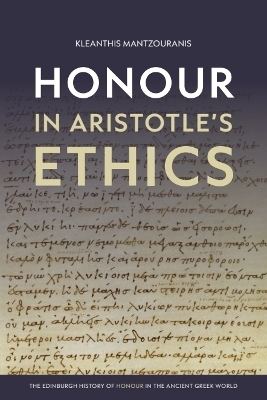
Honour in Aristotle's Ethics
Seiten
2026
Edinburgh University Press (Verlag)
978-1-3995-3225-9 (ISBN)
Edinburgh University Press (Verlag)
978-1-3995-3225-9 (ISBN)
- Noch nicht erschienen (ca. Januar 2026)
- Versandkostenfrei
- Auch auf Rechnung
- Artikel merken
A thorough re-evaluation of the nature and workings of honour in Aristotle’s psychology and ethics.
Why does Aristotle label honour (timē) as the ‘greatest’ among the external goods required for the good life (eudaimonia)? And how does this statement relate with human emotions and Aristotle’s famous assertion that human beings are by nature political animals? Despite the dominant place of honour in Aristotle’s philosophy of human affairs (ethics, politics, rhetoric), its role has been grossly understudied, mainly because honour has been erroneously conceived as an outmoded notion out of sync with modern preoccupations and concerns. Drawing on contemporary sociology, philosophy and psychology, this monograph offers a thorough re-evaluation of Aristotelian timē that challenges common assumptions both about ancient and about modern ‘honour’. Aristotle’s incisive remarks on the role of timē in human psychology and behaviour reveal that, far from being a parochial concept, Greek timē is indicative of a universal human concern for esteem and social recognition in our lives as social beings.
Why does Aristotle label honour (timē) as the ‘greatest’ among the external goods required for the good life (eudaimonia)? And how does this statement relate with human emotions and Aristotle’s famous assertion that human beings are by nature political animals? Despite the dominant place of honour in Aristotle’s philosophy of human affairs (ethics, politics, rhetoric), its role has been grossly understudied, mainly because honour has been erroneously conceived as an outmoded notion out of sync with modern preoccupations and concerns. Drawing on contemporary sociology, philosophy and psychology, this monograph offers a thorough re-evaluation of Aristotelian timē that challenges common assumptions both about ancient and about modern ‘honour’. Aristotle’s incisive remarks on the role of timē in human psychology and behaviour reveal that, far from being a parochial concept, Greek timē is indicative of a universal human concern for esteem and social recognition in our lives as social beings.
Kleanthis Mantzouranis is a Research Fellow at the University of Bologna
Acknowledgments
Abbreviations, Editions, Transliteration
Introduction
1. The Features of Honour
2. Honour, Axia and Self-Respect: Emotions Towards Face-Threats
3. Honour, Axia and the Principles of Social Interaction: Emotions and Virtues of Sociability
4. Emotions Towards the Fortunes of Others: Pity and Indignation
5. Emotions of Social Comparison: Envy and Emulation
6. ‘Proper Love of Honour’ or Philotimia
7. Greatness of Soul
Conclusion
Bibliography
| Erscheint lt. Verlag | 31.1.2026 |
|---|---|
| Reihe/Serie | The Edinburgh History of Honour in the Ancient Greek World |
| Verlagsort | Edinburgh |
| Sprache | englisch |
| Maße | 156 x 234 mm |
| Themenwelt | Literatur ► Klassiker / Moderne Klassiker |
| Geschichte ► Allgemeine Geschichte ► Vor- und Frühgeschichte | |
| Geisteswissenschaften ► Philosophie ► Ethik | |
| Geisteswissenschaften ► Philosophie ► Philosophie Altertum / Antike | |
| ISBN-10 | 1-3995-3225-1 / 1399532251 |
| ISBN-13 | 978-1-3995-3225-9 / 9781399532259 |
| Zustand | Neuware |
| Informationen gemäß Produktsicherheitsverordnung (GPSR) | |
| Haben Sie eine Frage zum Produkt? |
Mehr entdecken
aus dem Bereich



aus dem Bereich
auf den Spuren der frühen Zivilisationen
Buch | Hardcover (2023)
C.H.Beck (Verlag)
CHF 27,95
Konzepte – Methoden – Theorien
Buch | Softcover (2024)
UTB (Verlag)
CHF 55,85


