


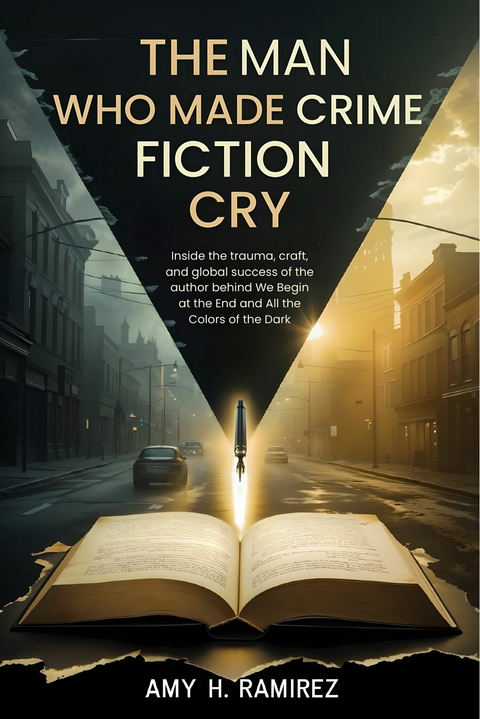
The Man Who Made Crime Fiction Cry (eBook)
260 Seiten
Publishdrive (Verlag)
978-0-00-090435-5 (ISBN)
A nineteen-year-old stumbles through London streets, blood streaming from stab wounds, his future seemingly destroyed in a single moment of random violence. What he doesn't know is that this attack will become the foundation for one of the most powerful voices in contemporary literature.
Chris Whitaker should have been another tragic statistic. Academic failure. Violent assault. Trauma that left him hiding behind corporate masks for over a decade. But something extraordinary happened when he finally put pen to paper at midnight, transforming his deepest wounds into words that would heal millions.
Tall Oaks wasn't just a debut novel-it was a declaration that crime fiction could make readers weep with recognition rather than thrill with violence. When We Begin at the End swept international awards and became a global phenomenon, the literary world realized something unprecedented was happening. Here was an author who could make the darkest genre serve the light.
But how does someone transform the worst night of their life into their greatest gift?
Through exclusive research and intimate exploration, this biography reveals the hidden journey from victim to victor that most readers never see. Discover the midnight writing sessions that became therapy. The corporate success that nearly destroyed his authentic voice. The leap of faith that abandoned financial security for artistic truth.
Watch as rejection letters pile up before breakthrough recognition. See how All the Colors of the Dark pushed the boundaries of what crime fiction could achieve. Learn why celebrities and trauma survivors alike embrace work that makes hardened crime readers reach for tissues.
This isn't just another literary biography-it's proof that our greatest wounds can become our most powerful gifts when courage meets craft.
From London streets to international acclaim, from broken teenager to healing mentor, Chris Whitaker's story demonstrates that authentic voices can transform not just individual lives but entire genres.
The question isn't whether you'll be moved by this story-it's whether you're ready to discover how your own wounds might become windows to help others find light.
Order now and discover the transformative power of turning pain into purpose.
1
The Boy Who Stumbled
Early Years in London
The streets of London have a way of shaping the children who grow up on them, and Chris Whitaker was no exception. Born into a working-class family in one of the world’s most literary cities, he was surrounded by the ghosts of countless stories—though he had no way of knowing that one day, he would join their ranks as a storyteller himself.
London in the 1970s and 80s was a city of contrasts, much like the fiction Chris would later write. The same streets that housed centuries of literary tradition also bore witness to economic hardship, social upheaval, and the everyday struggles of ordinary families trying to make their way in an increasingly complex world. For young Chris, these early years were marked not by any obvious signs of future literary greatness, but by the quiet observations of a boy who seemed to notice more than he let on.
His childhood was relatively unremarkable by external standards—no dramatic poverty, no exceptional privilege, just the middle ground of working-class London life where dreams were practical things and ambitions were kept in check by reality. Yet within this ordinary setting, something was already stirring in the boy who would one day transform personal trauma into profound art. He was the kind of child who listened more than he spoke, who watched people with an intensity that would later serve him well as a novelist.
The London of Chris’s youth was a city rebuilding itself, much as he would later rebuild his own life after trauma. The post-war optimism was giving way to economic uncertainty, and families like his were caught between the promise of social mobility and the harsh realities of limited opportunities. This tension between hope and disappointment, between what was promised and what was possible, would later become a recurring theme in his novels.
Even as a boy, Chris seemed to carry a weight that others his age didn’t fully understand. There was a seriousness to him, a depth that suggested he was processing the world differently from his peers. Teachers noticed it, family members saw it, but no one could have predicted where this quiet intensity would eventually lead. In many ways, he was already the character-driven observer he would become as a novelist, studying human nature from the sidelines of his own childhood.
The city itself became his first classroom in human complexity. London’s diverse neighborhoods, its mix of cultures and classes, its ancient history layered beneath modern struggles—all of this seeped into young Chris’s consciousness. He was learning, without knowing it, about the kind of authentic human stories that would later distinguish his fiction from more formulaic crime novels.
Academic Struggles and Missed Opportunities
School, for Chris Whitaker, was never the safe harbor it was meant to be. While other children found their rhythm in the structured world of academics, Chris seemed to march to a different drummer—one that the educational system of the time was ill-equipped to hear or understand.
His struggles weren’t born of lack of intelligence; anyone who spoke with him could sense a sharp mind at work. Rather, they stemmed from a fundamental disconnect between how he processed the world and how the world expected him to perform. The traditional markers of academic success—test scores, homework completion, classroom participation—seemed to elude him not because he couldn’t achieve them, but because they felt irrelevant to the deeper questions that occupied his mind.
Teachers saw a boy who was capable but unmotivated, present but disengaged. They couldn’t see what Chris himself was only beginning to understand: that he was already writing stories in his head, already observing human behavior with the keen eye of a future novelist, already grappling with questions about pain and resilience that wouldn’t find their proper outlet for years to come.
The missed opportunities accumulated like unpaid debts. Projects left unfinished, potential unrealized, chances for recognition or advancement squandered through a combination of disinterest and self-sabotage. Each failure reinforced the narrative that was building in his mind—that he was somehow different, somehow less capable of succeeding in the conventional ways that society valued.
His parents, like most working-class families, believed in education as the pathway to a better life. They pushed, they encouraged, they sometimes despaired. But Chris seemed immune to their urgings, as if he were living in a parallel universe where the rules everyone else followed simply didn’t apply to him. This created tension at home, disappointment that hung in the air like smoke, and a growing sense that he was letting everyone down—including himself.
The irony, of course, is that Chris was already learning some of the most important lessons of his future career. His academic struggles were teaching him about failure, about disappointment, about the gap between expectations and reality. His outsider status was giving him the observational skills that would later make his characters so authentic and compelling. But at the time, all he could see was his own inability to meet the standards that seemed to come naturally to everyone else.
These early academic failures established a pattern that would follow him for years: the sense that he was somehow broken, that success was meant for other people, that his own path would always be more complicated and uncertain than those around him. This feeling of being fundamentally different—not better or worse, just different—would later become one of his greatest strengths as a writer, allowing him to create characters who felt like real people rather than literary constructs.
The Weight of Youthful Mistakes
Adolescence is a minefield under the best of circumstances, but for Chris Whitaker, the explosive potential of teenage poor judgment would prove particularly costly. The mistakes of his youth weren’t extraordinary by teenage standards—drinking, cutting classes, making decisions based on impulse rather than wisdom—but their consequences would ripple through his life in ways he couldn’t have imagined.
The weight of these mistakes wasn’t just in their immediate impact, but in how they reinforced his growing sense of being fundamentally flawed. Each poor choice seemed to confirm what his academic struggles had already suggested: that he was destined to disappoint, destined to fall short of expectations, destined to watch opportunities slip through his fingers like water.
There was the drinking, which started as teenage experimentation but quickly became something more troubling. Not quite addiction, but certainly dependency—a way of numbing the constant sense that he was failing to measure up to some invisible standard. The alcohol provided temporary relief from the pressure of being constantly disappointed in himself, but it also ensured that the cycle of poor decisions would continue.
The social dynamics of his peer group didn’t help. Like many teenagers struggling to find their identity, Chris gravitated toward others who were also on the margins, also acting out, also using rebellion as a way of dealing with their own uncertainties. These friendships, while providing a sense of belonging, also created environments where bad decisions were normalized and even celebrated.
His family watched with growing concern as their bright, sensitive boy seemed determined to sabotage his own future. The conversations grew more strained, the disappointment more palpable. Chris began to internalize not just his own sense of failure, but his family’s worry and frustration as well. The weight of letting others down added another layer to the burden he was already carrying.
What made these youthful mistakes particularly painful was Chris’s own awareness of them. He wasn’t acting out of ignorance or genuine rebellion; he was making choices he knew were wrong, as if compelled by some internal force he couldn’t understand or control. This self-awareness made the mistakes feel even heavier, as if he were a passenger in his own life, watching himself make decisions that he knew would lead to consequences he didn’t want to face.
The pattern was becoming clear: Chris was his own worst enemy, sabotaging opportunities before they could disappoint him, choosing failure over the risk of trying and falling short. It was a protective mechanism, but one that came at an enormous cost. Each mistake built upon the last, creating a narrative of self-defeat that seemed impossible to escape.
A-Level Failures and Their Aftermath
The A-level examinations represented more than just academic assessment for Chris Whitaker—they were his last, best chance to prove that despite everything, he could still salvage something from his educational years. They were the gateway to university, to respectability, to the kind of future his parents had dreamed of for him. Their failure would represent not just academic disappointment, but the closing of a door that might never open again.
The most dramatic of these failures came on what should have been one of the most important days of his academic life. Missing an examination because he was intoxicated wasn’t just a mistake—it was a moment of such profound self-sabotage that it seemed to crystallize everything that had been building for years. Here was the culmination of all the poor choices, all the missed opportunities, all the weight of...
| Erscheint lt. Verlag | 17.6.2025 |
|---|---|
| Sprache | englisch |
| Themenwelt | Literatur ► Biografien / Erfahrungsberichte |
| ISBN-10 | 0-00-090435-X / 000090435X |
| ISBN-13 | 978-0-00-090435-5 / 9780000904355 |
| Informationen gemäß Produktsicherheitsverordnung (GPSR) | |
| Haben Sie eine Frage zum Produkt? |
 EPUB (Adobe DRM)
Größe: 1,4 MB
Kopierschutz: Adobe-DRM
Adobe-DRM ist ein Kopierschutz, der das eBook vor Mißbrauch schützen soll. Dabei wird das eBook bereits beim Download auf Ihre persönliche Adobe-ID autorisiert. Lesen können Sie das eBook dann nur auf den Geräten, welche ebenfalls auf Ihre Adobe-ID registriert sind.
Details zum Adobe-DRM
Dateiformat: EPUB (Electronic Publication)
EPUB ist ein offener Standard für eBooks und eignet sich besonders zur Darstellung von Belletristik und Sachbüchern. Der Fließtext wird dynamisch an die Display- und Schriftgröße angepasst. Auch für mobile Lesegeräte ist EPUB daher gut geeignet.
Systemvoraussetzungen:
PC/Mac: Mit einem PC oder Mac können Sie dieses eBook lesen. Sie benötigen eine
eReader: Dieses eBook kann mit (fast) allen eBook-Readern gelesen werden. Mit dem amazon-Kindle ist es aber nicht kompatibel.
Smartphone/Tablet: Egal ob Apple oder Android, dieses eBook können Sie lesen. Sie benötigen eine
Geräteliste und zusätzliche Hinweise
Buying eBooks from abroad
For tax law reasons we can sell eBooks just within Germany and Switzerland. Regrettably we cannot fulfill eBook-orders from other countries.
aus dem Bereich


