


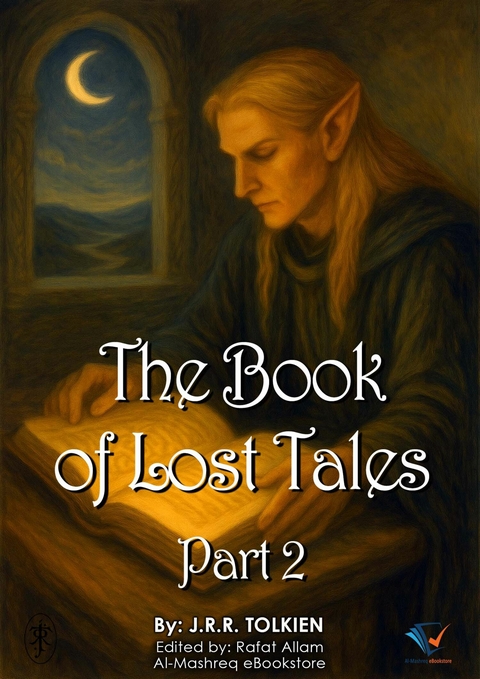
The Book of Lost Tales, Part 2 (eBook)
200 Seiten
Al-Mashreq Ebookstore (Verlag)
978-0-2289-6201-4 (ISBN)
J.R.R. Tolkien (1892-1973) was an English author, scholar, and linguist best known for creating The Hobbit (1937) and The Lord of the Rings (1954-1955). Born in South Africa, he moved to England as a child and later studied at Oxford, where he became a professor of Anglo-Saxon and English literature. A veteran of World War I, Tolkien drew on his love of mythology, language, and medieval literature to craft Middle-earth, an intricate fantasy world with its own histories, cultures, and languages like Elvish. His works, blending epic adventure with deep themes of heroism, friendship, and the struggle against evil, redefined modern fantasy. Though initially slow to gain popularity, The Lord of the Rings became a global phenomenon, influencing countless writers and artists. Tolkien continued expanding his legendarium until his death in 1973, with posthumous works like The Silmarillion (1977) further enriching his mythos. Today, he is celebrated as one of literature's greatest world-builders.
The Tale of Turambar, like that of Tinúviel, is a manuscript written in ink over a wholly erased original in pencil. But it seems certain that the extant form of Turambar preceded the extant form of Tinúviel. This can be deduced in more ways than one, but the order of composition is clearly exemplified in the forms of the name of the King of the Woodland Elves (Thingol). Throughout the manuscript of Turambar he was originally Tintoglin (and this appears also in the tale of The Coming of the Elves, where it was changed to Tinwelint, I. 115, 131). A note on the manuscript at the beginning of the tale says: ‘Tintoglin’s name must be altered throughout to Ellon or Tinthellon = Q. Ellu’, but the note was struck out, and all through the tale Tintoglin was in fact changed to Tinwelint.
Now in the Tale of Tinúviel the king’s name was first given as Ellu (or Tinto Ellu), and once as Tinthellon (pp. 50–1); subsequently it was changed throughout to Tinwelint. It is clear that the direction to change Tintoglin to ‘Ellon or Tinthellon = Q. Ellu’ belongs to the time when the Tale of Tinúviel was being, or had been, rewritten, and that the extant Tale of Turambar already existed.
There is also the fact that the rewritten Tinúviel was followed, at the same time of composition, by the first form of the ‘interlude’ in which Gilfanon appears (see I. 203), whereas at the beginning of Turambar there is a reference to Ailios (who was replaced by Gilfanon) concluding the previous tale. On the different arrangement of the tale-telling at this point that my father subsequently introduced but failed to carry through see I. 229–30. According to the earlier arrangement, Ailios told his tale on the first night of the feast of Turuhalmë or the Logdrawing, and Eltas followed with the Tale of Turambar on the second.
There is evidence that the Tale of Turambar was in existence at any rate by the middle of 1919. Humphrey Carpenter discovered a passage, written on a scrap of proof for the Oxford English Dictionary, in an early alphabet of my father’s devising; and transliterating it he found it to be from this tale, not far from the beginning. He has told me that my father was using this version of the ‘Alphabet of Rúmil’ about June 1919 (see Biography, p. 100).
When then Ailios had spoken his fill the time for the lighting of candles was at hand, and so came the first day of Turuhalmë to an end; but on the second night Ailios was not there, and being asked by Lindo one Eltas began a tale, and said:
‘Now all folk gathered here know that this is the story of Turambar and the Foalókë, and it is,’ said he, ‘a favourite tale among Men, and tells of very ancient days of that folk before the Battle of Tasarinan when first Men entered the dark vales of Hisilómë.
In these days many such stories do Men tell still, and more have they told in the past especially in those kingdoms of the North that once I knew. Maybe the deeds of other of their warriors have become mingled therein, and many matters beside that are not in the most ancient tale—but now I will tell to you the true and lamentable tale, and I knew it long ere I trod Olórë Mallë in the days before the fall of Gondolin.
In those days my folk dwelt in a vale of Hisilómë and that land did Men name Aryador in the tongues they then used, but they were very far from the shores of Asgon and the spurs of the Iron Mountains were nigh to their dwellings and great woods of very gloomy trees. My father said to me that many of our older men venturing afar had themselves seen the evil worms of Melko and some had fallen before them, and by reason of the hatred of our people for those creatures and of the evil Vala often was the story of Turambar and the Foalókë in their mouths—but rather after the fashion of the Gnomes did they say Turumart and the Fuithlug.
For know that before the Battle of Lamentation and the ruin of the Noldoli there dwelt a lord of Men named Úrin, and hearkening to the summons of the Gnomes he and his folk marched with the Ilkorindi against Melko, but their wives and children they left behind them in the woodlands, and with them was Mavwin wife of Úrin, and her son remained with her, for he was not yet war-high. Now the name of that boy was Túrin and is so in all tongues, but Mavwin do the Eldar call Mavoinë.
Now Úrin and his followers fled not from that battle as did most of the kindreds of Men, but many of them were slain fighting to the last, and Úrin was made captive. Of the Noldoli who fought there all the companies were slain or captured or fled away in rout, save that of Turondo (Turgon) only, and he and his folk cut a path for themselves out of that fray and come not into this tale. Nonetheless the escape of that great company marred the complete victory that otherwise had Melko won over his adversaries, and he desired very greatly to discover whither they had fled; and this he might not do, for his spies availed nothing, and no tortures at that time had power to force treacherous knowledge from the captive Noldoli.
Knowing therefore that the Elves of Kôr thought little of Men, holding them in scant fear or suspicion for their blindness and lack of skill, he would constrain Úrin to take up his employ and go seek after Turondo as a spy of Melko. To this however neither threats of torture nor promises of rich reward would bring Úrin to consent, for he said: “Nay, do as thou wilt, for to no evil work of thine wilt thou ever constrain me, O Melko, thou foe of Gods and Men.”
“Of a surety,” said Melko in anger, “to no work of mine will I bid thee again, nor yet will I force thee thereto, but upon deeds of mine that will be little to thy liking shalt thou sit here and gaze, nor be able to move foot or hand against them.” And this was the torture he devised for the affliction of Úrin the Steadfast, and setting him in a lofty place of the mountains he stood beside him and cursed him and his folk with dread curses of the Valar, putting a doom of woe and a death of sorrow upon them; but to Úrin he gave a measure of vision, so that much of those things that befell his wife and children he might see and be helpless to aid, for magic held him in that high place. “Behold!” said Melko, “the life of Turin thy son shall be accounted a matter for tears wherever Elves or Men are gathered for the telling of tales” but Urin said: “At least none shall pity him for this, that he had a craven for father.”
Now after that battle Mavwin got her in tears into the land of Hithlum or Dor Lómin where all Men must now dwell by the word of Melko, save some wild few that yet roamed without. There was Nienóri born to her, but her husband Úrin languished in the thraldom of Melko, and Túrin being yet a small boy Mavwin knew not in her distress how to foster both him and his sister, for Úrin’s men had all perished in the great affray, and the strange men who dwelt nigh knew not the dignity of the Lady Mavwin, and all that land was dark and little kindly.
The next short section of the text was struck through afterwards and replaced by a rider on an attached slip. The rejected passage reads:
At that time the rumour [written above: memory] of the deeds of Beren Ermabwed had become noised much in Dor Lómin, wherefore it came into the heart of Mavwin, for lack of better counsel, to send Túrin to the court of Tintoglin,1 begging him to foster this orphan for the memory of Beren, and to teach him the wisdom of fays and of Eldar; now Egnor2 was akin to Mavwin and he was the father of Beren the One-handed.
The replacement passage reads:
Amended passage to fit better with the story of Tinúviel and the afterhistory of the Nauglafring:
The tale tells however that Úrin had been a friend of the Elves, and in this he was different from many of his folk. Now great had his friendship been with Egnor, the Elf of the greenwood, the huntsman of the Gnomes, and Beren Ermabwed son of Egnor he knew and had rendered him a service once in respect of Damrod his son; but the deeds of Beren of the One Hand in the halls of Tinwelint3 were remembered still in Dor Lómin. Wherefore it came into the heart of Mavwin, for lack of other counsel, to send Túrin her son to the court of Tinwelint, begging him to foster this orphan for the memory of Úrin and of Beren son of Egnor.4
Very bitter indeed was that sundering, and for long [?time] Túrin wept and would not leave his mother, and this was the first of the many sorrows that befell him in...
| Erscheint lt. Verlag | 14.6.2025 |
|---|---|
| Sprache | englisch |
| Themenwelt | Literatur ► Fantasy / Science Fiction ► Fantasy |
| Schlagworte | Beren and Lúthien • Christopher Tolkien • Eärendel • early Silmarillion • Elvish lore • epic beginnings • fantasy drafts • fantasy evolution • First Age • High Fantasy • Literary • lost tales • Noldor • poetic legends • Sun and Moon myth • Tolkien mythology • Tolkien’s universe • unpublished Tolkien • Valinor • world-building |
| ISBN-10 | 0-2289-6201-3 / 0228962013 |
| ISBN-13 | 978-0-2289-6201-4 / 9780228962014 |
| Informationen gemäß Produktsicherheitsverordnung (GPSR) | |
| Haben Sie eine Frage zum Produkt? |
 EPUB (Adobe DRM)
Kopierschutz: Adobe-DRM
Adobe-DRM ist ein Kopierschutz, der das eBook vor Mißbrauch schützen soll. Dabei wird das eBook bereits beim Download auf Ihre persönliche Adobe-ID autorisiert. Lesen können Sie das eBook dann nur auf den Geräten, welche ebenfalls auf Ihre Adobe-ID registriert sind.
Details zum Adobe-DRM
Dateiformat: EPUB (Electronic Publication)
EPUB ist ein offener Standard für eBooks und eignet sich besonders zur Darstellung von Belletristik und Sachbüchern. Der Fließtext wird dynamisch an die Display- und Schriftgröße angepasst. Auch für mobile Lesegeräte ist EPUB daher gut geeignet.
Systemvoraussetzungen:
PC/Mac: Mit einem PC oder Mac können Sie dieses eBook lesen. Sie benötigen eine
eReader: Dieses eBook kann mit (fast) allen eBook-Readern gelesen werden. Mit dem amazon-Kindle ist es aber nicht kompatibel.
Smartphone/Tablet: Egal ob Apple oder Android, dieses eBook können Sie lesen. Sie benötigen eine
Geräteliste und zusätzliche Hinweise
Buying eBooks from abroad
For tax law reasons we can sell eBooks just within Germany and Switzerland. Regrettably we cannot fulfill eBook-orders from other countries.
aus dem Bereich


