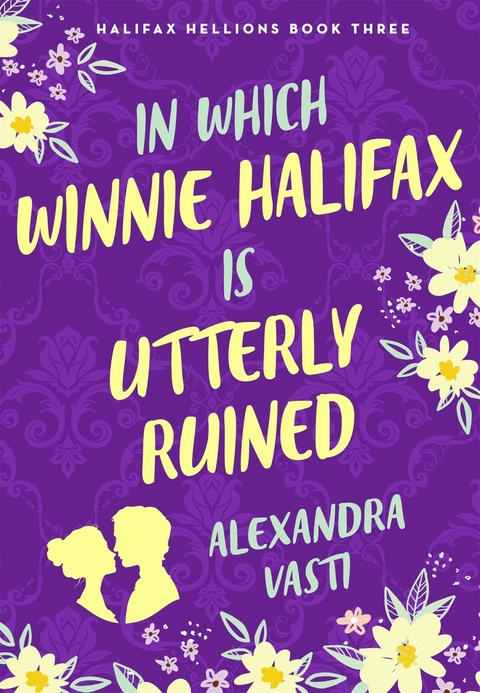
In Which Winnie Halifax is Utterly Ruined (eBook)
160 Seiten
Atlantic Books (Verlag)
978-1-80546-592-8 (ISBN)
Alexandra Vastiloves coffee, beignets, and books, in no particular order. She is the author of Ne'er Duke Well and the Halifax Hellions series. In between writing swoony Regency romances with hijinks and heart, she teaches British and Caribbean literature in New Orleans.
"e;Hot, smart, funny, and charming as hell"e; - Alix E. Harrow on THE HALIFAX HELLIONS series. The final novella in Alexandra Vasti's Halifax Hellions series. In 1811, Winifred Wallace told one lie. To secure her future as an independent sheep farmer, she invented an estranged husband named Mr. Spencer Halifax and forged their marriage record. Ten years later, her deception catches up with her: in the form of the disturbingly real, distressingly attractive earl on her doorstep. Spencer Halifax wants to set a good example for his beloved hellion sisters. Ever since their father's death, he's tried to play the role of sensible earl - and involving himself with a felonious sheep farmer is decidedly not sensible. But Winnie's passion and fierce self-reliance draws him in, even as her closely guarded secrets keep him out. When Spencer asks Winnie to travel with him to London to disentangle their semi-legal union, she's horrified. London is where her mother stole several lavish necklaces from noblemen. But she cannot pass up the chance to return the stolen jewelry. Though returning the gems is more difficult than Winnie imagined, and she soon realizes that the only way forward is to trust Spencer with the truth of her past. Even if doing so threatens their pretend marriage and the all-too-real feelings between them.
Alexandra Vastiloves coffee, beignets, and books, in no particular order. She is the author of Ne'er Duke Well and the Halifax Hellions series. In between writing swoony Regency romances with hijinks and heart, she teaches British and Caribbean literature in New Orleans.
Chapter 1
Ten years later
Spencer Halifax, Earl of Warren, looked at the jailer. The man was built like a bull—a short bull—and appeared to be missing at least three fairly important teeth.
“You are certain?” Spencer asked. He tried to peer again into the dimness of the tiny ring of cells, but it was no use. It was too dark, and the building was too windowless, and the cells were entirely too fetid. “You’re certain she’s in there?”
“Oh, aye, she’s in there.” The jailer spat directly on the floor. “A hellish vixen, she is. She’s been here eighteen hours, and the only moment of peace I’ve had is when I went to piss. Screeching and caterwauling to wake the dead and—”
The jailer paused and looked up at Spencer. It was several inches up, and his loutish form seemed to quail a bit, deflating under Spencer’s gaze. He did not, perhaps, often encounter men who could outmatch him in a fight without breaking a sweat.
“Who did you say she was to you?” the jailer asked.
“I didn’t.”
Spencer thought again of the letter he’d received from his solicitor. Of the hours he’d spent on the coach staring in consternation at the fair copy of the ten-year-old marriage record.
Winifred Halifax.
Mrs. Spencer Halifax.
“I believe,” he said, “that the woman you have incarcerated in this hellhole is my wife.”
The jailer choked. “Ah—begging your pardon, sir, but surely—surely—”
The man looked up into Spencer’s face and appeared to think the better of what he was about to say.
“Take me to her,” Spencer instructed, and the jailer backed nervously away.
As he followed the jailer deeper into the dank interior, Spencer tried to gather his wits.
Two months ago, his best friend and solicitor, Henry Mortimer, had brought to him a newspaper clipping. A woman calling herself Mrs. Spencer Halifax had come to Henry’s attention after the startling commercial success of her naturally dyed woolen embroidery floss.
Mrs. Halifax’s Handmade Thread, the advertisement read. Rich lustrous embroidery for les femmes à la pointe du raffinement—for the first time available on English shores.
The implication that Mrs. Halifax had just sailed in from Paris with boxes of high-grade woolen yarn struck Spencer as rather amusing. He doubted there was a Mrs. Halifax at all—certainly not the seductive golden-haired Aphrodite in heavily embroidered evening wear who graced the advertisements.
Henry had found it all somewhat less funny. “Does it not trouble you that the woman is parlaying your name for attention?”
“She’s not calling herself the Countess of Warren, is she?”
Henry had looked put out. “Of course not—she could be jailed for that. But I suspect she looked you up in Debrett’s and used your name for her own notoriety.”
“We have plenty to go around.” Between their wealth, their connection to one of the royal dukes, and his twin sisters’ flamboyant talent for getting themselves into scrapes, the Halifax name was not precisely what it had been when Spencer’s father—the fourth earl—had been alive.
But that fact gave Spencer a hot, uncomfortable feeling in his chest, so he tried not to think about it.
Henry had compressed his lips. “Be that as it may, I question her motives.”
Spencer had rubbed his temples, wondered briefly if at twenty-eight he could be old enough to need spectacles, and told Henry to look into Mrs. Spencer Halifax and her woolen thread if it pleased him to do so.
Henry, who was both diligent and clever, had tracked down Mrs. Halifax’s advertisement printer, and from there her man of business. Spencer had been startled to discover that she was real and living in a place called Llanreithan, which was decidedly not in France but rather in Wales.
According to Henry’s formidable investigative skills, Mrs. Halifax lived alone in Wales while her husband—Spencer Halifax—made his home in London.
Henry had shuffled his papers with an air of agitation. “Does this not concern you?”
“Why would it concern me? Surely I cannot be the only man with the name in a city of a million inhabitants.”
“All of you exhaust me,” Henry had mumbled.
“Who?”
“Halifaxes. All of you. Damn it.”
Spencer had waited patiently for Henry to elaborate, but no revelations appeared forthcoming.
That had been the end of the matter—though in truth, Spencer found himself thinking of embroidery rather more than was his usual—until Henry had stormed into Spencer’s office one evening before dinner, looking fantastically disheveled.
Spencer blinked. He had seen Henry discomposed a time or two in their decade of friendship—thrice, probably, though one of those times Spencer had been so deep in his cups he could not precisely recall Henry’s appearance—but it was not a usual occurrence.
“I found the banns,” Henry declared. His hair was standing on end above his left ear.
“Whose banns?”
Henry withdrew a battered leather portfolio from his brief-bag. “Yours.”
“What the devil could you possibly—”
Henry flipped open the portfolio across the polished surface of the huge mahogany desk. “It’s that woman. Mrs. Halifax, in Wales. I wanted to confirm that she was not using your name for her own nefarious purposes—”
“Nefarious purposes? For God’s sake, Henry, she makes thread.”
“So I looked for record of her marriage. It took a few weeks—the post seems rather slow between here and that particular part of Wales—but her parish church assured me that the marriage was all aboveboard. They had a copy of the banns themselves, you see.”
Spencer stared at his friend. “I don’t understand what any of this has to do with me.”
“They had a copy of the banns,” Henry explained patiently. “Not the real thing. Because the real banns were filed here in London ten years ago. They sent me their copy when I raised the specter of legal action—”
“You did what?”
“Look, Spencer! Look at the damned banns!”
Dear God, Henry must be agitated. Spencer looked.
And then he blinked, rubbed his eyes, and looked again.
I certify that the banns of marriage between Spencer George Halifax of [illegible smudge] Mayfair and Winifred Wallace of 79 Hackney Road were duly published in the Church of Saint Mary le Bow for the first time on January 12th of 1811, for the second time on January 19th of …
He looked back up at Henry. “What on Earth…”
Henry scrubbed his hand through his hair, disordering it further. “I told you. I told you the woman had some ulterior motive. That is you, Spencer. She’s used your name. She’s used your address!”
Spencer George Halifax. “I’m certain there are plenty of men with George as their second name,” he protested. “For God’s sake, it’s the king’s name.”
“Are there any other Spencer George Halifaxes living at Number Twelve Mayfair?”
Spencer stared down at the handwritten page. “Are you certain that says twelve? I rather think it might read twenty. Or eight, if I tilt the page a bit…”
“It is undeniable,” Henry said flatly, “that for whatever reason, this woman has chosen to pass herself off as your wife.”
“I was eighteen in 1811, for Christ’s sake. I wasn’t getting married—I was getting drunk with you at Cambridge.”
His parents had not yet died. He had not yet become the earl. He had still been just plain Spencer, wild and careless and young.
“I went to Bow Church,” Henry said, “but their records for that year were lost in a fire.”
“Good God.” If this Mrs. Halifax was some kind of confidence woman—not that he believed that she was—she was proving to be shockingly good at covering her tracks.
“I suggest you go down to Llanreithan and determine from where they’ve procured this copy of the banns. If this Mrs. Halifax claims to have the original, perhaps you can examine it more closely.”
“To what end?” Spencer asked. “I’m not going to bring the woman up on charges, for God’s sake. She has done nothing to harm me or mine.”
“You don’t understand.” Henry ran a hand through his hair again and looked down at the desk. “If the original records cannot be obtained to prove that this Spencer George Halifax was not you Spencer George Halifax, then this semi-legible fair copy might be all that we have to go on.”
“Meaning…?”
“Meaning that if this Mrs. Halifax claims she is married to you—with these banns as evidence—you might not be able to contradict her.”
“I—what?”
“Spencer.” Henry’s dark eyes fixed on him with an expression he could not quite interpret. “In the eyes of the courts, you might actually be married to this woman.”
That information had been highly motivating. Spencer had packed, given the very thinnest of excuses to his sisters, Margo and Matilda, and set off for Wales the very next day.
Llanreithan was about as far from London as it was possible to be and still be on dry land—a full week’s travel by coach. He was not fond of long carriage journeys. Despite nearly a decade of forcing himself into the proper mold of the Earl of Warren, he still preferred to be out-of-doors as much as possible, his face to the sky and his feet in the dirt.
Henry had taken a first at Cambridge. Spencer had mostly clung to Henry’s coattails, and tried to do what...
| Erscheint lt. Verlag | 3.7.2025 |
|---|---|
| Reihe/Serie | The Halifax Hellions |
| Verlagsort | London |
| Sprache | englisch |
| Themenwelt | Literatur ► Historische Romane |
| Schlagworte | alexandra vasti • Alexis Hall • an earl like you • bestselling romance 2026 • books for fans of tessa dare • books like bridgerton • books like the governess game • Bridgerton • Bringing Down the Duke • candice camp • Caroline Linden • christine britton • christine britton whats a duke got to do with it • devil in winter • earl crush • Elizabeth Hoyt • Eloisa James • Evie Dunmore • for fans of alexandra vasti • for fans of Bridgerton • Georgette Heyer • Grace Callaway • infamous lex croucher • Julia Quinn • Lex Croucher • Lisa Kleypas • Loretta Chase • Martha Waters • monica mccarty • mortal follies • ne'er duke well • never say never to an earl • nico rosso • Regency Romance • regency romantic comedies • regency rom coms • Romance • Romancing Mister Bridgerton • romcom • sarah maclean • sexy regency romance • Spicy Regency Romance • Suzanne Allain • ten things i hate about the duke • Tessa Dare • the duchess deal |
| ISBN-10 | 1-80546-592-9 / 1805465929 |
| ISBN-13 | 978-1-80546-592-8 / 9781805465928 |
| Informationen gemäß Produktsicherheitsverordnung (GPSR) | |
| Haben Sie eine Frage zum Produkt? |
 EPUB (Wasserzeichen)
DRM: Digitales Wasserzeichen
Dieses eBook enthält ein digitales Wasserzeichen und ist damit für Sie personalisiert. Bei einer missbräuchlichen Weitergabe des eBooks an Dritte ist eine Rückverfolgung an die Quelle möglich.
Dateiformat: EPUB (Electronic Publication)
EPUB ist ein offener Standard für eBooks und eignet sich besonders zur Darstellung von Belletristik und Sachbüchern. Der Fließtext wird dynamisch an die Display- und Schriftgröße angepasst. Auch für mobile Lesegeräte ist EPUB daher gut geeignet.
Systemvoraussetzungen:
PC/Mac: Mit einem PC oder Mac können Sie dieses eBook lesen. Sie benötigen dafür die kostenlose Software Adobe Digital Editions.
eReader: Dieses eBook kann mit (fast) allen eBook-Readern gelesen werden. Mit dem amazon-Kindle ist es aber nicht kompatibel.
Smartphone/Tablet: Egal ob Apple oder Android, dieses eBook können Sie lesen. Sie benötigen dafür eine kostenlose App.
Geräteliste und zusätzliche Hinweise
Buying eBooks from abroad
For tax law reasons we can sell eBooks just within Germany and Switzerland. Regrettably we cannot fulfill eBook-orders from other countries.
aus dem Bereich