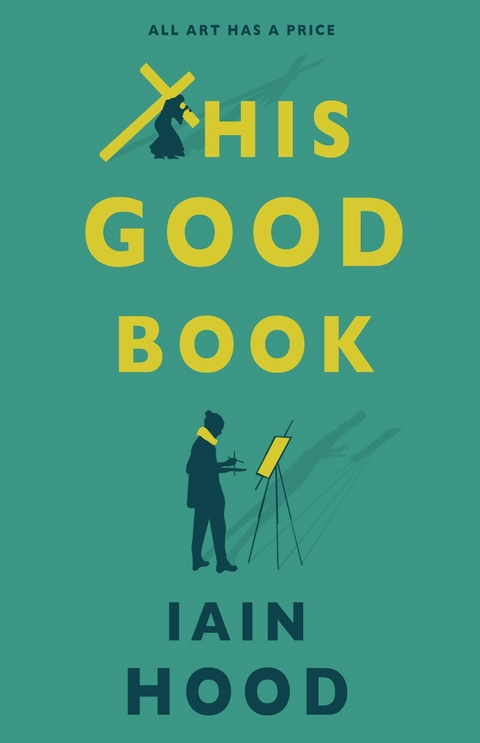
This Good Book (eBook)
208 Seiten
Renard Press (Verlag)
978-1-913724-56-6 (ISBN)
Iain Hood was born in Glasgow and grew up in the seaside town of Ayr. He attended the University of Glasgow and Jordanhill College, and later worked in education in Glasgow and the west country. He attended the University of Manchester after moving to Cambridge, where he continues to live with his wife and daughter. His first novel, This Good Book, was published in 2021, followed by Every Trick in the Book in 2022 and My Book of Revelations in 2023.
I
There was only one man I knew who was exactly six feet tall, and I met him in Glasgow in 1988, in the February. He caught my eye because of the colour of his flesh in the light coming through the darkened hallway at a party in a flat on Hyndland Road. Straight away I said to Stephen, ‘Who is he?’
Looking over, Stephen said, ‘Oh, that’s Douglas.’ Then he turned to me and said, ‘Susan Alison MacLeod! Look at the look on you!’
And I said, ‘He’s the one. Look at the tone of his flesh. Like a Lucian Freud.’
And Stephen said, ‘“Flesh”? Do you mean skin, Susan Alison?’
And I said, ‘I know what I mean and Freud paints flesh.’
Douglas stretched to open the double doors into the kitchen and his white cable-knit rode up to reveal his centre at his belly button. His flesh was yellow ochre and burnt sienna and raw umber and there was a halo of pale blue-white fluorescent light around his head and shoulders. The light around him in the darkness of the hallway formed a circle, and the door frame formed a square. He moved his legs into an isosceles of reflected light from the fake white and blue diamond tile linoleum floor. Eight heads high. The perfection of the proportion of him. The luminousness of him. His hair and moustache and beard were like a young Peter Green, if you know who Peter Green is.
And Stephen said, ‘You’re thinking of meat, perhaps?’
And I said, ‘I’m thinking of my Crucifixion.’
And Stephen said, ‘Anyway, you know him, Susan Alison. Douglas MacDougal’s all over the Art School like a rash.’
And I said, ‘I don’t know him from Adam.’
And Stephen said, ‘You have to.’
And I said, ‘I’ve never seen him before in my puff. Cross my heart and hope to die.’
Douglas was talking to some fresher or other, looming over her.
And Stephen said, ‘Do you want me to introduce you, Suse?’
And I said, ‘No, not just yet. I just want to stand here watching him. But I want you to, after.’
Douglas was stretching his arms above his head and stifling a yawn, and then yawning with an unlit smoke lolling at the side of his mouth.
And Stephen said, ‘Are you in love or something? He’s just a man. Just flesh and blood like you and me and all the rest of us in here.’
And I said, ‘You know it’s bigger than that. He’s the one for my Crucifixion. The end.’
Sometimes I wonder, if I had known that it was going to take me fourteen years to paint this painting of the Crucifixion with Douglas as Jesus, and what it would take for me to paint this painting, would I have been as happy as I was then?
Stephen started bouncing around and said, ‘Amen. In nomine Patris et Filii et Spiritus Sancti.’
If it sounds like we were a bit drunk, that’s because that was the way it was.
Was there always something tragic about Douglas, like he was going to die young and leave a beautiful corpse? Like in the summer, the day he came back from Glastonbury smelling of man and bonfire and lightly fried plantain and good sweat and three-day-worn clothes and his skin golden burnt and his hair just-so sun-bleached? He could not be a better Christ on the cross. God-made man, all man. The more I looked at the sky-baby-blue of his eyes. Like Zeffirelli’s Jesus of Nazareth and the shallow beauty of Robert Powell’s eyes that apparently got him the part. I didn’t want to go for a brutal rendering. Matthias Grünewald’s lip-smacking relish at twisting the emaciated body of Christ as he tortures the paint and makes Christ bleed near-solid gobbets of blood. Or Nikolai Ge’s hideously terrifying and terrified Christ screaming at the top of his lungs to the sky and a God who cannot be there as his bedraggled rags soak with blood-red paint. A beautiful, western-idealised, perfect Jesus was the point and the reason and the joke, and though perhaps always tragic Douglas did like to laugh, and he liked the joke. It was part of the reason he wanted to do it. But that was later.
When Stephen introduced us, Douglas was so drunk he was close to incoherent. He said to us, ‘Ask me what kinda car I want.’
And Stephen said, ‘What kind of car do you want?’
And Douglas said, ‘A Jaguar. Now ask me what kinda guitar I like.’
And I said, ‘OK. What kind of guitar do you like?’
And he said, ‘A Jaguar. See what I’m saying? A Fender Jaguar. Now ask me what my favourite animal is.’
And I said, ‘Is it a jaguar?’
And Douglas goes, ‘What? No. It’s a lion, isn’t it? A lion is the king of the jungle. A jaguar? That’s like… that’s like the Duke of Windsor or the Earl of Gloucester in comparison to the King. Heh, I was staying in Notting Hill last year, and all the pubs were like The Earl of Gloucester and the Duke of… they don’t name their pubs down there, they give them a title.’
He was so drunk.
When I asked him if he’d model for me for a Crucifixion, he said he wanted to do it because of the paintings of Francis Bacon and I said, ‘Oh, you like the paintings of Francis Bacon?’
And he said, ‘Crucifixion? Three Studies for a Crucifixion? Three Studies for Figures at the Base of a Crucifixion?’
And I said, ‘You like them?’
And he said, ‘No! Ever since I saw them I’ve been trying to obliterate them from my mind, and you painting me as Christ on the cross is about the best way I can think of, eh, of annihilating those images. Annihilating them! To extirpate them from my memory.’ He liked words. Concepts. Ideas. Words. And he said, ‘You kill me, so you do.’
By the end of the night he was telling me that, with him in tow, I was going to create something authentic and genuine and a masterpiece and something that was good. And, after Stephen had disappeared somewhere, Douglas kept rocking back and forth and circling me, never still, every so often suddenly balancing himself with his outstretched arms as though the floor was tilting, as though we were on a ship far out at sea, or like he was a cat landing after being shoved off of somewhere high up.
We weren’t talking, just looking around ourselves, when I heard it – just beyond hearing or something like it could be felt, even if not heard, a sound like sad, longing music. It was like I could make it be heard if I just let myself sing it, so I started singing to him this strange song about old songs and sad songs and being reminded of friends and about fairgrounds and road signs.
And Douglas said, ‘What’s that you’re singing?’
And I said, ‘I don’t know. Mibby a song I heard somewhere. It’s playing in my ears. Or… I think it might be a song that hasn’t been written yet.’
And he said, ‘You’re writing this song?’
And I said, ‘I… Yes. No. I mean… I don’t know.’ My head was swirling.
Of course, because Stephen had disappeared, it was muggins here that had to help Douglas get home. It was like trying to get a six-foot-high stack of cheese-and-ham toasties and art textbooks piled up on a skateboard home.
When we got to the mouth of his close I sort of stopped holding him up and said, ‘In you go.’
He swayed for a wee while. Then he looked round at me, kind of glaikit looking, drunk glaikit, and I was wondering whether this actually was the right close, but I didn’t see I had many options to find out otherwise. He stumbled forward and off he went when I pointed and repeated, ‘In.’
In them days in the 80s every artist in Glasgow was buying or renting or squatting in Tollcross and environs to be near the Transmission Gallery and yes, I had been to Transmission in the year it opened and I had been inspired to go to the Art School because of what I had heard of the artists who started Transmission. But for my sins the year I graduated I found a space, a place to live with a studio attached, out along Argyle Street towards the Kelvingrove and yes, OK, near the Park Bar, where island people and teuchters drank when in Glasgow, though I never went in there because teuchters were what I sought to fly away from.
It was a garden flat that in the back yard had a huge high-walled, high-windowed transparent flat-roofed space that had housed a bakery. Have you ever had dreams where suddenly you find some incredible space in your home that you never realised before was there? A terraced penthouse accessed by way of your loft skylight or a basement that lies below your living-room floorboards? I’ve had those dreams and I assume they’re common enough. Well, my...
| Erscheint lt. Verlag | 30.6.2021 |
|---|---|
| Verlagsort | Lodnon |
| Sprache | englisch |
| Themenwelt | Literatur ► Romane / Erzählungen |
| Schlagworte | 90s • clare grogan • Confession • Crime • Crucifixion • dark humour • Glasgow • painting • School of Art • Scottish |
| ISBN-10 | 1-913724-56-5 / 1913724565 |
| ISBN-13 | 978-1-913724-56-6 / 9781913724566 |
| Informationen gemäß Produktsicherheitsverordnung (GPSR) | |
| Haben Sie eine Frage zum Produkt? |
 EPUB (Wasserzeichen)
DRM: Digitales Wasserzeichen
Dieses eBook enthält ein digitales Wasserzeichen und ist damit für Sie personalisiert. Bei einer missbräuchlichen Weitergabe des eBooks an Dritte ist eine Rückverfolgung an die Quelle möglich.
Dateiformat: EPUB (Electronic Publication)
EPUB ist ein offener Standard für eBooks und eignet sich besonders zur Darstellung von Belletristik und Sachbüchern. Der Fließtext wird dynamisch an die Display- und Schriftgröße angepasst. Auch für mobile Lesegeräte ist EPUB daher gut geeignet.
Systemvoraussetzungen:
PC/Mac: Mit einem PC oder Mac können Sie dieses eBook lesen. Sie benötigen dafür die kostenlose Software Adobe Digital Editions.
eReader: Dieses eBook kann mit (fast) allen eBook-Readern gelesen werden. Mit dem amazon-Kindle ist es aber nicht kompatibel.
Smartphone/Tablet: Egal ob Apple oder Android, dieses eBook können Sie lesen. Sie benötigen dafür eine kostenlose App.
Geräteliste und zusätzliche Hinweise
Buying eBooks from abroad
For tax law reasons we can sell eBooks just within Germany and Switzerland. Regrettably we cannot fulfill eBook-orders from other countries.
aus dem Bereich