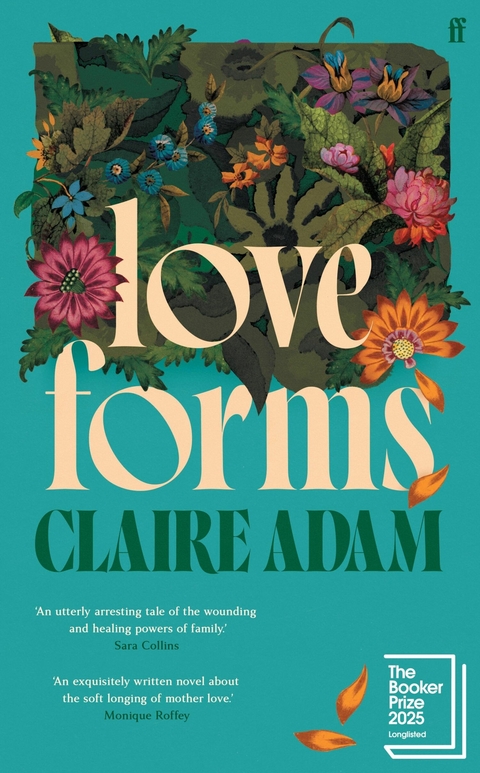
Love Forms (eBook)
352 Seiten
Faber & Faber (Verlag)
978-0-571-33957-0 (ISBN)
Claire Adam was born and raised in Trinidad and Tobago. She was educated in the US and now lives in London with her husband and two children. Her first novel Golden Child won multiple prizes and was named one of the BBC's '100 Novels that Shaped the World'.
LONGLISTED FOR THE BOOKER PRIZE 2025A Book of the Year in The Times and The Critic'A quietly devastating masterpiece'. MARIAN KEYES'Adam is a master storyteller.' SARA COLLINS'Love Forms achieves a sort of alchemy.' FINANCIAL TIMES'Reads like a Claire Keegan short story expanded by Elizabeth Strout.' THE TIMESIn the heart-aching new novel from the author of the award-winning Golden Child, a mother searches for the daughter she left behind a lifetime ago. Trinidad, 1980: Dawn Bishop, aged 16, leaves her home and journeys across the sea to Venezuela. There, she gives birth to a baby girl, and leaves her with nuns to be given up for adoption. Dawn tries to carry on with her life - a move to England, a marriage, a career, two sons, a divorce - but through it all, she still thinks of the child she had in Venezuela, and of what might have been. Then, forty years later, a woman from an internet forum gets in touch. She says that she might be Dawn's long-lost daughter, stirring up a complicated mix of feelings: could this be the person to give form to all the love and care a mother has left to offer?'From the very first page, I knew I was in the hands of a master storyteller. An utterly arresting tale of love and grief, of the wounding and healing powers of family, of the many guises of a mother's love. It's an absolute triumph.'SARA COLLINS'Exquisitely written. A compelling and tender story of what - and who - is hidden in almost every family that feels as old as the hills and yet acutely contemporary.'MONIQUE ROFFEY'An arresting voice that made me think of silk: its delicate beauty belies its intrinsic strength.'CLAIRE KILROY'A compelling read taking us to the heart of difficult family situations and evocative secret places.'ROMESH GUNESEKERA
It was my father who made the arrangements. My uncle helped, since he lived down south, where all this kind of business is carried out. I’m talking south-south: down past the airport, past the swamp, past the oilfields, everything. Way down at the bottom of the island, down where Columbus landed, long ago. There’s hardly anything down there, just fishing villages. Peaceful, old-time places: a few ramshackle wooden houses, and children playing marbles in the shade under the trees. Everywhere you look, in those places, you see pirogues pulled up onto the sand: little wooden boats, fishing boats, supposedly – although how much fishing the men really do nowadays is anybody’s guess. The boats are very basic. Open-topped, maybe twenty feet long, with just a plank of wood to sit on and a boat-engine clamped onto the back. But somehow they manage to make the journey across those seven miles of ocean between Trinidad and Venezuela – and carrying all kinds of things, not just fish. It’s a dangerous journey, though, even when special arrangements are made, as they were for me.
My father brought me the clothes I was to wear: black T-shirt and long-pants; a big long-sleeved men’s shirt to wear over the T-shirt, also in black, and with the buttons cut out. We’d be travelling by night, and anything that might catch in torchlight had to be covered, including my own skin. The Trinidad and Tobago Coast Guard was one difficulty, the Guardia Nacional on the Venezuelan side was another, but the worst problem was bandits. Bandits would steal the engine off the back of the boat and leave you out there to drift, or they would take the whole boat, and throw you in the sea. I also had a pillowcase to go over my head: the reflection of torchlight against things like eyeballs and teeth had been known to give people away.
The shirts, the trousers, the pillowcase – all these things were cheap, cheaply made; they weren’t things I would normally have worn, or owned. Probably, they came from some roadside vendor in central Trinidad. I doubt my father bought them himself: more likely, he sent one of his men out to do it – someone unimportant and unknown, who wouldn’t be recognised and connected to our family. I’m only guessing, of course. I didn’t ask about these details at the time. If I had asked, I’m sure someone would have said, ‘Dawn, girl, the less you know, the better.’
It was early August when I made the journey. In my room, alone, I changed out of my shorts and T-shirt, into the black clothes my father had brought. My knapsack was already packed, hidden at the bottom of my wardrobe. I set it on the floor at the foot of my bed, looked through it, then zipped it closed again. I was full of a nervous energy; I would have liked to tidy up, or clean the room, but there was nothing left to do – the bed was made, the floor swept; the desk and bookshelves, still full of my ordinary school things, were tidied and dusted. I took my posters down from the walls. (The posters showed close-up photos of boys from music bands that were popular at the time.) I sat at my desk and pulled the tacks from my little pink-framed cork-board on the wall. All my revision schedules, exam schedules, my friends’ phone numbers, my motivational sayings handwritten on little scraps of paper – I took them all down from the cork-board, and crumpled them up. Then with nothing else to do but wait, I sat on the floor, my elbows on my knees, leaning against the side of the bed.
Only my mother was at home with me that afternoon. I don’t know how she passed the time; we didn’t speak. At some point, I heard her footsteps downstairs: she slid the patio doors shut, and then turned the key in the lock. I heard her pull the curtains shut too. I don’t know what made her do that – it was only afternoon – but maybe she was possessed by the same feeling of shame as I was, and the sense that a part of our lives was coming to an end. Or maybe she was just like me – filled with the same nervous energy, her hands searching for things to keep busy with, to help pass the time. I don’t know. After that, it went quiet: I heard nothing. I imagined her sitting on the sofa in the living room, her arms folded, her handbag and car keys waiting nearby on the kitchen counter. In any case, for quite a long time, maybe half an hour, we stayed in our different parts of the house, each thinking our own private thoughts, and watching the hands of the clock tick forward.
My mother drove. I sat beside her in the front seat: we wanted me to be seen, to look as if I were on my way to the airport. We went down the hill, first, along the road that my father had cut through the forest, then along the bumpy, potholed road by the golf course. A pause at the bend, waiting for a chance to merge onto the main road, and then the same old sharp acceleration as always – first gear, then quickly into second, then third – as she turned onto the stretch that runs alongside the Maraval river. Nowadays, there are gated communities all along that road, low-rise apartment blocks with pools and tennis courts, but back in 1980, on the day that my mother and I set out, it was still just bush. The picture I have of it in mind now is not so much from that day, as from all the other ordinary days that had gone before: thick wild grass grown to shoulder-height; forest trees, branches heavy with ripe fruit; bright flashes of birds amongst the green leaves.
The first handover was made in mid-afternoon, somewhere between the university campus and the airport. An unfamiliar road, and one I’ve never been able to find again. I remember squat brick houses sparsely placed, the rain just fallen, rising again now as vapour from the hot asphalt. My mother slowed outside one of the gates, and then pulled over in front of a parked car. A man appeared at her window: clean-shaven, neatly dressed; probably black nylon trousers and a light-coloured shirt-jac. I can still bring to mind something of his manner: courteous, eager, important; full of reassurance that his mind was only on the task at hand. ‘Right, Mrs Bishop,’ he might have said. ‘Right, right. Everything good. Everything done fix up. We ready.’
My mother got out. I waited alone in the car, watching them through the front windscreen. She and the man walked together to his car, just ahead, and he opened the door on the driver’s side and she ducked down to look inside. I don’t know what she was looking at. She came out again, and the driver pushed the door shut, and she bent down and pressed her thumb against the tyre. Then they walked around the front of the car and she tried the other tyre, and the driver opened the other doors, one by one, and she looked inside, and checked the other tyres. They came back around to the back of the car and the driver opened the trunk, and my mother looked inside. My mother reached into her bag and took out a small brown envelope and handed it to him. He took it quickly, and put it in his pocket. Then she turned and beckoned to me to come. I got out of my mother’s car. As I walked the short distance to the car in front, I was aware of being observed from the windows of the houses all around; I suppose people must have been watching from behind their curtains. I remember sweating in my hot black clothes and trying to hold my knapsack over my stomach.
‘Go in the back, go in the back,’ the man said.
I thought he meant the trunk, and I stopped, unsure. He came around and opened the door of the back seat for me, like a chauffeur.
‘In here,’ he said. ‘You’ll have to get down. Not right now. I’ll tell you when.’
I got into the man’s car. The windows were covered in dark film. My mother and the man were behind the car, out of sight. I looked out the window to the side, instead, towards the man’s house. A hibiscus hedge; a metal gate, painted white, with a red metal letterbox. Beyond the gate, a front lawn; croton plants growing along the border of the driveway. On the upstairs verandah of the house, a hanging birdcage, a large bird moving slowly inside the cage.
The car sank as the man got in the front and started the engine. I remember him as energetic, eager to set off. He pressed a button to wind the window down on my side, so I could wave to my mother as we left. But I didn’t want to see her: I was afraid of what I would do. Instead, as we drove away, I slid down to the footwell so I was out of her sight, and I arranged myself there, my thighs pressing uncomfortably against the front of my body. Later, I stretched my legs out across to the other footwell so I could breathe more easily.
I must have been in that car for three or four hours. I’m only guessing, based on the distance I know we travelled, all the way down the southern main road. I didn’t look out the windows: the road was familiar enough, and I could tell where we were just by the smell. The stink of the swamp: unpleasant, but not unnatural. The fuel smell of the airport: sweetish, volatile, dangerous. A different petrochemical smell as we went further south: the thicker, dirtier, heavier smell of the oilfields as we passed Pointe-à-Pierre. After San Fernando, the road became less familiar, everything more confusing; I couldn’t picture the exact road we were on. But...
| Erscheint lt. Verlag | 17.6.2025 |
|---|---|
| Sprache | englisch |
| Themenwelt | Literatur ► Romane / Erzählungen |
| ISBN-10 | 0-571-33957-3 / 0571339573 |
| ISBN-13 | 978-0-571-33957-0 / 9780571339570 |
| Informationen gemäß Produktsicherheitsverordnung (GPSR) | |
| Haben Sie eine Frage zum Produkt? |
 EPUB (Adobe DRM)
Kopierschutz: Adobe-DRM
Adobe-DRM ist ein Kopierschutz, der das eBook vor Mißbrauch schützen soll. Dabei wird das eBook bereits beim Download auf Ihre persönliche Adobe-ID autorisiert. Lesen können Sie das eBook dann nur auf den Geräten, welche ebenfalls auf Ihre Adobe-ID registriert sind.
Details zum Adobe-DRM
Dateiformat: EPUB (Electronic Publication)
EPUB ist ein offener Standard für eBooks und eignet sich besonders zur Darstellung von Belletristik und Sachbüchern. Der Fließtext wird dynamisch an die Display- und Schriftgröße angepasst. Auch für mobile Lesegeräte ist EPUB daher gut geeignet.
Systemvoraussetzungen:
PC/Mac: Mit einem PC oder Mac können Sie dieses eBook lesen. Sie benötigen eine
eReader: Dieses eBook kann mit (fast) allen eBook-Readern gelesen werden. Mit dem amazon-Kindle ist es aber nicht kompatibel.
Smartphone/Tablet: Egal ob Apple oder Android, dieses eBook können Sie lesen. Sie benötigen eine
Geräteliste und zusätzliche Hinweise
Buying eBooks from abroad
For tax law reasons we can sell eBooks just within Germany and Switzerland. Regrettably we cannot fulfill eBook-orders from other countries.
aus dem Bereich