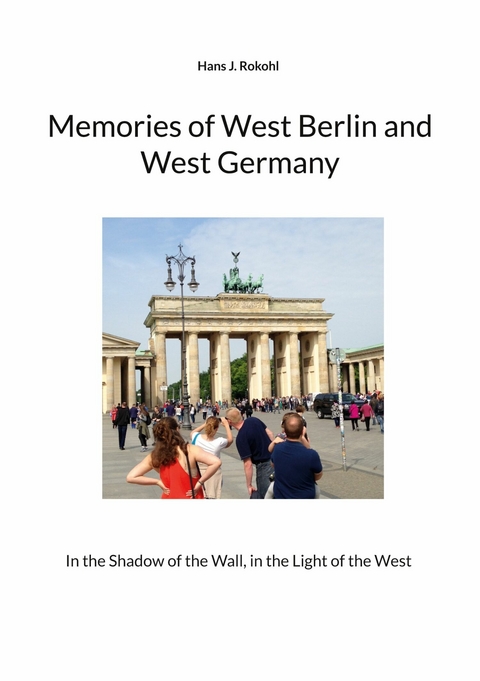
Memories of West Berlin and West Germany (eBook)
164 Seiten
BoD - Books on Demand (Verlag)
978-3-8192-8928-6 (ISBN)
Born on August 6, 1941 in Berlin-Mitte, grew up in shattered West Berlin, finished secondary school. Followed by an apprenticeship in the metal trade, evening school to become a mechanical engineering technician. Educational initiative: Secondary school leaving certificate, studied industrial engineering at the Technical University of Berlin, Dipl.-Ing., volunteer work in South Africa, doctorate in engineering. Technical articles and 1st publication. Worked as a business consultant, later in the defense sector. Married to a dentist since 1982, two daughters and two grandchildren. Wrote a novella about a Berlin friendship and his many travels have resulted in two books. He is particularly fond of the two protagonists Kalle and Manni, two real Berliners who are upset by the educated classes of all kinds.
Post-war memories
From the beginning
My post-war memories begin with the Allied air raids on the center of Berlin. Simeonstraße, where I lived with my mother and aunt, grandma and grandpa, was completely destroyed in the hail of bombs. Thus bombed out, the Beck family was assigned an apartment at Burgherrenstraße 11, not far from Tempelhof Airport. Grandpa was put to work repairing Me 109s and other fighter planes. I will tell you more about life in Burgherrenstraße in the post-war period, from the time of the economic miracle until I finished school. But what happened before that? How and in what circumstances did the Beck family live in Berlin-Mitte back then?
The idea came to me while reading a crime novel by Philipp Kerr. In the first book of his “Berlin Trilogy” (March Violets), he describes the impression his protagonist, private detective Berni Günther, got of Simeonstraße when he visited a Jewish fence there. Incidentally, the Kerr crime novels were the basis for Volker Kutscher's “Babylon Berlin”.
From Alte Jakobstraße, which runs parallel to Lindenstraße, you can see Simeonstraße through the gate, followed by Wassertorstraße, where you can see the Evangelical Simeon Church. At the end you come to Prinzenstraße, where there was a crossing in GDR times. Kerr's protagonist describes Simeonstraße in 1936 something like this:
“Simeonstraße was only a few streets away from Neuenburger Straße, but differed in that in Neuenburger Straße only the paint was peeling off the window frames, but in Simeonstraße the
window glass was missing. A really poor area. The 5- to 6-storey tenements stood high above the narrow cobbled street, over which clotheslines were stretched.”
“Sullen youths loitered in the dark doorways, staring at the snot-nosed children playing noisily on the sidewalks, unimpressed by the swastika and hammer-and-sickle graffiti on the walls of the houses, not to mention the obscene images”
“Below the littered street level and in the shadows of the buildings were cellar stores offering goods and services. But there was no need for them.”
The Beck family lived at Simeonstraße 7 for at least 20 years. This can be seen from daughter Ilse's birth certificate, which was issued by the Prussian Registry Office VI from 1924 to the end of 1944.
My mother and my aunt Ille spent their childhood there, went to elementary school and were baptized and confirmed in the Simeon Church. I was also baptized there. Grandma was very fond of this.
The picture shows the street around 1930. People are trading firewood for potato peelings. In the background you can see the passageway to Alte Jakobstraße, on the other side of the street, where passers-by are walking, you can see one of the cellar stores. The poor pavement can also be seen. If you were to walk in the other direction, you would reach Simeonkirche.
I wonder if the Becks were queuing here too. And whether they lived all the time in the dark first floor apartment at the back of the house that I remember. In a photo from 1935 at the fountain in Urbanstraße in March, all four of them don't look like poor people, but rather well-dressed for the time. Perhaps Kerr exaggerated the circumstances in his novel. As a Scot, he knows that things were similar in Glasgow.
For the Becks, the assignment to Tempelhof was probably a gain, an apartment for the better-off. Even if they all lived in one room. Bright, with a balcony, there was central heating and an elevator, which later also worked.
Simeonstrasse 1944/45
To anticipate, Simeonstraße no longer exists. It was completely destroyed during the war. You can still find it on previous city maps, see illustration.
We lived in this street at the time, in a rear building or side wing, on the first floor, the apartment was dark. Grandma and Grandpa probably had a janitor's job, and my mother and I and my Aunt Ilse (Ille) lived with them. I can't say why I lived there and not with my father as a family. My father had probably been there too. I know that from Grandma because I always had to put my left hand on the table when I ate.
At the end of 1944, Berlin-Mitte was completely destroyed by Allied air raids, because the backyard factories produced material that was vital to the war effort. The whole of Simeonstraße (see arrow) was also in ruins. Only the Simeon Church (see arrow), where I was baptized (see family book entry), remained standing.
There are photos of me and my mother from that year.
I can still remember one of those nights. Grandma or my mother dragged me across the burning ruins, my dark bobble hat over my head. We found accommodation with one of Grandpa's sisters, Frieda or Erna, in Jahnstraße in Kreuzberg. I still remember the wonderfully blue Mensch-Ärger-Dich-Nicht glass play figures.
After that we were evacuated from Berlin, my mother stayed with me and Grandma, Grandpa and Aunt Ille stayed in Berlin.
***
Leisten near Schnega 1945 to 1947
In Berlin, the bombing raids increased more and more. Mothers and their children were evacuated. My mother, grandmother and I came to Hitzacker on the Elbe, which is now part of the Lüchow-Dannenberg district in Lower Saxony. The area became famous for anti-nuclear demonstrations against the final repository for radioactive waste that was to be built there. There is still a photo of me sitting there looking after the allied air units on their flight to Berlin. Maybe I'll find it.
Then we were assigned to the Müllers in Leisten near Schnega, see map below. The Müllers had a farm in the Lower Saxon style, as shown here. The house consisted of a residential part and a barn part. In the barn there was a gallery with rooms for maids and farmhands. Now we were quartered there. Downstairs were the cattle, some cows and two horses in the stables, upstairs on the gallery were the chicken nests. There were also lots of fleas.
My mother and grandma made themselves useful in the household, after all, the pigs had to be fed too. I, on the other hand, was less useful. When the farmer's wife asked me if I had stolen another egg, I sheepishly said yes. My mother's head turned red every time. Well, sugar eggs were my favorite food. I wasn't a good little boy in other ways either. Once I was gone, half the village was looking for me. I think I had gone to a soccer match in Schnega. I don't know whether I was picked up there or, more likely, whether I was standing outside the door again. But I still remember the wooden pattens on my bottom.
Grandpa, meanwhile, who worked as a saddler repairing airplane seats in the hangars at Tempelhof Airport, was given an apartment nearby at Burgherrenstraße 11. That meant a room in a four-room apartment on the fourth floor, which he had to share with Aunt Ille. Another room was occupied by Mrs. Kater and son Charles. In mid-June 1946, Aunt Ille, now married, moved in with her husband's family. My cousin Wolfgang was born in October. We stayed in Leisten with the Müllers because the supply situation in Berlin was catastrophic. Also because my mother had her appendix taken out in the next town, I think it was Uelzen. She almost died from it. She was left with a large, disfiguring scar. In the summer of 1947 I was of school age, but not fit for school. I had to leave my sugar-egg paradise, but I didn't have to listen to the squealing of the stabbed pigs any more.
Here you can see the line from Berlin to Schnega today. The hamster trains certainly ran like this back then.
Burgherrenstraße 11 - 1947 to 1949
On the map you can see where Burgherrenstraße house no. 11 is located, see arrow. Me and the neighborhood children, and those from Dudenstraße 11 around the corner, played in the street. Small Karee: Burgherrenstraße, Schulenburgring, Methfesselstraße, Dudenstraße. Large Karee: Dudenstaße, Platz der Luftbrücke, Manfred-von-Richthofen-Straße, Schulenburgring. Otherwise in the Kaiser-Corso, in winter with the sledges up the Kreuzberg (Viktoriapark).
So my mother, grandma and I were back in Berlin, now in Tempelhof. How the four of us lived in one room is a mystery to me. Thank goodness Aunt Ille was staying with her husband's family. I once visited her secretly, Grazer Damm so and so at Kiefer. She stood there in the kitchen like Cinderella in a fairy tale and couldn't shut her mouth. I was only a good seven years old. She then brought me back. Soon afterwards, my marriage to Hans Kiefer ended in divorce, he got custody of my son Wolfgang and Aunt Ille had to move out. There were five of us in Burgherrenstraße.
I don't remember the currency reform, the subsequent blockade and the founding of the Federal Republic of Germany, but rather the conditions associated with it. You could buy something with the new money if you had more than the allotted 60 + 20 DM, I got something from the school meals and the others got social food. Grandpa kept rabbits on the balcony to eat. I can still see the skinned animals in front of me. The best thing was going to the Grunewald forest with Grandpa to collect firewood. The district heating in the apartment didn't work back then.
I have already written elsewhere about the school drama at the then 6th Tempelhof elementary school, now the Tempelherren School. Here I have recorded the route to...
| Erscheint lt. Verlag | 13.6.2025 |
|---|---|
| Sprache | englisch |
| Themenwelt | Literatur ► Romane / Erzählungen |
| Schlagworte | Berlin and West Germany • Contemporary history • My own poems and short stories • personal experience • Situation in West Berlin |
| ISBN-10 | 3-8192-8928-3 / 3819289283 |
| ISBN-13 | 978-3-8192-8928-6 / 9783819289286 |
| Informationen gemäß Produktsicherheitsverordnung (GPSR) | |
| Haben Sie eine Frage zum Produkt? |
 EPUB (Wasserzeichen)
DRM: Digitales Wasserzeichen
Dieses eBook enthält ein digitales Wasserzeichen und ist damit für Sie personalisiert. Bei einer missbräuchlichen Weitergabe des eBooks an Dritte ist eine Rückverfolgung an die Quelle möglich.
Dateiformat: EPUB (Electronic Publication)
EPUB ist ein offener Standard für eBooks und eignet sich besonders zur Darstellung von Belletristik und Sachbüchern. Der Fließtext wird dynamisch an die Display- und Schriftgröße angepasst. Auch für mobile Lesegeräte ist EPUB daher gut geeignet.
Systemvoraussetzungen:
PC/Mac: Mit einem PC oder Mac können Sie dieses eBook lesen. Sie benötigen dafür die kostenlose Software Adobe Digital Editions.
eReader: Dieses eBook kann mit (fast) allen eBook-Readern gelesen werden. Mit dem amazon-Kindle ist es aber nicht kompatibel.
Smartphone/Tablet: Egal ob Apple oder Android, dieses eBook können Sie lesen. Sie benötigen dafür eine kostenlose App.
Geräteliste und zusätzliche Hinweise
Buying eBooks from abroad
For tax law reasons we can sell eBooks just within Germany and Switzerland. Regrettably we cannot fulfill eBook-orders from other countries.
aus dem Bereich