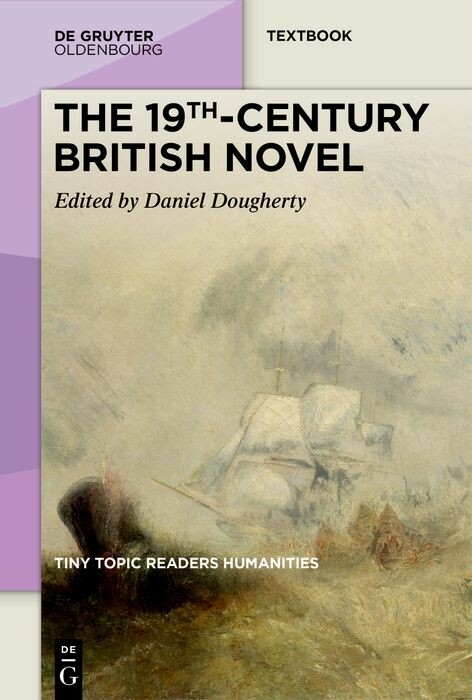
The 19th-Century British Novel (eBook)
119 Seiten
De Gruyter (Verlag)
978-3-11-156204-9 (ISBN)
The 19th Century British novel continues to delight readers and populate syllabi of survey courses as well as specialized electives. Because there is such a tremendous volume of literature that emerged from England during this century, this volume offers a guided, chronological tour through the century, featuring authors including Charles Dickens, George Eliot, Joseph Conrad, and many more.
This volume is meant to provide a reading list for students and educators interested in these texts, including excerpts, images (some of which are taken from the novels themselves), external online resources, and appendices. In addition, this volume features links to essays by 19th century authors contemplating their own work and position in their moment, as well as suggested reading lists for contemporary scholarship on the novel broadly construed.
As an educational resource, this volume contains many of the tools and texts that are important for new readers of the 19th century British novel as well as educators building survey courses or specialized electives with an eye towards accessibility and convenience.
Early Victorian Novels
Early Victorian Novels
Queen Victoria’s ascent to the throne in 1837 was a watershed moment not only for the English, but also for people around the world. During her reign – which spanned nearly sixty-five years – England was perpetually engaged in at least one war, and typically several, whether on land or at sea. The British Empire flourished, growing seemingly without end, and the Victorian period felt like an epoch that might last forever. Technology boomed: railroads crisscrossed England, the telephone was invented, and the entire nation was synched to national time kept by clocktowers all set to the same standard, all before Victoria entered middle age. Literacy expanded across the nation, and a voracious population of readers from all classes emerged looking to consume stories of all kinds. The novel – the genre par excellence of the century – was typically released serially, one part at a time, for about a shilling a month. Likewise, novels circulated through lending libraries, allowing more English citizens than ever to keep up with the latest and most compelling stories. At pubs and on factory floors, novels were read aloud for the entertainment and enjoyment of any who would listen. Still, inequalities compounded year over year, and the deplorable conditions of the London poor became something which politicians and novelists grappled with throughout Victoria’s reign.
Image 6: J.M.W. Turner, “The Fighting Téméraire,” 1839.
Authors relied on the biographical form – the chronicling of one individual life – to show the social stratification of London and the nation: the heroine becomes ordinary, but the richness of her mind dazzles readers. Gone are Odysseus and Othello: Brontë’s Jane Eyre and Dickens’s Pip become the flag bearers of nineteenth century narrative. Children’s literature blossomed, and fairy tales were translated and adapted for new generations of children in England. In the novels of the mid-century, the world is full of latent potentiality, the sense that anything is possible and that turns of fortune come in the form of surprise visitors and hidden secrets. Authors begin to reflect on their status as authors both inside and outside of their texts: William Makepeace Thackeray governs Vanity Fair with the metaphor of the puppet master performing for a crowd, for example, while Wilkie Collins and Dickens write essays contemplating what they write, why, and, most important of all, for whom?
Charlotte Brontë’s Jane Eyre
Published in 1847 in London. Available on Project Gutenberg at https://www.gutenberg.org/ebooks/1260/ [last access 27.11.2024].
Image 7: F.H. Townsend, “How dare I, Mrs. Reed? How dare I? Because it is the truth,” illustration in Jane Eyre: An Autobiography, by Charlotte Brontë (New York: G.P. Putnam’s sons, 1898).
Jane Eyre
Published under the pen name Currer Bell, Charlotte Brontë’s 1847 Jane Eyre is styled as the autobiography of Jane Eyre, edited, rather than written, by Bell. Born in 1816 to the Reverend Patrick Brontë, Charlotte would become the de facto mother to her younger siblings after her mother’s 1821 death. Always a lover of literature – from fairy tales to Aesop’s Fables to The Arabian Nights – Brontë began her journey as a writer early, writing the Juvenilia with her siblings well before publishing any of her work professionally. Jane Eyre is her best known novel, and it is exceptional: the dazzling interiority that Jane demonstrates and her powerful voice and sense of conviction give the novel its depth and passion. A Bildungsroman, or a coming-of-age novel, the story sees Jane grow from a little orphaned girl to a competent, capable woman who has stood by what she believes in and is, finally, rewarded for doing so. Trafficking in conventions of the Gothic, the fairy tale, and romance, Jane Eyre is a book with many twists and turns, and the famous and shocking wedding scene and its aftermath surprise readers today as much as it did in Brontë’s time. Brontë would publish other novels before her 1855 death including Villette and Shirley, but it is Jane Eyre that typifies her style and themes best.
Now on to the novel …
Chapter II
I resisted all the way: a new thing for me, and a circumstance which greatly strengthened the bad opinion Bessie and Miss Abbot were disposed to entertain of me. The fact is, I was a trifle beside myself; or rather out of myself, as the French would say: I was conscious that a moment’s mutiny had already rendered me liable to strange penalties, and, like any other rebel slave, I felt resolved, in my desperation, to go all lengths.
“Hold her arms, Miss Abbot: she’s like a mad cat.”
“For shame! for shame!” cried the lady’s-maid. “What shocking conduct, Miss Eyre, to strike a young gentleman, your benefactress’s son! Your young master.”
“Master! How is he my master? Am I a servant?”
“No; you are less than a servant, for you do nothing for your keep. There, sit down, and think over your wickedness.”
They had got me by this time into the apartment indicated by Mrs. Reed, and had thrust me upon a stool: my impulse was to rise from it like a spring; their two pair of hands arrested me instantly.
“If you don’t sit still, you must be tied down,” said Bessie. “Miss Abbot, lend me your garters; she would break mine directly.”
Miss Abbot turned to divest a stout leg of the necessary ligature. This preparation for bonds, and the additional ignominy it inferred, took a little of the excitement out of me.
“Don’t take them off,” I cried; “I will not stir.”
In guarantee whereof, I attached myself to my seat by my hands.
“Mind you don’t,” said Bessie; and when she had ascertained that I was really subsiding, she loosened her hold of me; then she and Miss Abbot stood with folded arms, looking darkly and doubtfully on my face, as incredulous of my sanity.
“She never did so before,” at last said Bessie, turning to the Abigail.
“But it was always in her,” was the reply. “I’ve told Missis often my opinion about the child, and Missis agreed with me. She’s an underhand little thing: I never saw a girl of her age with so much cover.”
Bessie answered not; but ere long, addressing me, she said – “You ought to be aware, Miss, that you are under obligations to Mrs. Reed: she keeps you: if she were to turn you off, you would have to go to the poorhouse.”
I had nothing to say to these words: they were not new to me: my very first recollections of existence included hints of the same kind. This reproach of my dependence had become a vague sing-song in my ear: very painful and crushing, but only half intelligible. Miss Abbot joined in –
“And you ought not to think yourself on an equality with the Misses Reed and Master Reed, because Missis kindly allows you to be brought up with them. They will have a great deal of money, and you will have none: it is your place to be humble, and to try to make yourself agreeable to them.”
“What we tell you is for your good,” added Bessie, in no harsh voice, “you should try to be useful and pleasant, then, perhaps, you would have a home here; but if you become passionate and rude, Missis will send you away, I am sure.”
“Besides,” said Miss Abbot, “God will punish her: He might strike her dead in the midst of her tantrums, and then where would she go? Come, Bessie, we will leave her: I wouldn’t have her heart for anything. Say your prayers, Miss Eyre, when you are by yourself; for if you don’t repent, something bad might be permitted to come down the chimney and fetch you away.”
They went, shutting the door, and locking it behind...
| Erscheint lt. Verlag | 14.8.2025 |
|---|---|
| Reihe/Serie | Tiny Topic Readers Humanities |
| Zusatzinfo | 9 b/w and 6 col. ill. |
| Sprache | englisch |
| Themenwelt | Literatur ► Romane / Erzählungen |
| Geisteswissenschaften ► Geschichte | |
| Geisteswissenschaften ► Sprach- / Literaturwissenschaft | |
| Schlagworte | 19. Jahrhundert • 19th century literature • British Literature • educational resource • Lehrmaterial • Literatur / Großbritannien • Roman • The novel |
| ISBN-10 | 3-11-156204-2 / 3111562042 |
| ISBN-13 | 978-3-11-156204-9 / 9783111562049 |
| Informationen gemäß Produktsicherheitsverordnung (GPSR) | |
| Haben Sie eine Frage zum Produkt? |
 EPUB (Wasserzeichen)
Größe: 4,8 MB
DRM: Digitales Wasserzeichen
Dieses eBook enthält ein digitales Wasserzeichen und ist damit für Sie personalisiert. Bei einer missbräuchlichen Weitergabe des eBooks an Dritte ist eine Rückverfolgung an die Quelle möglich.
Dateiformat: EPUB (Electronic Publication)
EPUB ist ein offener Standard für eBooks und eignet sich besonders zur Darstellung von Belletristik und Sachbüchern. Der Fließtext wird dynamisch an die Display- und Schriftgröße angepasst. Auch für mobile Lesegeräte ist EPUB daher gut geeignet.
Systemvoraussetzungen:
PC/Mac: Mit einem PC oder Mac können Sie dieses eBook lesen. Sie benötigen dafür die kostenlose Software Adobe Digital Editions.
eReader: Dieses eBook kann mit (fast) allen eBook-Readern gelesen werden. Mit dem amazon-Kindle ist es aber nicht kompatibel.
Smartphone/Tablet: Egal ob Apple oder Android, dieses eBook können Sie lesen. Sie benötigen dafür eine kostenlose App.
Geräteliste und zusätzliche Hinweise
Buying eBooks from abroad
For tax law reasons we can sell eBooks just within Germany and Switzerland. Regrettably we cannot fulfill eBook-orders from other countries.
aus dem Bereich