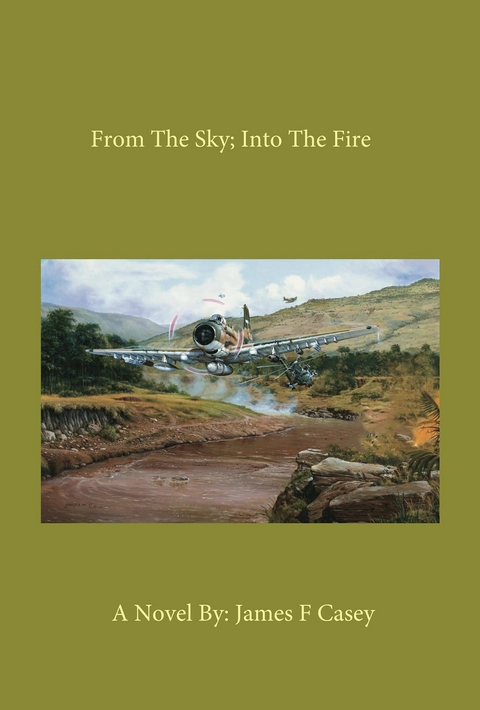
From the Sky; into the Fire (eBook)
180 Seiten
Bookbaby (Verlag)
979-8-3178-0418-3 (ISBN)
James Casey's aviation journey began on the flightlines of the United States Air Force, where he enlisted and loaded bombs onto B-52s. Selected for a USAF scholarship, he graduated from Loyola Marymount University in Los Angeles in 1978 and returned to the skies, serving eight more years as a pilot flying the O-2, A-37, and F-15. After his military service, Casey spent 32 years flying for Delta Airlines, piloting every aircraft type in Delta's fleet and retiring as a captain on the Boeing 777. His passion for aviation continued after retirement, serving as an instructor, director of flight training, and chief pilot. As an accomplished author of several fiction and non-fiction works centered around aviation, James Casey brings the world of flight to life with authenticity, heart, and a deep respect for those who live and serve in the skies.
"e;From the Sky; into the Fire"e; is the story of a pilot who fought in the Vietnam War and was shot down in enemy territory. A race between his would-be rescuers and the enemy, who is constantly hunting him, shows the incredible efforts of the US Air Force Search and Rescue Units, their dedication to duty, and devotion to service. Their heroic adventures are often overlooked and are a small part of their missions to save others.
I. Going Downtown
The news media and the Generals called it the F-105 Thunderchief. But the men who flew it into combat—who trusted its brute strength and raw power with their lives—knew it by a simpler name: the “Thud.”
Friday, 15 December 1967 – 0937L
The formation cut across the sky like a spear of steel—four giant KC-135 tankers in trail, each escorted by a swarm of fighter jets. The fighters buzzed around them like hornets, darting in and out for fuel, sleek and purposeful, a lethal ballet in the stratosphere.
To an outsider, it looked seamless. Calm. Professional. Inside the cockpits, it was anything but.
Each pilot was a paradox: a practiced warrior wrapped around a terrified little boy. They’d trained for years to sound calm, to speak in clipped, cold radio calls that betrayed none of the fear clawing at their guts. Today, that training would be tested. A mistake meant more than failure—it meant capture, torture, or death.
They’d been airborne for barely twenty minutes, but the strain of lifting tons of iron bombs four miles up into the sky had already drained much of the fuel in their tanks. One by one, the F-105s took their turn behind the tankers, refueled. Then, once they were all, again filled with fuel, they turned away, peeled off—dropping low and turning east, toward the most dangerous airspace on Earth.
The tankers receded into the sunlit heavens. The fighters descended into battle.
Sixteen F-105Ds, sleek and powerful, each loaded with six 750-pound bombs, formed the strike force. Supporting them were four F-105G Wild Weasels, hunting SAMs and flak. Four F-4Cs orbited high above, the MiG killers.
“Wolf, fence in.” Major Tim Hartley’s voice came over the radio—tight, professional.
Switches flipped. Master arm on. ECM pods active. Radios silent. They were crossing the line. From here on out, every mile brought them closer to death.
“Two. Three. Four.” The replies came fast. Crisp. Not a tremor in a single voice.
“Lobo, fence in.”
“Two. Three. Four.”
One by one, the call signs checked in—Wolf, Lobo, Grizzly, Polar, Fist, Cobalt. Then silence.
Down they went, slicing into the undercast. The world turned to swirling gray soup. Visibility: zero. Wingtip to wingtip at 480 knots, no more than three feet apart. Turbulence shoved at the aircraft. Instruments jumped. Every pilot clenched the stick, watching, correcting, sweating. A blink could be fatal.
They were flying blind, trusting their lead, trusting each other. This wasn’t formation flying. This was formation survival.
At 3,000 feet, they punched through into sudden, stunning clarity. The jungle below was a vibrant, pulsing green. Ahead, like a warning from the Earth itself, rose Thud Ridge—a jagged spine leading directly to Hanoi.
Hartley gave a slight rudder kick. Wings shifted. Time to spread out.
Combat spread: each element a mile apart. The fighters fanned out, slipping into tactical spacing, racing at low altitude through enemy country.
Below them, the jungle raced past in a blur. They were flying faster than a speeding bullet, just 100 feet above the trees. From a distance, it might’ve looked beautiful. But to the pilots, that jungle was a graveyard in waiting. It hid guns. It hid missiles. It hid the enemy.
Hartley’s plan was daring: stay low—so low the SAMs couldn’t track them. Challenge the guns head-on. Fly right into the dragon’s mouth.
They’d hit the Initial Point at exact one-minute intervals. From there, the attack would unfold like clockwork—pop up, roll in, bombs off, then disappear into the weeds, engines screaming in afterburner.
“One pass, then haul ass,” Hartley had said.
It would be five minutes of hell. Every pilot would be exposed for no more than 30 seconds. Long enough to die. Not long enough to think about it.
Hartley had chosen the best: fifteen men who flew like demons and followed orders like scripture. This was the varsity team.
Bringing up the rear was First Lieutenant Tom Morgan—Polar 4. Tail-end Charlie. Last over the target. The worst spot. By the time he rolled in, every gun on the ground would be wide awake.
Three months in-country. Thirty-four missions. Not a rookie, but close. Hartley believed in him. Trusted him.
Morgan’s heart pounded. Sweat trickled down his back. His mouth was dry.
The sky above: oppressive gray. The jungle below: endless green. No horizon. Just a trap closing in.
He stayed in formation. Watched his lead like a hawk. Scanned for threats. Everything down there was hostile. Every shadow could hide a muzzle flash.
He caught a glimpse of the landscape—the dense canopy, impossibly lush. Beautiful, if he weren’t about to be killed in it.
For a half second, he let the thought linger.
Then he forced it away.
That wasn’t a jungle.
It was death.
And it was coming for him.
Nguyen Duc Nung was nervous.
Today marked the weekly inspection by Le Nhu Thinh, the local Communist Party boss. Every week, Thinh made a show of supervising operations at the facility officially known as the People’s Allocation and Relocation Complex for the Greater Good of the Southwest Province. Unofficially, it was just the Buc Mai warehouse—if anyone spoke of it at all.
The complex hadn’t been built for military use, but over time, nearly 90% of the traffic flowing through it consisted of supplies and hardware for the war effort. Originally, there were four large storage buildings running north to south, with a rail line and siding to the east. A year ago, a fifth, even larger warehouse had been added to the north, oriented perpendicularly. From above, the layout resembled a giant inverted L.
Trucks came and went around the clock. Dozens idled in the open area west of the buildings, waiting their turn at the loading docks. Military planners had once hoped the site was too small to attract American bombers, but they’d still installed two 37mm anti-aircraft guns on the property. Two kilometers to the east, a Soviet-made 57mm radar-guided battery stood watch at a military training post, bolstering the local defenses.
Altogether, the area bristled with firepower: sixteen 14.5mm guns, six 37mm, two 57mm, an SA-2 missile site, and hundreds of AK-47s in civilian and military hands within a 20-kilometer radius. It was among the most heavily defended facilities in the region.
But Thinh hadn’t come to inspect munitions. He was here for his cut of black-market profits.
Officially, Thinh oversaw the district’s operations. In reality, he controlled nearly everything. A portion of all goods that arrived by rail, especially food and armaments—was quietly siphoned off for him. Hanoi expected a certain percentage of supplies to vanish along the Ho Chi Minh Trail. Who could say what had really happened once shipments left the capital?
Nung had been chosen to run the warehouse not because he was ambitious, but because he wasn’t. He was smart enough not to skim too much and get noticed, and too cautious to try cheating Thinh. Nung handled all the work, took all the risks, and Thinh reaped all the rewards. In exchange, Nung got to keep his comfortable job. As a bonus, Thinh had secured a safe staff position in Haiphong for Nung’s eldest son—a far better fate than dying in the jungle. Nung hated the corruption, but he was grateful.
“This seems a little light,” Thinh said, weighing the envelope in his hand with a raised brow.
“I assure you, Sir, it’s all there,” Nung replied quickly. “Next week should be better. We’ll turn a nice profit on the beef that arrived last night.”
Thinh smiled—faintly. He enjoyed watching his subordinates squirm.
“I have something special for you, sir,” Nung offered, gesturing to an elderly man standing just outside the office door.
“A full case of genuine Russian vodka.” Nung beamed as the man brought in a crate and set it down. “It was bound for a General in Cambodia. The box was labeled ‘Personal Goods.”
Thinh gave it a cursory glance. “Very nice. The general should spend less time drinking and more time fighting,” he muttered. “A clear head is essential in battle.”
Without looking at the man, he added, “Put it in the trunk.”
The old man scurried away.
Thinh didn’t like lingering at the warehouse. If the Americans ever discovered how much matériel passed through here, they’d level the place. Still, he needed to be seen, reminding the workers of his authority. He didn’t care if they liked him. That sort of pretense was for politicians in democracies. Here, fear would do.
He would’ve left even faster had he known the truth: the district’s main telephone exchange had been wiped out by an F-111 strike the night before. Communications had been severed for over eight hours. No air raid warning ever reached the Buc Mai complex.
“I have to go, Nguyen,” Thinh said abruptly, rising. “There’s a British reporter down near An Lộc with a TV crew. I want to keep an eye on him.” He tapped the envelope of money. “Let’s see if we can do better next week, yes? And how’s your son? Still enjoying Haiphong?”
The question was rhetorical. Thinh didn’t care—it was simply a reminder that Nung owed him.
“Yes, sir. Very well, thank...
| Erscheint lt. Verlag | 9.6.2025 |
|---|---|
| Sprache | englisch |
| Themenwelt | Literatur ► Romane / Erzählungen |
| ISBN-13 | 979-8-3178-0418-3 / 9798317804183 |
| Informationen gemäß Produktsicherheitsverordnung (GPSR) | |
| Haben Sie eine Frage zum Produkt? |
 EPUB (Ohne DRM)
Größe: 1,1 MB
Digital Rights Management: ohne DRM
Dieses eBook enthält kein DRM oder Kopierschutz. Eine Weitergabe an Dritte ist jedoch rechtlich nicht zulässig, weil Sie beim Kauf nur die Rechte an der persönlichen Nutzung erwerben.
Dateiformat: EPUB (Electronic Publication)
EPUB ist ein offener Standard für eBooks und eignet sich besonders zur Darstellung von Belletristik und Sachbüchern. Der Fließtext wird dynamisch an die Display- und Schriftgröße angepasst. Auch für mobile Lesegeräte ist EPUB daher gut geeignet.
Systemvoraussetzungen:
PC/Mac: Mit einem PC oder Mac können Sie dieses eBook lesen. Sie benötigen dafür die kostenlose Software Adobe Digital Editions.
eReader: Dieses eBook kann mit (fast) allen eBook-Readern gelesen werden. Mit dem amazon-Kindle ist es aber nicht kompatibel.
Smartphone/Tablet: Egal ob Apple oder Android, dieses eBook können Sie lesen. Sie benötigen dafür eine kostenlose App.
Geräteliste und zusätzliche Hinweise
Buying eBooks from abroad
For tax law reasons we can sell eBooks just within Germany and Switzerland. Regrettably we cannot fulfill eBook-orders from other countries.
aus dem Bereich