


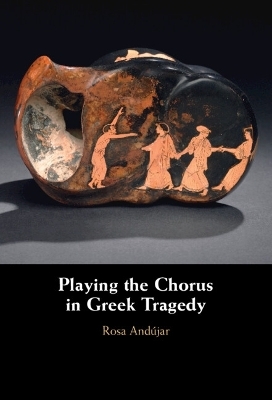
Playing the Chorus in Greek Tragedy
Seiten
2025
Cambridge University Press (Verlag)
978-1-009-65360-2 (ISBN)
Cambridge University Press (Verlag)
978-1-009-65360-2 (ISBN)
The role of the chorus in ancient Greek drama has been conceived too narrowly by many scholars since Aristotle, and by modern audiences. Rosa Andújar argues that the chorus' multiple activities besides singing reveal it to be as nimble and dynamic as the actors that populated the ancient dramatic stage.
Modern audiences see the chorus as an emblematic yet static element of ancient Greek drama, whose reflective songs puncture the action. This is the first book to look beyond these odes to the group's complex and varied roles as actors and physical performers. It argues that the chorus' flexibility and interactive nature has been occluded by the desire from Aristotle onwards to assign the group a single formal role. It presents four choreographies that ancient playwrights employed across tragedy, satyr play, and comedy: fragmentation, augmentation, interruption, and interactivity. By illustrating how the chorus was split, augmented, interrupted, and placed in dialogue, this book shows how dramatists experimented with the chorus' configuration and continual presence. The multiple self-reflexive ways in which ancient dramatists staged the group confirms that the chorus was not only a nimble dramatic instrument, but also a laboratory for experimenting with a range of dramatic possibilities.
Modern audiences see the chorus as an emblematic yet static element of ancient Greek drama, whose reflective songs puncture the action. This is the first book to look beyond these odes to the group's complex and varied roles as actors and physical performers. It argues that the chorus' flexibility and interactive nature has been occluded by the desire from Aristotle onwards to assign the group a single formal role. It presents four choreographies that ancient playwrights employed across tragedy, satyr play, and comedy: fragmentation, augmentation, interruption, and interactivity. By illustrating how the chorus was split, augmented, interrupted, and placed in dialogue, this book shows how dramatists experimented with the chorus' configuration and continual presence. The multiple self-reflexive ways in which ancient dramatists staged the group confirms that the chorus was not only a nimble dramatic instrument, but also a laboratory for experimenting with a range of dramatic possibilities.
Rosa Andújar is Senior Lecturer in Liberal Arts at King's College London. She has published widely on Greek tragedy and its rich reception. Her publications include The Greek Trilogy of Luis Alfaro (2020), which won the 2020 London Hellenic Prize, Greeks and Romans on the Latin American Stage (2020), and Paths of Song: The Lyric Dimension of Greek Tragedy (2018).
Introduction; 1. Fragmenting the chorus; 2. Augmenting the chorus; 3. Interrupting the chorus; 4. Interacting with the chorus; Coda: choral politics.
| Erscheinungsdatum | 04.11.2025 |
|---|---|
| Zusatzinfo | Worked examples or Exercises |
| Verlagsort | Cambridge |
| Sprache | englisch |
| Gewicht | 677 g |
| Themenwelt | Literatur ► Lyrik / Dramatik ► Dramatik / Theater |
| Kunst / Musik / Theater ► Film / TV | |
| Kunst / Musik / Theater ► Theater / Ballett | |
| ISBN-10 | 1-009-65360-1 / 1009653601 |
| ISBN-13 | 978-1-009-65360-2 / 9781009653602 |
| Zustand | Neuware |
| Informationen gemäß Produktsicherheitsverordnung (GPSR) | |
| Haben Sie eine Frage zum Produkt? |
Mehr entdecken
aus dem Bereich



aus dem Bereich


