


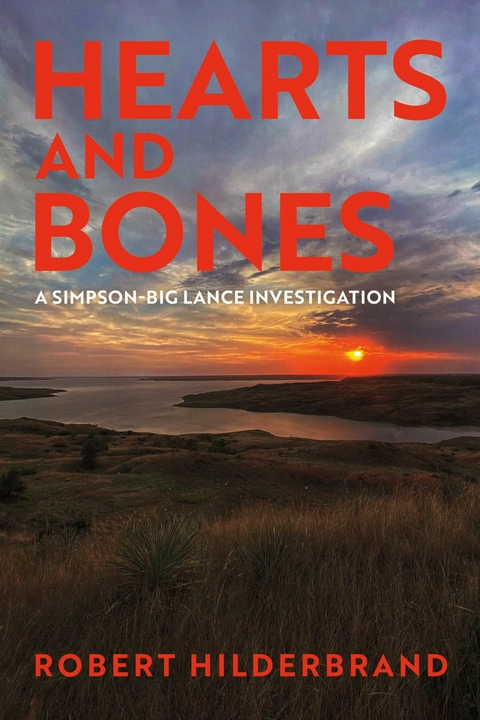
Hearts and Bones (eBook)
312 Seiten
Bookbaby (Verlag)
979-8-3178-0032-1 (ISBN)
Robert Hilderbrand is a retired Professor of History who taught for many years at The University of South Dakota. As a historian, he published several books in the fields of American and international history. This is his first novel in a series of Simpson-Big Lance investigations. He lives in Chandler, Arizona and Braunschweig, Germany with his wife, Jan.
Professor of Anthropology David Woolcloth has disappeared in the midst of a controversy over the returns of Native American remains. When his body is found on the eve of an international conference in the chamber at the state museum where the remains are stored, Director of Campus Security Leroy Simpson and Detective Tom Big Lance search for his murderer among those who might have wished him dead, including advocates on both sides of the controversy, his professional rival, his wife and his lovers. Simpson, who has never dealt with a murder case before, receives little respect as a campus security officer, and Big Lance, as the only Native American on the local police force, is unpopular among his peers. Although their investigation is hampered by their status as outsiders among law enforcement officers, their long-standing friendship allows them to cross cultural boundaries as they search for the killer. Fans of detective fiction, residents of the Great Plains and anyone interested in the difficulties faced by Native Americans will enjoy this book.
2.
Within a year after finding the secret room, David Woolcloth had a national reputation. His studies of the burial site were published in prestigious journals, then reworked into a scholarly monograph that won the highest prize in his profession. The collection itself became a mecca for anthropologists, who traveled to Pierre to view the skeletons and consult with their discoverer and curator. Woolcloth was promoted and made director of the museum, despite his lack of political connections. His was a rising star, and a bright one.
He was also in demand as a speaker, presenting his ideas and findings to both lay and professional gatherings. He spent whole weeks away from home, sometimes even longer. One month the closest he came to Pierre was when he flew over it on his way from New York to Los Angeles. It was during one of those absences that Helene lost the baby, and she would judge him harshly for not being there when it happened. He tried to tell her that he was sorry, that he couldn’t have done anything about it anyway, but she couldn’t stop thinking that his lack of interest was somehow responsible for the unhappy end of her pregnancy. She’d called his name from the bathroom when she’d first seen the paper filled with her bright red blood, before she’d remembered that he wasn’t in the house to answer. She’d had to drive herself to the emergency room, at Sisters of Mercy Hospital on the other side of town. It was the next day by the time she could get ahold of David, who’d just checked into another hotel somewhere out East. His voice had sounded sad when she’d told him, but it was the sadness of someone who has heard of a terrible event, not of someone who has experienced it. They’d never talked again about starting a family.
Under Woolcloth’s guidance the museum thrived and became a source of community pride. The three-legged buffalo went into storage, along with most of the other old displays. Among the new exhibits, the centerpiece was a reconstruction of the Indian burial site in the largest hall in the middle of the building. Of course, it all cost money, which Woolcloth turned out to have a talent for raising from foundation and corporate sources. Even the legislature, meeting each year in Pierre, voted funds to increase the museum’s budget. It wasn’t long before there was talk of constructing a new building, which Woolcloth came to view as a monument to himself and his discovery.
Not everyone was delighted by Woolcloth’s success. The former director, who accepted an offer of early retirement, had supporters within the university. Even if they knew that their friend had been incompetent, as many of them did, they resented what they saw as Woolcloth’s ambition and opportunism, his too-eager readiness to shove the older man aside. In the Humanities departments, his behavior was criticized as “entrepreneurial,” a description that would have meant praise if used in the School of Business. Several anthropologists, who’d seen Woolcloth promoted ahead of them, were understandably envious of their colleague’s good fortune. They may not have wished their chairman any harm, and certainly not dead, but they took little pleasure in the awards and honors he received with annoying regularity. Over the years they formed a negative faction within the department, which was led by Woolcloth’s assistant at the museum.
Arlan Hall and Woolcloth had been friends almost from the minute they’d met. Hall had been the head of the search committee that selected Woolcloth and had been among the group that had showed him around the area on his first day in town. They’d shared an enthusiasm for the open country of South Dakota, as well as for the practice of anthropology, and had spent endless hours talking about both. The morning after Woolcloth found the skeletons, the first person he’d wanted to tell was Hall. Hall’s response had been genuine excitement—for the museum, for anthropology, and for his friend. A year later, when Woolcloth was named the museum’s new director, he’d picked Hall to serve as his assistant. No one was surprised by the choice, although some had been surprised that Hall accepted. Woolcloth’s celebrity, and the way that he’d pursued it, had put a strain on their friendship that would grow as the two men tried to work together. It wouldn’t be long before Hall became the leader of Woolcloth’s opposition and his primary rival within the department. The differences between them might have been softened by their previous friendship, but somehow they weren’t, as each man now added betrayal to the list of grievances he held against the other.
If it had not been so obvious that Woolcloth was dead, Billy Ardrey might have gone rushing into the room. He would have wanted to check for a pulse, and to see if he could help the stricken man in some way. But the sight of Woolcloth’s skin, gray and flaccid, like liver sausage, made him stay back. And then there was the smell, too rotten even for the room’s sophisticated ventilation system to neutralize. That held him back too.
“Jesus,” Simpson said, keeping his voice low. “I guess Professor Woolcloth isn’t missing anymore.”
“That’s our man, huh?” Big Lance asked. He didn’t sound too surprised to hear the news.
Simpson didn’t bother to answer but shifted his attention to Ardrey. He put his hand on his young assistant’s shoulder, turning him gently away from the door and the body within. He assumed this was Billy’s first, and he didn’t want him to spend too long looking at it. There was no reason for the boy to embarrass himself in front of a city policeman like Big Lance.
Big Lance reached over and closed the door, hooking it with his elbow. The room had become a possible crime scene, and he didn’t want to do anything to contaminate any evidence that might be in it. “Let’s go find a phone,” he said. “I need to call this in and get the State DCI guys over here.”
They walked down the hall to where the secretary was sitting at her desk. Big Lance asked if he could use her phone, and she said sure, he could help himself.
“Maybe I’d better use the one inside,” Big Lance said, walking toward the door to Woolcloth’s office. “Director Simpson here has something to tell you.” He smiled at Simpson as he walked by.
Simpson pulled a chair over to the secretary’s desk, then sat down on it. “We’ve found David Woolcloth,” he said, his voice as calm as he could make it. “He was in the vault. Dead.”
“But . . .” She started to object but thought better of it.
“But what?”
“Oh, nothing. It’s just that I saw him leave the museum on Wednesday. This was one place I didn’t imagine he could possibly be.”
“And where did you imagine he could be?”
“You know. Don’t you?” Her voice lost all its confidence on the last two words.
Simpson shook his head.
“With his girlfriend. That graduate student of his.”
“What makes you say that?”
She shrugged her shoulders.
“There must be some reason. It might help if you tell me what it is.”
“Well, because it was Wednesday—the day that he disappeared. He always saw her then, went to her place for lunch. Every Wednesday. He’d usually be gone for two or three hours. Sometimes he didn’t come back in the afternoon at all.”
“How do you know that? That he always saw her on Wednesdays? Did he tell you?”
“No. But he gave me her phone number, so I could reach him in an emergency. He didn’t tell me it was hers, but it wasn’t hard to look up in the directory.”
“So you figured that was where he was going when he left here on Wednesday?”
“That’s right, and not just because it was Wednesday.”
“Oh? Why else?”
“Because he left early, which he almost never did, and because he seemed excited, like he couldn’t wait to get somewhere.”
“Did anyone else know what Woolcloth did on Wednesdays? Anyone here at the museum, I mean.”
“No. I don’t think so. I guess I couldn’t say for sure, but I’ve never heard anyone say anything about it.”
“Who else was here on Wednesday, say when Woolcloth left for lunch?”
“I don’t know. There would have been somebody at the desk out front—one of the volunteers, but I couldn’t say which one. Some of the curator’s staff might have been here, at the other end of the museum. They’re too far away for me to see much of them during the day. Oh, and Arlan.”
“Arlan?”
“Professor Hall, the assistant director. I remember because he worked right through the lunch hour and was looking for Professor Woolcloth in the afternoon.”
“Did you tell him where he was?”
“Of course not.”
“And you don’t think he knew?”
“No.”
Simpson changed positions and saw Big Lance standing in the doorway to Woolcloth’s office. It looked like he’d been listening for a while. He had an odd smile on his face.
“The DCI team will be right here,” Big Lance said.
Simpson stood up immediately. “We’d better get back down there,” he said. They’d left Ardrey behind to make sure nobody entered the vault, and Simpson didn’t want Billy to have to face the DCI guys alone.
They turned the corner and headed down the hall. Big Lance put his hand on Simpson’s shoulder. “Hey, Leroy,” he said, “you sounded a lot like a detective back there. I’d better...
| Erscheint lt. Verlag | 4.6.2025 |
|---|---|
| Sprache | englisch |
| Themenwelt | Literatur ► Krimi / Thriller / Horror |
| ISBN-13 | 979-8-3178-0032-1 / 9798317800321 |
| Informationen gemäß Produktsicherheitsverordnung (GPSR) | |
| Haben Sie eine Frage zum Produkt? |
 EPUB (Ohne DRM)
Größe: 707 KB
Digital Rights Management: ohne DRM
Dieses eBook enthält kein DRM oder Kopierschutz. Eine Weitergabe an Dritte ist jedoch rechtlich nicht zulässig, weil Sie beim Kauf nur die Rechte an der persönlichen Nutzung erwerben.
Dateiformat: EPUB (Electronic Publication)
EPUB ist ein offener Standard für eBooks und eignet sich besonders zur Darstellung von Belletristik und Sachbüchern. Der Fließtext wird dynamisch an die Display- und Schriftgröße angepasst. Auch für mobile Lesegeräte ist EPUB daher gut geeignet.
Systemvoraussetzungen:
PC/Mac: Mit einem PC oder Mac können Sie dieses eBook lesen. Sie benötigen dafür die kostenlose Software Adobe Digital Editions.
eReader: Dieses eBook kann mit (fast) allen eBook-Readern gelesen werden. Mit dem amazon-Kindle ist es aber nicht kompatibel.
Smartphone/Tablet: Egal ob Apple oder Android, dieses eBook können Sie lesen. Sie benötigen dafür eine kostenlose App.
Geräteliste und zusätzliche Hinweise
Buying eBooks from abroad
For tax law reasons we can sell eBooks just within Germany and Switzerland. Regrettably we cannot fulfill eBook-orders from other countries.
aus dem Bereich


