


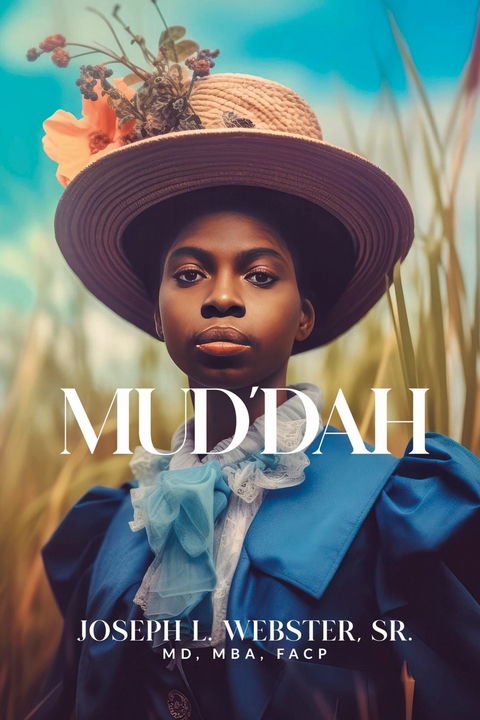
MUD'DAH (eBook)
316 Seiten
Bookbaby (Verlag)
979-8-3509-6905-4 (ISBN)
Dr. Joseph Webster is a dynamic force in gastroenterology, leading with unparalleled expertise and innovation in West Orlando, Florida. He graduated from the University of Miami Medical School and UCLA's David Geffen School of Medicine, where he served as chief resident. Dr. Webster also holds an MBA in Healthcare Management from George Washington University and a Magna Cum Laude degree in Pharmacy from Florida A&M University. As the visionary CEO of the Webster Surgery Center and former leader of the comprehensive Clinic for Digestive Disorders, Dr. Webster excels in integrating cutting-edge technology with exceptional patient care. His commitment to culturally sensitive healthcare has established him as a prominent community leader, serving as president of both the Florida State Medical Association and the Institute for African American Health. Beyond his professional achievements, Dr. Webster is a devoted father and active community advocate, championing health and wellness initiatives. His research on childhood obesity, diabetes, and value-based care has earned him numerous accolades, underscoring his forward-thinking approach. A Fellow of the American College of Physicians and a Diplomate of the American Board of Gastroenterology, Dr. Webster's leadership and dedication continue to drive advancements in healthcare, making a lasting impact on the community.
In this richly woven narrative of "e;Mud'dah,"e; embark on a transformative journey through the life of an extraordinary woman whose strength, ingenuity, and unwavering spirit illuminate every page. This deeply moving story is a tribute to the indomitable courage of women, especially the Black women whose experiences and contributions are often overlooked. Set against the backdrop of a world that frequently tests her resolve, Mud'dah's life is a testament to the power of perseverance and the unyielding will to overcome. From the challenges of her early years to the triumphs that define her legacy, Mud'dah navigates the complexities of life with grace and an unbreakable spirit. Her journey is not merely one of survival but of profound self-discovery, enduring love, and the tenacious pursuit of dreams. "e;Muddah"e; celebrates the rich cultural heritage of Black Americans, offering readers an intimate glimpse into the traditions, struggles, and triumphs that shape their community. However, Muddah's story transcends cultural boundaries, resonating with women of all races and backgrounds. Her experiences echo the universal themes of familial bonds, community support, and the relentless pursuit of one's goals. As you turn the pages of "e;Muddah,"e; you will be inspired by her resilience and ingenuity. Each chapter unfolds a new layer of her life, revealing the depth of her character and the breadth of her influence. Mud'dah's legacy is a powerful reminder of the strength inherent in all women, encouraging readers to reflect on their own journeys and the women who have shaped them. This book is a celebration of womanhood in all its forms. It honors the quiet yet powerful contributions of Black women while inviting women of all races to find common ground in shared experiences of love, struggle, and triumph. Mud'dah's story is a call to embrace our collective strength, to honor our diverse heritages, and to celebrate the unwavering spirit that unites us all. Join Mud'dah on her remarkable journey, feel her strength, and celebrate her story. Let her legacy inspire you to recognize and cherish the powerful women in your life.
Chapter 1:
(1910–1920)
In 1909, the National Nut Grower’s Association held its eighth annual convention in Albany, Georgia. The closest town to Monticello, Florida, was across the state line in Thomasville, Georgia—approximately 50 miles from Albany, Georgia. The following year, 1910, the annual convention was held in Monticello, Florida. Although a small town, Monticello was well respected by the neighboring towns; in 1875, the A.M.E. Church had its Annual State of Florida Conference in Monticello.
Small farms were still suffering from the economic effects of the Civil War. There was a notable switch from farming traditional crops, such as corn, tobacco, cotton, and so on, to horticulture and nuts. Pecans and watermelons became two major exports for Monticello. The winters were harsh, and the coldest temperature ever recorded in Monticello was ten degrees below zero in February 1893.
Two years later, in 1895, approximately 250 miles to the north, perhaps the greatest gathering of African-American minds in modern history convened in Atlanta, Georgia at the famous Cotton States Convention. Unfortunately, the most significant accomplishments of the planning for a desirable future of inclusion of African Americans in a “post-slavery” economy had no immediate impact on what was happening in rural north Florida in 1910.
Even more harsh than the cold winters was the progressively increasing “chill” of the repressive nature of the socioeconomic conditions and continued dehumanization and immoral treatment that the first-generation descendants of recently freed slaves had to encounter in Monticello. This treatment was mirrored throughout the deconstructed post-slavery of the New Confederacy.
It was the same year when Rosa Lee Abigail Brown was born as the second child to Cornelius Brown, Sr. and Sylvia Siplin-Brown. The Browns were an extremely large family. The community that Rosa grew up in was called the “Brown Community,” and one of the A.M.E. Churches is called “Brown Philadelphia A.M.E. Church” even to this day.
According to oral history, some Browns were part of the Marcus Garvey movement to repatriate to Africa, and traveled to the Ivory Coast. However, Rosa’s dad never owned any significant property recorded to our knowledge. The Siplin family, as were many families, was a mixed family of African, European, and Native American heritage. Therefore, many to almost all of them were mulatto. The “Creek” and “Seminole” intermarried with former slaves.
According to U.S. Census data, in 1910, approximately 60% of Jefferson County, Florida residents were of African descent and former slaves. According to the 1860 U.S. Census, 75% of the adjacent Leon County comprised slaves with approximately 1,500 “free Africans.”3
The total of 17,000 residents in 1910 was the largest number of people in Jefferson County ever recorded since the U.S. Census started in 1830. Only a few of those families would benefit from Reconstruction and amass large tracts of land—up to several hundreds of acres per family.
Following racial violence, segregation, and limited opportunities, the Great Migration of African Americans from the Deep South to the Northeast, Midwest, West, and other points away from the slave plantations resulted in a significantly reduced African-American population in the South.
However, unlike other counties in Florida, a staggering 60% of the population in Jefferson County and over 80% of Gadsden County—thirty miles to the west—remained of African descent.
Many African Americans also went deeper into central and southern Florida and to the Caribbean islands to escape slavery and the ravages of Reconstruction and the Jim Crow South. Cuba, which had recently acquired the status of an independent republic state following the end of the Spanish-American War in 1902, also served as a destination for many.
According to Dr. Larry Rivers’ 4Slavery in Florida: Territorial Days to Emancipation (2000), nearly 95% of the plantations were concentrated in approximately seven counties in the “Big Bend” of Florida’s Panhandle. Monticello is situated almost exactly in the middle of the “Big Bend.”
Among the many plantations on the North end of Jefferson, where the Browns lived, was the “Anderson Plantation.” After Anderson built his plantation in Monticello, he moved to Texas to start another plantation following the Texas annexation in 1844.
At that time, Texas was generous in granting land to the white settlers and immigrants. Some 4,800,000 acres of land were granted through the pre-emption acts. The first act was passed in 1845 and allowed settlers who lived or made improvements on up to 320 acres of land for at least three years to buy title to it for 50 cents. [4]5
Anderson left the Monticello property to his son Christopher and moved the rest of his family to Texas. At that time, the Browns were living on the Anderson plantation. Unlike the white settlers, the Brown family did not get any ‘free land’! Frank, the youngest of the siblings, was only two years old when their mother died. Therefore, Rosa Lee was the only motherly figure in his life. Consequently, all the siblings would call Rosa “MUD’DAH” (way her siblings pronounced mother) which became her nickname for life.
In 1910, Howard Taft was the president of the United States of America. He was the heaviest president in the history of the U.S.A., topping the scales at over 350 pounds. Rumors had it that the president was found stuck in the bathtub in the White House.
However, the story doesn’t hold water, as at that time, the president’s suite at the White House had a bathtub so big that Taft couldn’t possibly have gotten stuck in it, as documented in Brady Carlson’s Dead Presidents: An American Adventure into the Strange Deaths and Surprising Afterlives of Our Nation’s Leaders.”
It was 15 years after the famous “1895 Cotton States Convention” in Atlanta, Georgia, where Booker T. Washington and W.E.B. Du Bois had their classical debate. The event’s highlight was Brooker’s famous “Atlanta Compromise” speech, aimed at promoting racial cooperation. It was also where the National Medical Association (N.M.A.), the Professional Trade Association for African-American physicians, dentists, and pharmacists, was founded after a futile effort of 26 years to eliminate racial discrimination by the all-white American Medical Association [5]6
Within five years following the second Niagara Falls movement and the founding of the National Association for the Advancement of Colored People (N.A.A.C.P.), the current courthouse in Monticello was completed in 1909. It was modeled after Thomas Jefferson’s iconic “Monticello” in Italy.
Jefferson had over 5,000 acres of land and nearly 200 enslaved Africans. He freed only two of his slaves while he was alive. He never freed his concubine, Sally Hemmings .However, the motto engraved on the courthouse, “To each his own,” entailed a different story, according to Suum Ciuque.7
Ironically, and perhaps more demonstrative of the racial climate that Rosa was born in, Florida led the nation in lynchings in 1910—many of them taking place in Monticello, Capitol of Jefferson County. The lynching and other forms of physical torture and mental abuse continued for the next half-century. The last lynching was recorded in the U.S.A. was that of Michael Donald, in 1981
We know precious little about Cornelius Brown, Sr. He was born shortly after the Civil War ended in 1865, and was married to Sylvia Siplin, born in 1887. The Browns lived on the Anderson plantation, and they were sharecroppers. Presumably, the Anderson Plantation was the original slave owner of Cornelius Brown.
After the Civil War, the Browns remained on the property as sharecroppers, which was the custom in the antebellum reconstruction period. According to oral history, some of the Browns owned grits mills, turpentine stills, and allegedly, moonshine stills.
According to Dr. Larry Rivers, Florida was divided into three slave-owning territories based on the region’s cultural and political backgrounds. The parts included Middle Florida, the area between the Apalachicola River on the west and the Suwannee River on the east; East Florida, the area between the Suwannee River on the west and the Atlantic Ocean to the east; and West Florida, the area between the original Rio Perdido River on the west and the Apalachicola River on the east.
Monticello, Florida, the birthplace of Rosa Abigail Brown, was in a regional district of Central Florida. Rivers’ works further indicate that a significant portion of the farms in the middle Florida region were small farm plantations with less than ten slaves, as opposed to the mega-acre plantations with several hundred slaves found in Mississippi, Georgia, Louisiana, Alabama, and other slave-owning states. However, there were a few exceptions.
The Casa Bianca plantation can be traced directly back to President James Monroe, comprising some 3,000 acres of land and reportedly up to 125 slaves at the beginning of the Civil War. Some of the slaves were from “Antelope,” a Spanish slave ship that the United States captured because the importation of slaves was declared illegal in 1820. Owning slaves was still not illegal.
Dabney Bailey Palmer was another plantation owner with slaves and vast land. The Palmer family was a founding member of the city of Monticello and...
| Erscheint lt. Verlag | 28.2.2025 |
|---|---|
| Sprache | englisch |
| Themenwelt | Literatur ► Biografien / Erfahrungsberichte |
| ISBN-13 | 979-8-3509-6905-4 / 9798350969054 |
| Informationen gemäß Produktsicherheitsverordnung (GPSR) | |
| Haben Sie eine Frage zum Produkt? |
 EPUB (Ohne DRM)
Größe: 1,8 MB
Digital Rights Management: ohne DRM
Dieses eBook enthält kein DRM oder Kopierschutz. Eine Weitergabe an Dritte ist jedoch rechtlich nicht zulässig, weil Sie beim Kauf nur die Rechte an der persönlichen Nutzung erwerben.
Dateiformat: EPUB (Electronic Publication)
EPUB ist ein offener Standard für eBooks und eignet sich besonders zur Darstellung von Belletristik und Sachbüchern. Der Fließtext wird dynamisch an die Display- und Schriftgröße angepasst. Auch für mobile Lesegeräte ist EPUB daher gut geeignet.
Systemvoraussetzungen:
PC/Mac: Mit einem PC oder Mac können Sie dieses eBook lesen. Sie benötigen dafür die kostenlose Software Adobe Digital Editions.
eReader: Dieses eBook kann mit (fast) allen eBook-Readern gelesen werden. Mit dem amazon-Kindle ist es aber nicht kompatibel.
Smartphone/Tablet: Egal ob Apple oder Android, dieses eBook können Sie lesen. Sie benötigen dafür eine kostenlose App.
Geräteliste und zusätzliche Hinweise
Buying eBooks from abroad
For tax law reasons we can sell eBooks just within Germany and Switzerland. Regrettably we cannot fulfill eBook-orders from other countries.
aus dem Bereich


