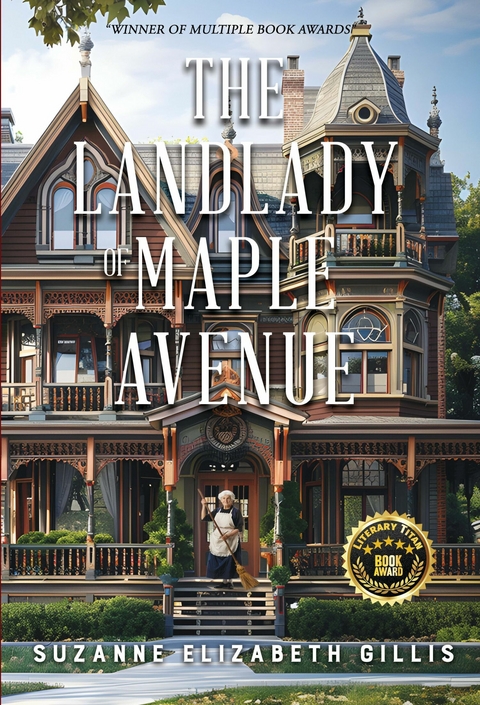
Landlady of Maple Avenue (eBook)
448 Seiten
Bookbaby (Verlag)
979-8-3178-0636-1 (ISBN)
Suzanne Elizabeth Gillis is an Award-Winning Fiction Author and Professional Screenwriter. She holds an MFA with honors in screenwriting from Columbia University Graduate School of the Arts and a BA in writing and narrative film from Hampshire College. She has been helping non-writers develop story ideas for feature screenplays and TV series since 2007. She has written over fifty original screenplays and is currently completing her second novel. Her debut historical fiction family saga novel, The Landlady of Maple Avenue, has already won a number of book awards. The story was inspired by true events about her father's Canadian family who immigrated to Cambridge, Massachusetts, in the 1920s. Her new fiction novel, Dr. Tightskin, is an LGBTQ comedy based on her original screenplay Under My Skin, which will be released soon.
INTERNATIONAL IMPACT BOOK AWARD - Historical FictionREADERS' CHOICE BOOK AWARD - SILVER WINNER Adult FictionREADERS' FAVORITE BOOK AWARD - FIVE STARS - Fiction & Literary FictionLITERARY GLOBAL BOOK AWARD - FINALIST - Historical FictionAMERICAN WRITING BOOK AWARD - FINALIST - Fiction & Women's FictionLITERARY TITAN BOOK AWARD - Literary Fiction A captivating and poignant portrayal of family, legacy, and the enduring strength of the human spirit. THE LANDLADY OF MAPLE AVENUE IS AN AWARD WINNING HISTORIAL FICTION FAMILY SAGA DEBUT NOVEL by Suzanne Elizabeth Gillis. The story is a poignant and humorous literary family saga inspired by true events. Set in the 1950s, it follows the aging Marceline Gillis, an immigrant mother of seven, as she plots to reclaim her position as the matriarch and rightful landlady of a Victorian house on Maple Avenue. Battling family tensions, disappointments, and the grief of losing loved ones, Marceline navigates the complexities of power, ownership, and legacy within her tight-knit Catholic family. Her journey is filled with heartache and determination as she seeks validation after a lifetime of hardship. Gillis demonstrates remarkable skill in bringing the complex dynamics of a mid-20th century immigrant family to life in a way that modern readers can easily connect with. Her sharp wit shines through in the dialogue between family members, creating moments of levity that balance perfectly with the more poignant aspects of the story, and every character felt so real like they'd jumped straight out of a time machine.
Chapter One
The New House
April 1951, Cambridge, Massachusetts
Maple Avenue had long been considered one of the prettiest streets in all of Central Cambridge. Sandwiched between Inman Square and Harvard Square, the street was lined with elm, oak, and maple trees on both sides, sprouting out of its richly colored red brick sidewalks. Its many properties consisted mainly of Greek Revivals and Victorian homes built in the late nineteenth century, once occupied by some of Cambridge’s wealthiest families.
Many homes had since fallen into disrepair, given their sheer size and constant need for upkeep. Several had been split into two or three separate units, reflecting the current economic times while providing rental income to help with the costs of running such large homes once inhabited by live-in servants.
The particular house in question—No. 27 Maple Avenue—was one such home. It was a three-story Queen Anne Victorian that now had three separate units, each requiring considerable work. Its once-glorious exterior had been beaten down to chipped, old brown paint, broken turrets around its dormers, and missing shutters from several of its many large windows. There were visible bare spots along its steep roof where the original scalloped shingles had been blown off by the harsh New England weather. A rusted rooster weathervane sat on its highest perch, tied on by some wire, having been rescued before, as it tilted too much to one side while twirling in the soft April breeze.
A realtor’s “For Sale” sign was on the front metal gate, and a recently added “Sold” sticker was slapped across it. It looked rushed and conspicuously applied. Parked by the front gate sat four members of the Gillis family inside a 1948 Buick Special, staring up at the massive home and its current state of disarray.
The thirty-seven-year-old driver, Bernie Gillis, peered through the bug-splattered windshield with a proud look before addressing his mother, Marceline Gillis, who sat in the back seat of his car.
“So, what do you think, Ma? You wanna go in and take a look around?” Bernie asked, holding out the keys in his hand. “I got the keys right here.”
Marceline ignored her eldest son, staring out the passenger window. She had been given the best view of the new house, while her youngest, thirty-year-old son, Johnny, sat up front with Bernie, and her elderly husband, Fred, sat in the back seat beside her.
She didn’t respond, still floored by the sheer size of the “new” house. She was a stocky woman of sixty-two, dressed in a plain brown dress and hat she often wore to church.
“Well, say something, Marce. The boys are talking to you!” her husband, Fred Gillis, said next to her. He was a frail-looking man of seventy-three, who lowered his newspaper, annoyed. “Do you want to take a look inside or what? We’re all getting hungry back here,” he complained.
Marceline again failed to respond, too focused on the main double-door entrance with its wraparound porch that hugged the right side of the driveway. The main doors were barely visible through the overgrown rose bushes that covered the entire front yard and walkway leading up to the house.
“You’ll have to climb a few stairs to get to the second-floor unit, Ma, but it’ll be well worth it once you look at your new kitchen!” Johnny smiled, smoking his Cuban cigar up front.
“So, what’s it gonna be, Ma?” Bernie asked impatiently, still holding the new keys. “Tommy’s waiting for us back at the apartment, and he’s expecting us to pick him up for lunch,” he said more firmly.
“Yeah, Marce. What’s it going to be?” Fred griped. “We’re all getting hungry just sitting here!” He clutched his stomach as it grumbled under his overalls, which he could set a clock to.
“Hush up, you! I’m thinking,” Marceline finally uttered, having refused to see the house before today.
She thought it was all unreal somehow, having grown up dirt-poor on a potato farm in New Brunswick, Canada. She had never owned anything of value her entire life and had always hoped to own a house—a dream that never materialized given her disappointing marriage to Fred, which resulted in her being forced to raise seven children practically on her own while caring for an alcoholic husband for most of her adult life.
She recalled her favorite son, Andrew Gillis, who was instrumental in finding the house, referring to it as “a place for Ma to rest and own of her very own.” Those words kept playing in her head, cut short by her son’s tragic death just before the final purchase of the house.
“So, what’s it gonna be, Ma? We’re all getting tired just sitting here,” Johnny repeated, blowing a perfect smoke ring out his cracked passenger window.
“Just look at all those rose bushes, Johnny,” she finally said, unable to see the entire front porch. “Why, you’d be taking your own life into your hands just trying to move anything in there.”
“Don’t worry about that, Ma,” Bernie laughed, wearing a new suit and tie to mark the special occasion. “We already hired some kids to cut those bushes down in the morning, so it’ll be all cleared away before we get here with the truck. Right, Johnny?”
She still couldn’t bring herself to imagine living there.
“Don’t worry, Ma. Once we get all this moving stuff done, you’re going to love living here. And just think—you’ll never have to move again!” Johnny confirmed in his own new suit, winking at his older brother beside him.
But she was still too reluctant to go inside, knowing the house had previously been owned by rich people who had live-in servants. Despite the house needing so many repairs, living in this section of Cambridge was overwhelming to her. She had gotten so used to the poor side of town, having lived in some of the worst housing in Cambridgeport for most of her adult life.
“I suppose it can wait till the morning,” she finally said worriedly. “There’s no use finding fault with it now, seeing how it’s already bought and paid for.”
“That’s the spirit, Marce! Look a gifted horse right in the mouth, after all the boys did for us. Let’s go get lunch now, Bernie. Tommy’s waiting,” Fred sighed, tapping his eldest son’s shoulder.
“Who said anything about getting lunch before we go to the cemetery?” she snarled at her husband beside her.
“But Tommy’s—”
“Let him wait! I want to make sure they put Andrew’s headstone in right. That’s the least we can do, seeing how he’s responsible for all of this,” she uttered.
“All right, Ma. We’ll stop by there first,” Bernie said as he started up the car.
The car pulled away from the curb as Marceline glanced back at the new house through the rear window, still unable to digest it all.
***
Dark clouds hung over Andrew Gillis’s grave at the Cambridge Cemetery that morning. A new, modest headstone had been installed in the double plot, with Andrew’s birth and death dates engraved on it. The dates indicated that he was a young man of thirty-two, having died only a few short weeks ago, with the ground still covered in dirt.
Marceline dusted off the top of the headstone, seemingly pleased with its appearance despite her heartache over losing her favorite son.
“My poor dear boy. And such a good boy he was, always wanted to please his ma,” she sighed, shaking her head.
Her other two sons didn’t like to hear her saying things like this, as they were used to being forced to compete for her love. They knew, even as children, that their brother Andrew was far more successful at this, always finding a way to please their mother in both his words and deeds—until he’d dropped dead of a heart attack on the kitchen floor.
The military had rejected Andrew Gillis from the war, not allowing him to enlist, unlike his three brothers and sister, Anna Mae, who all served in the Army. He was forced to stay home with his mother and father due to a heart condition—something Marceline often referred to as the “bad Gillis hearts.” It was true that the Gillis men had inherited weak hearts from Fred’s side of the family, which condemned many of them to endure premature deaths.
“It’s a shame he never even got a chance to live in the new house. And after all he did just to find it for all of us,” Bernie sighed, smoking his usual Lucky Strike cigarette by the grave.
“It was just like Andrew to always think of others first, isn’t it, Ma?” Johnny said, still smoking the same Cuban. “He even saved up working two jobs while we were all busy fighting the war, just to help pay for it.”
Fred placed a penny on his son’s new headstone and made the sign of the cross over his gray sweater, feeling the deep loss of his first dead child.
It was a double plot where another family member could also be buried later on, which the family assumed would be Fred, as he was already outliving many of the rest of the Gillis men, which puzzled them all.
“He’ll be missed, all right,” Marceline agreed. “If only he didn’t have that bad Gillis heart! Who knows what might have happened had he been allowed to stay with us longer.”
“Stop saying that!” Fred grunted, standing beside her.
“What?”
“Stop saying he had a bad heart!” Fred insisted, standing half a foot shorter than his stocky wife.
...| Erscheint lt. Verlag | 28.5.2025 |
|---|---|
| Sprache | englisch |
| Themenwelt | Literatur ► Romane / Erzählungen |
| ISBN-13 | 979-8-3178-0636-1 / 9798317806361 |
| Informationen gemäß Produktsicherheitsverordnung (GPSR) | |
| Haben Sie eine Frage zum Produkt? |
 EPUB (Ohne DRM)
Größe: 3,8 MB
Digital Rights Management: ohne DRM
Dieses eBook enthält kein DRM oder Kopierschutz. Eine Weitergabe an Dritte ist jedoch rechtlich nicht zulässig, weil Sie beim Kauf nur die Rechte an der persönlichen Nutzung erwerben.
Dateiformat: EPUB (Electronic Publication)
EPUB ist ein offener Standard für eBooks und eignet sich besonders zur Darstellung von Belletristik und Sachbüchern. Der Fließtext wird dynamisch an die Display- und Schriftgröße angepasst. Auch für mobile Lesegeräte ist EPUB daher gut geeignet.
Systemvoraussetzungen:
PC/Mac: Mit einem PC oder Mac können Sie dieses eBook lesen. Sie benötigen dafür die kostenlose Software Adobe Digital Editions.
eReader: Dieses eBook kann mit (fast) allen eBook-Readern gelesen werden. Mit dem amazon-Kindle ist es aber nicht kompatibel.
Smartphone/Tablet: Egal ob Apple oder Android, dieses eBook können Sie lesen. Sie benötigen dafür eine kostenlose App.
Geräteliste und zusätzliche Hinweise
Buying eBooks from abroad
For tax law reasons we can sell eBooks just within Germany and Switzerland. Regrettably we cannot fulfill eBook-orders from other countries.
aus dem Bereich